
Nigeria’s fintech industry is the most funded sector in the country’s startup ecosystem. When it comes to sending money to relatives, making online payments, financial savings, getting a loan, or investing, fintechs have become reliable channels.
So, which companies matter most? In this article, we look at some of the top Nigerian fintech companies by market reach, products, transaction volume, funding, infrastructure, and overall influence.
But before we dive into the top 20 Nigerian fintechs to watch in 2026, it’s important to understand what fintech means in Nigeria and why the sector is experiencing such rapid growth.
What Are Fintech Companies in Nigeria? How the Fintech Industry Evolved
In Nigeria, fintech is simply technology that makes financial services better, faster, and simpler for millions of citizens. It covers software, mobile apps, APIs, and payment systems that are now part of daily life across the country.
Nigeria’s fintech industry didn’t start as an independent sector. In the beginning, Nigerian fintech companies built solutions on top of existing banking infrastructure, improving user experience and convenience for local customers. But banks still handled the actual movement of money. They controlled customer accounts, settlement systems, and regulatory relationships.
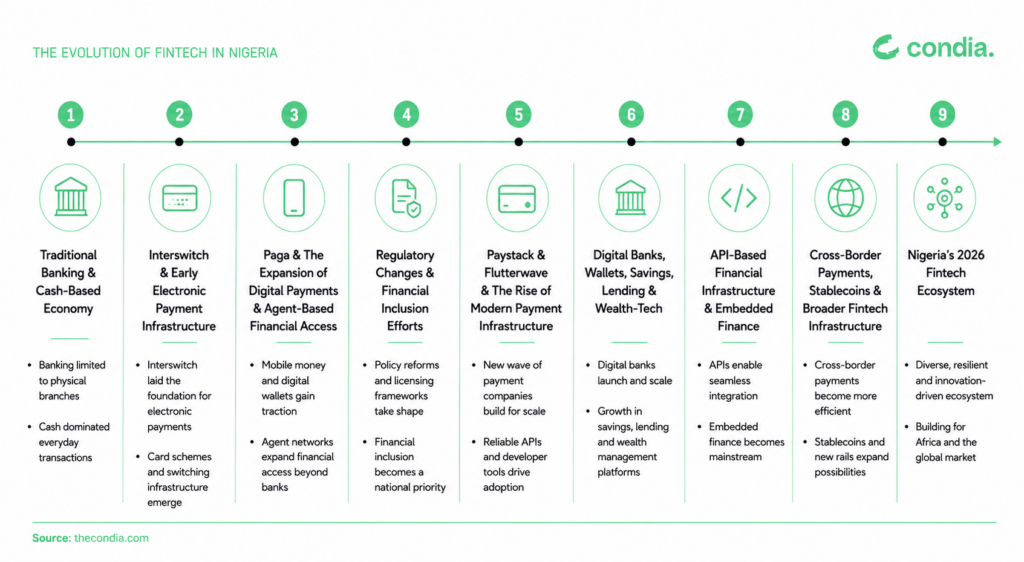
That changed when a new generation of startups began building their own payment infrastructure. Interswitch was one of the earliest examples. Founded in 2002, it helped build Nigeria’s electronic payment system at a time when cash and physical banking still dominated.
By the early 2010s, more Nigerian technology-driven companies emerged. These early Nigerian fintechs solved problems around payments, online commerce, and financial access for underserved communities. But they still depended heavily on partnerships with banks because the regulatory framework required many financial services to operate through licensed institutions.
In 2012, the Central Bank of Nigeria introduced the country’s first cashless policy as a pilot programme in Lagos State. The goal was to reduce cash dependence among Nigerians and encourage digital payments across the country. The policy created demand for digital payment solutions and opened doors for Nigerian fintech companies to participate more actively in the country’s financial services sector.
That October, the CBN launched the National Financial Inclusion Strategy to bring more Nigerians into the formal financial system. Until then, millions of Nigerians had no bank accounts and thus limited access to financial products. This further created an opportunity for Nigerian fintech solutions to grow and reach millions of unbanked citizens.
Between 2015 and 2020, a new group of Nigerian fintech companies emerged. Earlier companies like Paga had already made digital banking easier for Nigerian consumers, while fintechs like Paystack and Flutterwave focused on helping Nigerian businesses accept and manage online payments.
In 2018, the Central Bank of Nigeria introduced the Payment Service Bank framework. This allowed approved non-bank institutions to provide banking services, especially to underserved Nigerians in rural and semi-urban areas.
These policy changes transformed fintech regulation in Nigeria. Fintech companies were no longer just technology providers. They were becoming independent players who could build payment platforms, wallets, switching systems, and lending products under regulatory oversight. Today, many of the top Nigerian fintechs operate under this framework.
Why Fintech Companies Are Growing in Nigeria
Several factors like local market demand, the push for financial inclusion, rapid technology adoption, and the everyday need for easier money movement across the country drive fintech growth in Nigeria.
As financial transactions become unavoidable, every adult Nigerian sends and receives money, pays for goods, or manages business transactions. This makes fintech a mass-market product in Nigeria.
Solving Old Banking Problems (People Wanted Something Better)
Before fintech, you had to go to a Nigerian bank branch, which for many Nigerians meant long queues and lots of paperwork. It wasted time they could have used for work or business.
This frustration made many Nigerians look for a faster way. Fintech gave them that option, and today, Nigerian fintech apps are the primary banking tool for millions. With just a smartphone, any Nigerian could send or receive money in minutes no matter their reading level or location. Mobile apps, digital wallets, and local agents made payments easy. Once Nigerians saw how convenient it was, they quickly switched from traditional banks to fintech apps. This growing number of Nigerian users helped fintech companies expand rapidly across the country.
Making Financial Services for Everyone (Reaching More People)
Traditional banks asked for formal documents, followed strict rules, and expected customers to understand banking terms. This left out many Nigerians, especially those working in the informal sector like traders, farmers, and small business owners.
Nigerian fintech companies changed this when they built mobile apps that let Nigerian users do basic tasks in seconds, without stepping into a bank branch, and no banking knowledge needed. By serving this large group of Nigerians who had never used banks before, fintechs gained millions of new customers across the country.
Building the Tech Behind the Scenes (Helping More Fintechs Start)
Some Nigerian fintech companies do not deal with customers directly. Instead, they build the technology called APIs that lets other businesses add payment features to their own apps. This means new fintechs don’t have to build everything from scratch, which is very expensive.
Because of this, it became cheaper and easier to start a fintech company in Nigeria. More startups entered the Nigerian market, which created more competition and new ideas. The fintech boom in Nigeria also created jobs in areas like engineering, product management, marketing, cybersecurity, and compliance.
How Fintech Companies Make Money in Nigeria: Investor Confidence and Funding
Nigerian fintech companies benefit from multiple revenue channels, including transaction fees, subscriptions, API infrastructure, digital lending, foreign exchange, and partnerships.
For infrastructure-focused Nigerian fintechs, revenue comes from helping other Nigerian businesses access financial systems. They may not serve millions of consumers directly, but they can earn significant revenue by powering thousands of Nigerian businesses.
With a population of over 240 million and fast-growing digital adoption, the Nigerian fintech industry has continued to grow. Nigerian fintech companies have raised some of Africa’s largest startup rounds from 2019 to date.
Paystack’s $200 million acquisition by Stripe in 2020 remains a landmark moment in the Nigerian fintech industry, and the success stories of startups like Flutterwave, Moniepoint, and LemFi continue to put Nigeria on the global map.
However, fintech in Nigeria has not only been about success stories. The Nigerian fintech sector has seen many failures too.
Okra shut down in May 2025 after raising $16.5 million. Co-founder and CEO Fara Ashiru Jituboh stepped down, and the company returned about $4 million to investors. Other startups such as Thepeer and Lazerpay have also shut down.
List of the Top 20 Fintech Companies in Nigeria
Nigeria’s fintech sector has moved beyond payments. The top Nigerian fintechs now span cross-border payments, remittances, wealth management, savings, payment infrastructure, lending, blockchain, and stablecoins.
1. Flutterwave
Category: Payment Infrastructure
Founded: 2016
Founders: Olugbenga Agboola
Flutterwave, one of the top Nigerian fintechs, helps businesses accept and move money across Africa and beyond. Its products include Flutterwave for Business, Checkout APIs, Send App, and cross-border payment rails.
The company operates in more than 35 countries, holds 34 US Money Transmission Licenses, and has processed over $40 billion in transactions since inception.
In January 2026, Flutterwave bought open banking provider Mono, and in April 2026, it successfully secured a Central Bank of Nigeria microfinance license. In June 2026, Ripple invested in the company at a $3.2 billion valuation, and in July 2026, Circle Ventures also made a strategic investment.
2. Kora
Category: Payment Infrastructure
Founded: 2017
Founder: Dickson Nsofor
Kora handles cross-border collection, disbursement, and multi-currency settlement for international companies operating in Africa. Its infrastructure lets businesses connect to local payment methods without building individual integrations.
3. LemFi
Category: Remittances
Founded: 2021
Founders: Ridwan Olalere and Rian Cochran
LemFi is a cross-border platform for African migrants that allows users to send money internationally and deposit funds into local bank accounts.
With over 2 million global users, in January 2025, it raised $53 million in a Series B round led by Highland Europe. In May 2026, it added a $34.95 million Series B extension. Altogether, the fintech has raised $120 million since it was founded.
In June 2025, LemFi bought the UK credit fintech Pillar and currency exchange bureau Buttercrane.
4. Bamboo
Category: Wealth Management
Founded: 2018
Founders: Richmond Bassey and Yanmo Omorogbe
Bamboo gives Nigerians access to US stocks through a mobile app, making international investments available to retail investors. Bamboo is a leader in the growing wealth-tech space.
5. Cowrywise
Category: Wealth Management
Founded: 2017
Founders: Razaq Ahmed and Edward Popoola
Cowrywise helps Nigerians save and invest through its products, which include automated savings and access to mutual funds. Cowrywise has made structured savings and investment products accessible to everyday Nigerians.
6. Kuda Bank
Category: Digital Banking
Founded: 2017
Founders: Babs Ogundeyi and Musty Mustapha
Kuda is a digital-first bank offering retail and business banking services through mobile apps. Products include transfers, overdrafts, budgeting tools, and Kuda Business.
The company has over 7 million registered users and more than 100,000 SME accounts. It has raised over $90 million, and its valuation reached $500 million in 2021.
7. Moniepoint
Category: Payment Infrastructure / Banking
Founded: 2015
Founders: Tosin Eniolorunda and Felix Ike
Moniepoint has become one of the top Nigerian fintechs and one of Nigeria’s largest financial platforms, and its products include POS terminals, business banking, personal banking, and working capital loans.
The company has over 20 million monthly active users, 2 million merchants, and 10 million businesses served nationwide. It processes over $250 billion in annual payments. In 2025, it recorded ₦412 trillion ($294 billion) in transaction volume.
Moniepoint launched Moniebook in 2025 and bought the restaurant platform ORDA in March 2026. Investors include Visa, Google’s Africa Investment Fund, Development Partners International, and LeapFrog Investments.
8. OPay
Category: Digital Banking
Founded: 2018
Founder: Zhou Yahui
OPay, another of the top Nigerian fintechs, runs one of Nigeria’s largest consumer finance ecosystems, with products including a mobile wallet, savings, micro-loans, transfers, bill payments, and agent services.
The company has over 50 million registered users and more than 1 million agents. Opera’s April 2026 filings value it at $3.1 billion.
9. PalmPay
Category: Digital Banking
Founded: 2019
Founders: created under the Transsnet Group/Transsnet Financial umbrella, a strategic joint venture formed by Chinese smartphone giant Transsion Holdings (the manufacturer dominating Africa with Tecno, Infinix, and Itel) and Chinese internet firm NetEase.
PalmPay is a mobile-first platform for consumers and merchants with offerings including the PalmPay app, PalmPay Business, payments, rewards, and savings.
With over 35 million registered users and 1.1 million merchants and agents, PalmPay is one of Nigeria’s largest financial institutions.
10. PiggyVest
Category: Wealth Management
Founded: 2016
Founders: Somto Ifezue, Odunayo Eweniyi, and Joshua Chibueze
PiggyVest helps Nigerians automate savings and investments. Major products include Safelock, Target Savings, Investify, and Flex Dollar.
The platform has over 6 million registered users. It paid out $905.9 million to users in 2025. By its 10th anniversary in April 2026, cumulative payouts crossed $2.203 billion.
11. Interswitch
Category: Payments Infrastructure
Founded: 2002
Founder: Mitchell Elegbe
Interswitch is a foundational company in Nigeria’s payment ecosystem. Its products include Interswitch, Quickteller, and the Verve card scheme.
The company also runs switching infrastructure that connects banks and payment institutions. It also powers interbank switching for most Nigerian financial institutions and has been profitable for most of its existence. Visa invested $200 million in the company, and its valuation briefly exceeded $1 billion.
12. Paga
Category: Payments Infrastructure
Founded: 2009
Founders: Tayo Oviosu and Jay Alabraba
Paga combines digital payments with a large physical agent network. Products include the Paga Wallet, agent POS terminals, merchant tools, and remittance infrastructure.
The company has over 20 million registered users and more than 100,000 physical agent locations.
13. Paystack
Category: Payments Infrastructure
Founded: 2015
Founders: Shola Akinlade and Ezra Olubi
Paystack helps businesses accept digital payments through its products. The company serves over 300,000 businesses across Africa. Stripe acquired it in 2020 for over $200 million. In January 2026, Paystack reorganised into “The Stack Group” and bought Ladder Microfinance Bank.
14. Nomba
Category: Payment Infrastructure / Business Banking
Founded: 2016 (as Kudi.ai); rebranded to Nomba in 2022
Founders: Adeyinka “Yinka” Adewale and Pelumi Aboluwarin
Nomba is a Nigerian payment infrastructure and business banking platform providing POS terminals, online checkout, payment APIs, and business accounts.
In May 2023, Nomba raised $30 million in Pre-Series B led by Base10 Partners, with participation from Shopify. The company now serves over 600,000 Nigerian businesses and processes more than ₦3 trillion in monthly transaction volume.
Nomba’s product suite includes POS terminals, payment links, multi-currency wallets, and merchant management tools.
15. Remita
Category: Payments Infrastructure
Founded: 2005
Founder: John Obaro
Remita, operated by SystemSpecs, serves individuals, businesses, and government. Its products support payments, collections, payroll, and institutional finance.
The company’s strongest role is in government finance. It runs the platform for the Federal Government’s Treasury Single Account.
16. Fincra
Category: Payment Infrastructure / Cross-Border Payments
Founded: 2021
Founders: Wole Ayodele and Gideon Orovwiroro
Fincra is a payment infrastructure company providing APIs and merchant tools for online collections, local payouts, virtual accounts, and international transactions.
Fincra obtained its commercial Payment Solution Service Provider licence from the Central Bank of Nigeria in January 2023. It secured a Canadian PSP licence in March 2026 and an Enhanced Category PSP licence from the Bank of Ghana in May 2026.
Fincra operates across more than 15 African markets and supports nine currencies. Its regulatory footprint includes Nigeria, Ghana, South Africa, Tanzania, and Canada.
17. Grey
Category: Cross-Border Payments / Remittances
Founded: 2020 (as Aboki Africa); rebranded to Grey in 2022
Founders: Idorenyin Obong and Femi Aghedo
Grey is a Nigerian cross-border payments platform that provides foreign-currency accounts, international payment collection, and global payout services. It joined Y Combinator’s Winter 2022 batch.
Grey raised a $2 million seed round in August 2022. As of June 2026, it serves close to 3 million users, supports payouts in more than 55 countries, and enables transfers to over 170 destinations.
Grey offers USD, GBP, and EUR accounts, virtual cards, and business payment tools. It is registered as an MSB with FINTRAC (Canada) and FinCEN (US).
18. Raenest
Category: Digital Banking / Cross-Border Payments
Founded: 2022
Founders: Victor Alade, Sodruldeen Mustapha, and Richard Oyome
Raenest is a Nigerian multi-currency banking platform that helps individuals and businesses receive international payments, manage foreign-currency accounts, and send money across borders.
In February 2025, Raenest raised an $11 million Series A led by QED Investors, bringing its total funding to $14.3 million. The platform now serves more than 1 million people and processes over 10,000 transactions daily.
Raenest provides USD, GBP, and EUR accounts, foreign-exchange conversion, and business payment tools. It holds an IMTO licence from the Central Bank of Nigeria and has expanded into the US, India, and the Philippines.
19. FairMoney
Category: Digital Credit / Banking
Founded: 2017
Founders: Laurin Hainy, Nicolas Martin, and Matthieu Gendreau
FairMoney operates as a microfinance bank. It offers credit, retail banking, and SME loans. The company has over 10 million users in Nigeria and more than 50,000 small-business borrowers. It has raised over $55 million in funding and is one of Nigeria’s largest tech-driven lenders.
20. Cleva
Category: Cross-Border Banking / Digital Banking
Founded: 2023
Founders: Tolu Alabi and Philip Abel
Cleva is a Nigerian cross-border banking platform that provides African individuals and businesses with US dollar accounts for receiving and managing international income.
The company raised $1.5 million in pre-seed funding in January 2024, led by 1984 Ventures with participation from Y Combinator.
Cleva offers USD accounts, virtual cards, and international payment tools for freelancers, remote workers, and businesses. Cleva Payments Inc. is registered as a US Money Services Business.
These top Nigerian fintechs represent the best of what the country’s tech ecosystem has to offer. From payments to wealth management, the top Nigerian fintechs are solving real problems for millions of citizens. As the industry evolves, these top Nigerian fintechs will continue to lead the way.
People in this article




Last updated: August 20, 2026