

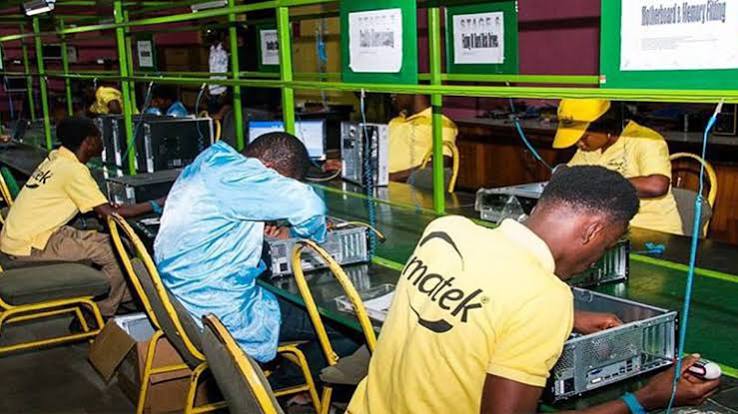
One of Nigeria’s oldest indigenous computer manufacturers, Omatek Ventures Plc, generated only ₦1.5 million in revenue in the first nine months of 2026. Its latest financial statements put the company’s total liabilities at approximately ₦5.18 billion, more than twice the value of its assets.
The company’s unaudited results for the nine months ended September 30, 2026, show a business with little revenue, a substantial pile of outstanding obligations and very limited cash available to meet them.
Omatek’s revenue rose from ₦200,000 in the first nine months of 2025 to ₦1.5 million in 2026 – a 7x increase. But the improvement is less impressive when placed against the company’s operating costs.
The group recorded a cost of sales of ₦300,000, leaving gross profit of ₦1.2 million. Administrative expenses, however, reached ₦48.35 million. These include the costs associated with running the business, such as administrative and operational expenses.
The result was an operating loss of ₦47.15 million. The company reported the same amount as its loss before and after tax for the period. Its third quarter alone accounted for a loss of ₦15.72 million, compared with ₦6.32 million in the same quarter of 2025.
In other words, Omatek spent far more on operating expenses than it earned from sales. Its revenue for the entire nine-month period was not enough to cover even a fraction of its administrative expenses.
The balance sheet is more interesting.
At the end of September, Omatek reported total assets of approximately ₦2.43 billion against liabilities of ₦5.18 billion. Assets represent the resources a company owns or controls, while liabilities represent its financial obligations. The difference leaves the group with negative equity of approximately ₦2.75 billion.
That means its reported obligations exceed the value of its assets by about ₦2.75 billion. It is not, on its own, proof that the company cannot meet all its payments or that it is insolvent. But it gives investors and creditors a clear indication of the scale of its balance sheet problem.
Where the ₦5.2bn comes from
The largest component of Omatek’s reported obligations is trade and other payables, which stood at approximately ₦3.96 billion at September 30.
Within that figure, accrued expenses accounted for about ₦3.27 billion. That is about 83% of the entire trade and other payables balance.
Accrued expenses are costs a business has incurred but has not yet paid. They can include obligations for services received, operating costs and other expenses recognised before the actual payment. In other words, the company may have already received the goods or services, or incurred the costs, but the corresponding cash has not left its accounts.
The size of Omatek’s balance makes the details important. The financial statements provide the total but do not explain what specifically makes up the ₦3.27 billion, who is owed the money or how old the obligations are.
The other components of trade and other payables include approximately ₦603.2 million in other payables, ₦58.14 million in trade payables and ₦25.4 million owed to staff.
Omatek also reported short-term loans and borrowings of approximately ₦1.002 billion. The company says its long-term loans from the Bank of Industry and First Bank have been amicably settled. However, the latest report does not provide enough information to establish the lender, terms or repayment schedule for the outstanding short-term borrowing.
There is also an inherent reporting issue. The September filing puts December 2025 accrued expenses at approximately ₦3.24 billion and total trade and other payables at ₦3.91 billion. Those comparative figures differ from the amounts reported in the earlier annual financial statements.
Little cash against billions in obligations
Omatek’s detailed cash note puts its bank balances at approximately ₦2 million at the end of September. Its current assets stood at about ₦28 million, while current liabilities were approximately ₦5.18 billion.
Current assets are resources a company expects to convert into cash, sell or use within a year. Current liabilities are obligations it generally expects to settle within the same period. Comparing the two helps assess whether a business has enough short-term resources to cover bills that fall due.
For Omatek, the gap is substantial. Its current assets amount to less than 1% of its current liabilities. Even if every naira of those assets were converted into cash, they would cover only a small fraction of the obligations due.
The company’s reported inventory was ₦25 million, made up of ₦20 million in finished goods and ₦5 million in raw materials. That inventory may support future sales, but it is not the same as cash available to pay creditors.
The group also reported investment property worth approximately ₦2.2 billion. This represents most of its non-current assets, but the value of a property on a balance sheet does not mean the company has that amount readily available in its bank account. The report recorded no movement in the investment property’s value from December 2025, and the income statements do not identify rental income from it.
Omatek’s property and other assets therefore do not resolve the immediate question of how it intends to meet its short-term obligations.
The company has previously indicated that it was working to attract fresh capital from national and international investors. Its latest going-concern note repeats that management and the board were intensifying those efforts. However, the note refers to a loss of ₦31.43 million for the six months ended June 30, 2026, rather than providing an updated September position. It does not state how much capital the company hopes to raise, whether discussions have advanced or when new funds might become available.
That leaves investors with a company that generated ₦1.5 million in nine months, recorded a ₦47.15 million loss and reported liabilities of ₦5.18 billion against assets of ₦2.43 billion.
The next question is not simply whether Omatek can return to selling computers at scale. It is how the company plans to address the obligations already on its books, particularly the ₦3.27 billion in accrued expenses that its latest financial statements do not adequately explain.
Last updated: November 3, 2026