

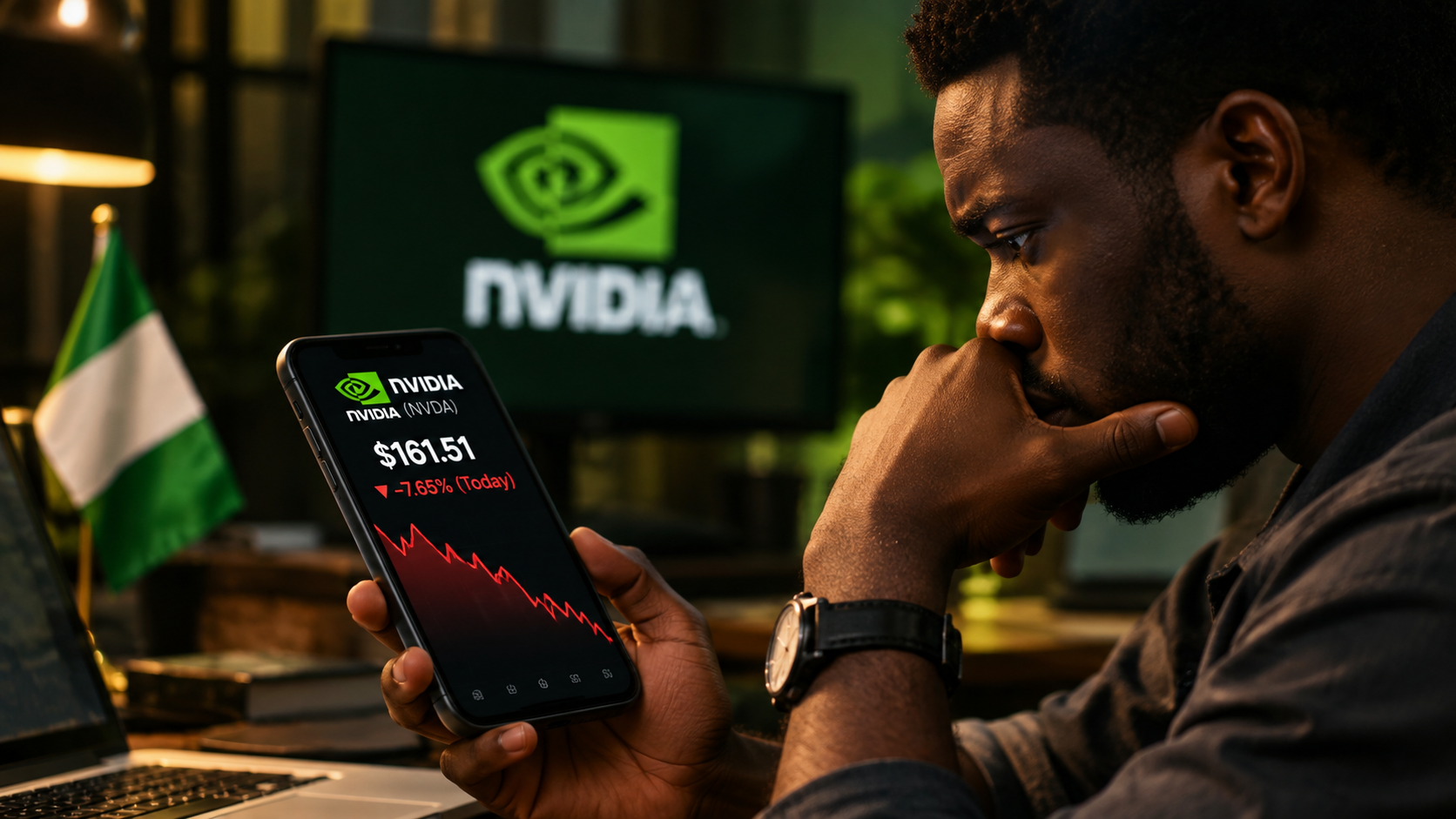
Nigerian investors who bought Nvidia as a dollar shelter found out on Thursday that the company’s CEO has resigned. The board announced that Jensen Huang had resigned as president, CEO and board member with immediate effect.
Chief financial officer Colette Kress, who has held that job since 2013, took over as interim CEO while directors consider internal and external candidates for the permanent role. The board also appointed Harvey C. Jones, a 30-year industry veteran who has served on Nvidia’s board since 1993, as its first-ever chairman.
The resignation followed a week in which Huang apologised to employees for being unfaithful to his wife. Reports described an affair with a woman that US intelligence agencies suspect of spying for China, and the board had been preparing to push him out before he stepped down. The resignation announcement says nothing about the status or findings of the board’s investigation, and no findings of national security wrongdoing have been made public.

A buyer of Nvidia stocks through a Nigerian platform, Femi, stayed ahead of the news the whole way. He told Condia that the CEO had been removed before Nvidia said so, and on Thursday the announcement caught up with him. He checks his phone before he does anything else each morning and finds a portfolio in the red. He bought Nvidia because everyone told him it was the future. Femi describes the money in it as savings he built little by little, and his mother keeps asking whether he has withdrawn it. He will not sell because selling would turn a paper loss into a real one.
Chuks made his decision days earlier. He sold when talk of removing the CEO became mainstream, took the small profit that was left, and moved back into dollars to wait for things to settle. In his words, Nvidia is Jensen, and he could not see who would drive the company without him.
Two readings of one man
Both men acted on the belief that the stock and the founder were one thing, and the analysts who spoke to Condia before the resignation disagree about whether that belief is right. Adeyemi, a fintech analyst, thinks it is. He calls Huang “the product vision, the relationship with TSMC, and the reason investors pay a premium for the stock,” and he warns that at a valuation this high any doubt can trigger a sharp correction.
Frank, an investment associate at Sahara Impact Ventures, thinks the value sits elsewhere. He argues that the long-term value is already locked in because Nvidia’s chip contracts with AI companies run for years and the money for the next generation of chips has been spent. So he treats the fall as short-term volatility that long-term holders should look through. He says the stock trades at a discount, and he would hold or buy more.
Benjamin Dada shares that view, saying he would do nothing and might actually buy more because he expects Nvidia’s fundamentals to remain strong.
Micah, cofounder of Ready Social, separates price from value and expects reactions to fade, yet he sets one condition that now matters, which is that Huang’s removal becomes a real problem if he is the only person who can deliver what Nvidia needs to deliver.
Micah’s condition and Adeyemi’s warning describe the same risk from opposite ends, and the resignation turns that risk from a hypothesis into a test. The first reading arrives quickly, because Nvidia’s quarterly earnings report is set for Tuesday, and Kress will be running the company when the numbers land. Omoniyi Kaka, a PR professional at Coronation, also a buyer of Nvidia stocks, expects sentiment to recover and sees the core business unchanged. Adewale, who bought two years ago, is holding and would buy more.
The market’s reaction is already visible in Nvidia’s share price. At 4:57 a.m. WAT on November 12, Google Finance listed the stock at $165.22, down 4.90% on the day. Reuters also reported that Nvidia shares had fallen 7.6% during Thursday’s trading as investors reacted to Huang’s departure. The decline puts a number on the uncertainty Adeyemi warned about, although the share price alone does not establish whether the company’s long-term value has changed.
Adewale also says he is indifferent, partly because he owns a Nigerian portfolio and keeps his risk appetite low, which makes him the calmest holder and the one with the most else to rely on.
What the dollar no longer guarantees
Micah explains that buying US stocks became a habit among Nigerian investors when the naira kept losing ground, and people wanted to own dollars and gain on the currency. With the naira steadier, he says the automatic currency gain has gone, so a US stock now deserves the same scrutiny as a Nigerian one, including its financials, its competitors and its discounted cash flows.
Frank goes further and says the naira has strengthened on the back of oil exports and that Nigerian equities have returned roughly 40 to 50% this year, while the S&P 500 has gained about 6% at most.
Adeyemi describes the result, which is that Nigerian investors feel a fall twice, once in the share price and again in the exchange rate when they pull money out. The arithmetic follows directly, because a stronger naira means each dollar converts into fewer naira at the point of sale, and that gives Chuks’s decision to wait in dollars a quiet exposure of its own if Frank’s reading of the naira holds.
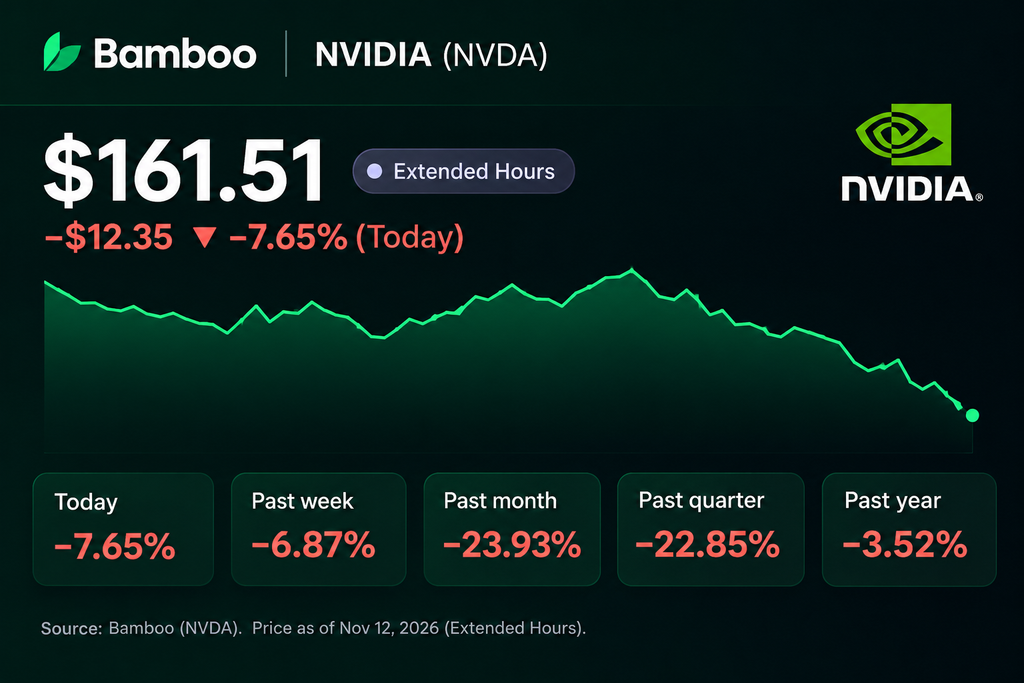
The figures on Bamboo, a platform through which Nigerian investors can buy US stocks, provide another view of the decline. Its Nvidia price screen showed $161.51 in extended hours, down 7.65% for the day and 6.87% over the previous week. The stock had lost 23.93% over the preceding month and 22.85% over three months. Its one-year performance was also negative, at 3.52% below its level a year earlier. The figures suggest that the latest leadership crisis arrived after an already difficult period for the stock, rather than starting the decline on its own.
Frank says investors without much wealth should favour index funds over single US stocks, since one stock falling then costs less, and he points out that Nvidia has fallen about 20% this month and was almost the only red stock in the US market over three days.
Micah offers the simplest test for what to do next, which is the time horizon. Someone holding for five years has no reason to sell on a headline, while someone who may need the money within a month cannot count on gains in a market this volatile.
Femi’s savings have a horizon too, and the way he describes his mornings suggests he has not settled it, whereas Chuks settled his by selling. Nvidia may recover within weeks or take much longer, and the board still has to name the person who will lead it. What investors in Lagos can decide today is how much of their money depends on that choice.
This article does not offer investment advice, and the views of the people quoted are personal opinions.
People in this article

Last updated: November 12, 2026