

The global AI boom has created an unusual problem for the smartphone market. The same technology race pushing companies to build bigger data centres is also making some of the components inside everyday phones more expensive.
Nigeria is now seeing that pressure at the retail level.
Prices collected from local vendors for six smartphones across Tecno, Infinix, Oppo, and itel show that all six became more expensive between January and June 2026. The increases ranged from about 7% for the Tecno Phantom V Fold to more than 20% for the itel S-Series Ultra and Oppo Reno Series.
That happened even though the naira strengthened against the dollar during the period.
The average dollar exchange rate moved from ₦1,418.28 in January to ₦1,364.67 in June. Import duty rates for phones also did not undergo a specific increase during the first half of 2026.
A vendor in Computer Village, Olawale, said of the increase, “It is the shipping; it is not the phone prices themselves. I mean, you know, phone prices are based on current exchange rates…If shipping fees are increased, taxes will definitely increase.”
That makes the price movement harder to explain simply through foreign exchange or taxes. The bigger pressure appears to be further up the supply chain.
In short, whatever savings importers gained from a more favourable exchange rate were completely wiped out by the skyrocketing cost of silicon components and logistics.
Price increases reached cheaper phones too
The January to June movement is clearest when the phones are grouped by their retail position.
The Tecno Phantom V Fold, which sold for between ₦1.15 million and ₦1.25 million in January, moved to between ₦1.25 million and ₦1.326 million by June, which is an 8.7% to 8.8% increase.
The Phantom X2 Pro moved from between ₦750,500 and ₦810,000 to between ₦820,000 and 878,850, which is an 8.5% to 9.2% increase.
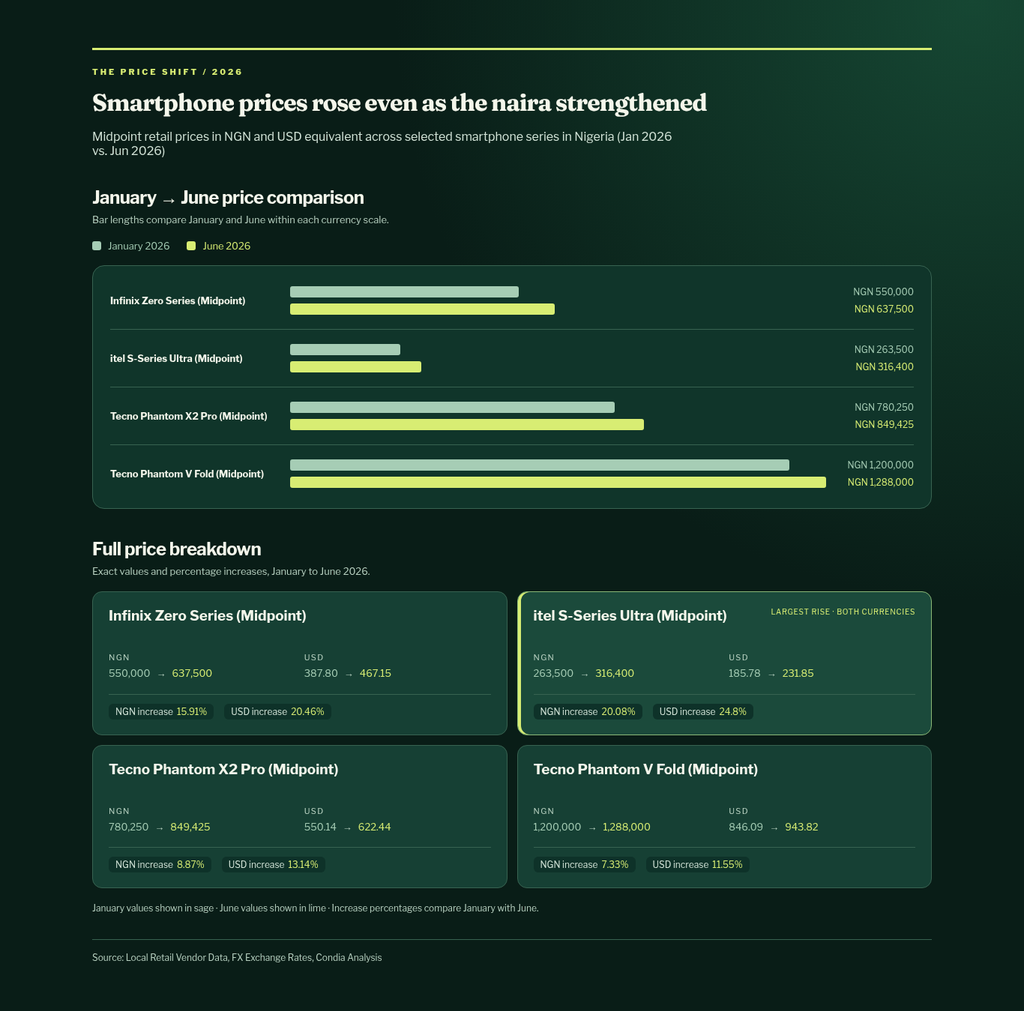
The increases were sharper for some cheaper models. The midpoint price of the Infinix Zero Series rose from about ₦550,000 to ₦637,500, while the itel S-Series Ultra moved from about ₦263,500 to ₦316,400.

The latter represents about a 20% increase. That matters because the cheaper end of the market is where price changes have the greatest consequences for people trying to get their first smartphone or replace an old one.
On the obvious increases, Olawale, a laptop engineer and devices trader, says “I’ll say entry and premium. Most of the Chinese premium devices… Those are the ones whose prices have increased.”
Omdia had already warned in June that Nigeria could see another 15% to 30% increase in smartphone prices through the rest of 2026 as component and memory costs rose.
“Africa’s ultra-affordable smartphone market is entering a structurally more challenging phase in 2026 as margin compression strains entry-tier device economics to a breaking point,” Manish Pravinkumar, principal analyst at Omdia, said in May.
The warning was not theoretical for long, as Jumia said during its Q1 earnings call that phone prices had risen by approximately 20% between late 2025 and early April, driven by higher memory chips and CPUs. The company said the increase was particularly visible in entry-level phones as supply chains adjusted.
Francis Dufay, Jumia’s chief executive, said consumers were already responding by buying lower specifications for the same amount of money.
“Consumers are trading down,” Dufay said.
Olawale’s experience goes contrary to Jumia’s. “Our customers didn’t change anything. They still go for what they want. I mean, even though the economy itself is crazy and prices have changed, when a phone series was released a few weeks ago, people are still buying…most times they swap to get upgraded versions,” he said.
So, a consumer does not necessarily stop buying a smartphone when prices rise. They can buy a cheaper model, accept less storage or memory, or postpone the upgrade. All three choices can change the quality of access to the internet.
AI is squeezing the parts inside ordinary phones
The pressure starts with memory. AI data centres require enormous quantities of advanced memory, particularly high-bandwidth memory and other components used alongside AI accelerators.
Semiconductor manufacturers have increasingly prioritised these higher-value applications, creating tighter supply conditions for conventional memory used in smartphones and other consumer electronics.
Samsung has warned that the memory shortage would continue, with AI demand keeping supply under pressure through 2026 and 2027. Its mobile business was already feeling the effect of higher memory costs.
The pressure was visible much closer to home.
In February 2026, Peter Sokunbi who runs Neradon Integrated Services, a Nigerian electronics business said the price of an 8GB RAM module used by his business had risen sharply.
“The 8GB RAM we used to buy at ₦15,000 or ₦20,000 is now ₦40,000,” he said.
Sokunbi was discussing computer memory rather than a direct price for a particular smartphone. But it illustrates the underlying component shock that manufacturers and distributors have been dealing with.
Omdia later found that the impact was becoming especially severe at the bottom of Africa’s smartphone market. In Q2 2026, shipments of smartphones priced below $100 fell 34% year-on-year, with Omdia linking the decline to rising memory costs and AI-driven changes in the supply chain.
“Vendors can no longer profitably manufacture $75 smartphones,” Pravinkumar said.
That creates a problem for a market such as Nigeria, where affordable phones have historically been the easiest route into mobile internet access.
The naira strengthened, but phones still got more expensive
The percentage decrease in the foreign exchange rate does not mean it stopped affecting importers. A retailer still has to buy inventory, manage working capital and price against the possibility that replacement stock will cost more.
Kayode Thomas, founder of Nigerian electronics retailer Rifugio Communications, explained this distinction in January.
“It’s not just the cost of the phone; it is your entire operating cost,” Thomas said, pointing to expenses including duties, demurrage, rent, salaries and utilities.
He also made another point that is easy to miss when comparing Nigerian phone prices with prices abroad. Local retailers carry costs that overseas listings do not, including warranties and local support.
On this, Olawale said the only way vendors can make money is if they increase their rates alongside the increase in shipping costs.
So even when the naira stabilises, it does not automatically mean a phone sitting on a Nigerian shelf will become cheaper. The H1 data suggests something else was happening at the same time: the cost of the device itself was rising. That is why the dollar equivalent is an important conversation.
The midpoint price of the itel S-Series Ultra rose from about $186 in January to about $232 in June using the monthly exchange rates. The Infinix Zero Series moved from about $388 to $467.
In other words, the increase was not simply a case of Nigerian vendors charging more naira because the naira had weakened. Some of these phones became more expensive even after adjusting for the currency movement.
The affordability problem is getting harder
All of these connect to Nigeria’s broader connectivity problem.
It has been established that Nigeria no longer has a network coverage problem alone. A lot of Nigerians can reach mobile networks, but having a signal does not guarantee that someone can afford the smartphone needed to make meaningful use of it.
The NCC acknowledged the problem in April when its executive vice chairman, Aminu Maida, said the commission was working on making cheaper smartphones available.
“We are looking at how cheaper smartphones can be introduced into the market,” Maida said.
Besides that, Nigeria was selected by the GSMA and its Handset Affordability Coalition for pilots aimed at expanding access to affordable 4G smartphones.
It’s therefore obvious the industry is trying to push the cost of smartphones down at almost the same time that the global semiconductor market is pushing some component costs in the other direction. That creates a difficult equation for manufacturers.
Omdia’s Q1 research found Nigeria’s smartphone market grew 8% year-on-year, showing that demand for connectivity has not disappeared. But the firm also warned that the sub-$150 segment was facing increasing pressure from rising component costs and affordability constraints.
So we have to ask: how long can consumers keep absorbing these increases?
For someone replacing a ₦250,000 phone, a 15% increase means another ₦37,500. For someone already stretching to afford a ₦300,000 device, the same increase pushes that purchase close to ₦350,000. This is where the AI supply-chain conversation intertwines with a Nigerian consumer story.
To be clear, the data does not mean every naira added to a smartphone price came directly from AI demand. Retail prices also reflect logistics, distribution, operating costs, inventory and individual brand strategies.
Last updated: October 6, 2026