
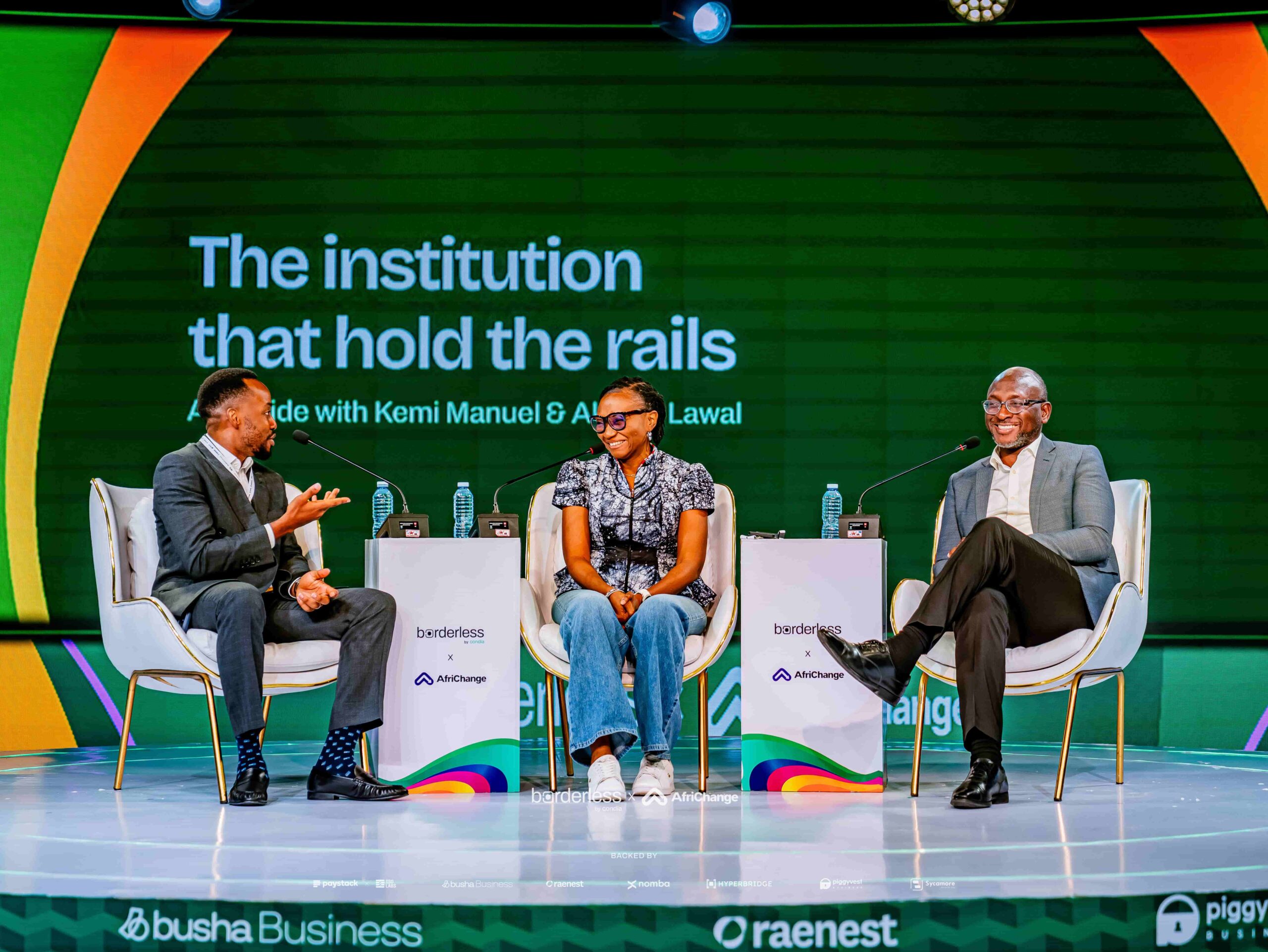
Roughly $100 billion in digital assets leave Nigeria to the rest of the world, with no licence attached to any of them, according to Akeem Lawal, Divisional Chief Executive Officer of Interswitch’s Payment Processing and Switching business.
Lawal made the disclosure during a fireside chat with Kemi Manuel, CEO of Zest Payments, at The Borderless Experience hosted by Condia.
During the fireside chat, both executives traced the progress of Nigeria’s financial services industry from the early 2000s, noting how much the industry had evolved and identifying areas the industry could focus on for the future.
For Manuel, who has spent her career across banking and payments, the industry has seen immense growth, moving from a largely manual era where even bank branches in the same institution lacked a way of connecting to each other seamlessly to one where virtually any licensed financial institution can now do so without any concerns.
Lawal walked through a similar arc from Interswitch’s perspective, describing how solving the problem of connecting bank branches led gradually to the creation of card networks, point-of-sale infrastructure, internet banking, and eventually contactless payments.
Both executives agreed that the problem worth solving now increasingly sits outside Nigeria’s borders rather than within it.
“The problem today that I see, and that Interswitch is trying to solve, is that we now need to take the sophistication we have created in Nigeria and expand it outside of Nigeria,” he said, describing a future where a Nigerian card works seamlessly in Ghana or South Africa and a Nigerian mobile wallet can be used to pay a retailer in Kenya.
That is the context into which his $100 billion figure landed. If that much value is already moving across African borders through channels with no formal licence attached, Lawal argued, it proves the market exists well ahead of any regulated infrastructure built to serve it.
Why cross-border money already moves without licences
Manuel located the barrier squarely in regulation rather than technology or appetite. “The biggest challenge I think we have in Africa is regulation, and it’s fragmented,” she said, pointing out that a fintech operating as a technical partner might avoid needing a licence in Nigeria while facing a hard licencing requirement for an identical business model in Ghana.
However, she noted that regulators across the continent have begun discussing a shared licence that would work across multiple markets at once, and expects more concrete talks to begin by 2027.
Lawal argued that banks and infrastructure providers, not fintechs acting alone, are best placed to close that gap. He described a model where institutions like Interswitch and commercial banks build a compliant, transparent layer underneath fintech products, allowing fintechs to focus on building while banks and infrastructure players absorb the compliance burden.
“I don’t think the fintechs can solve it alone,” he said. “They need commercial banks and infrastructure providers who can create that layer, so the fintechs can be fintechs, and the revolutionaries can keep their eyes on making sure compliance is good.”
Manuel, whose own institution sits inside a banking group, described her mandate in similar terms, framing Zest’s job as pushing Stanbic IBTC to behave with the agility of a standalone fintech while retaining a full banking licence underneath it.
What comes next for cross-border and contactless payments?
Responding to a question from the audience about why contactless payments have been slow to take off in Nigeria despite most point-of-sale terminals already supporting it, Manuel pointed to merchant hesitation rather than technology gaps.
Lawal added that trust remains the larger obstacle, since customers tapping a card without entering a PIN often assume the transaction is less secure than it actually is.
Last updated: August 27, 2026