

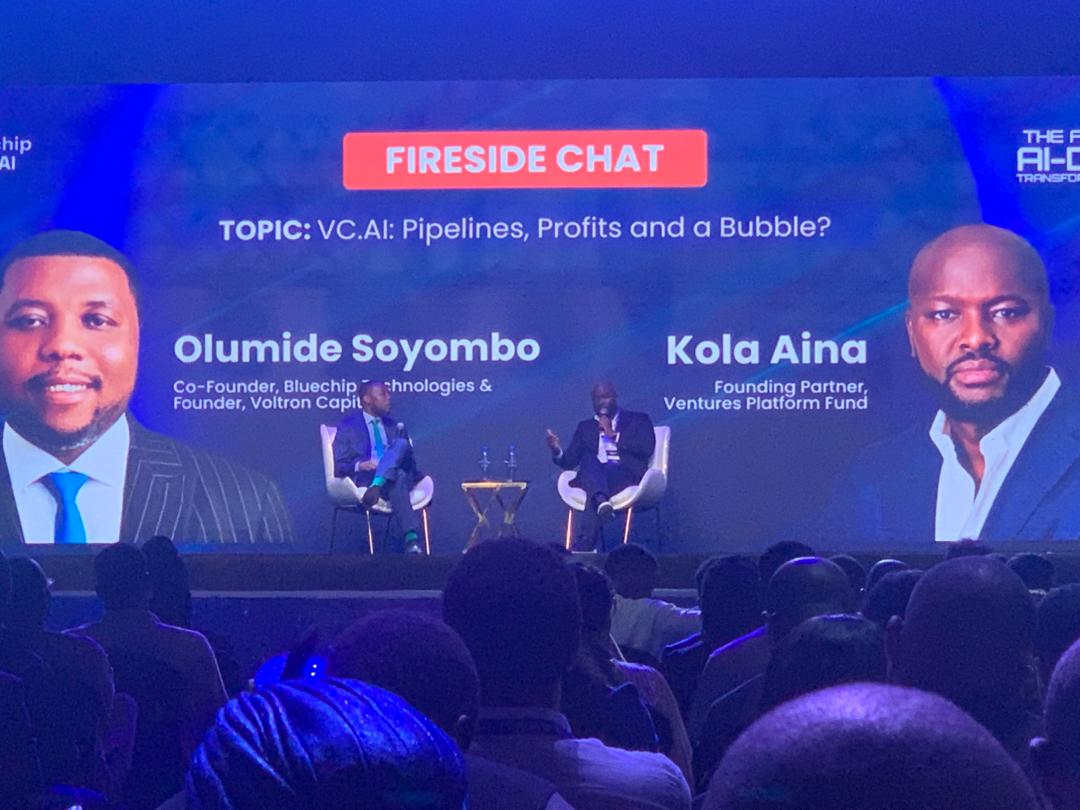
We are in an era of technological bloom, not a bubble, Kola Aina, the Founding Partner of Ventures Platform, said at the 2026 Bluechip Data and AI summit in Lagos.
In a fireside chat with Olumide Soyombo, the Co-founder of Bluechip Technologies and Founder of Voltron Capital, they explored Venture Capital. AI: Pipelines, Profits and Bubble.
Is AI a bubble or a bloom? Kola Aina makes the case for something bigger
The emergence of AI has drawn a lot of questions about how it will shape the future of technology. Kola Aina pushed back against the doom narrative, but did not dismiss the warning signs entirely. The question has been hanging over Silicon Valley and every tech ecosystem that looks to it for direction: are we watching the birth of a new economic era, or are we simply watching history repeat itself in a more expensive costume?
For Kola Aina, founding partner at Ventures Platform, one of Africa’s most prominent early-stage venture funds, the answer is neither simple nor entirely comfortable. But it is to be considered.
“I belong to the school of thought that believes that we are not, in fact, in a bubble,” Aina told the audience during a fireside chat at the summit. “And I know that’s contrarian. I actually think we’re in a bloom.”
According to him, this is “the birthing of a new horizon and a new inflexion point for the global economy.” Not a crash waiting to happen. A beginning. Globally, the debate over whether artificial intelligence represents real, lasting value or just another speculative frenzy has grown louder. The AI industry has pulled in trillions of dollars in investment over the past few years, with company valuations climbing at a pace that makes even seasoned investors nervous.
The most common comparison is to the dot-com crash of the early 2000s, when hundreds of companies with little more than a website and a pitch deck went public before the whole thing fell apart.
The veteran venture capitalist does not buy that comparison, at least not fully. “The last time we had a real bubble, the dot-com crash, you literally had companies that had no products, no revenue, talk less of profits, IPO,” he said. “Today, if you look at the Open AIs of this world, the Microsofts that are now becoming AI giants, NVIDIA, these are companies with real products being adopted by real companies. The industry today has revenues in the billions of dollars. So I don’t think that is the classic definition of a bubble.”
It is a fair point. Unlike the dot-com era, when a company’s worth was often built entirely on guesswork about future users and imagined revenue that never materialised, today’s leading AI companies are generating real, measurable revenue.
Microsoft has woven AI deeply into the tools that businesses use every day. OpenAI has built a growing commercial operation. NVIDIA, which makes the chips that power most of the world’s AI systems, has become one of the most valuable companies on the planet. These are not ghost ships. They carry real cargo.
Areas of concern to consider
Still, Aina has concerns. He does not buy into the bubble talk, but he admits the reckless behaviour worries him. “There is what looks like a very incestuous relationship,” he said. “Basically, there are about 10 to 12 companies buying and placing orders from each other. You place an order from me, I invest in you.”
He avoided a hard conclusion, but the message was clear. Tight insider money flows make you wonder whether valuations reflect real demand or just hype from a small, connected crowd.
This is not a concern unique to Aina. Several global financial institutions and independent analysts have raised similar flags, noting that a small cluster of big tech companies and frontier AI labs has created a kind of closed loop, where the same names keep appearing on both sides of the biggest deals.
In the venture world where Aina operates, the problem takes a different shape. “We’ve seen some really outrageous valuations that are not close to reality,” he said, before sharing a personal example.
Ventures Platform recently passed on investing in a company building an AI model trained on African languages, a category that falls squarely within the fund’s focus. The reason? The price being asked simply did not add up.
“They had a TechCrunch announcement recently because they managed to raise the money,” Aina said, with the kind of honesty that comes from years of making hard calls. “Part of me felt, Kola, you’ve been too prudent. But look, I think ultimately you have to take it on a case-by-case basis.”
Aina’s conclusion is grounded and clear. “There are going to be winners and losers,” he said. “There’s going to be lots of casualties and lots of blood left on the dance floor. But ultimately, you are going to have some incredible companies built on the backside of this, what looks like a balloon that some people call a bubble.”
The word he keeps coming back to is bloom. A bubble, by definition, bursts and leaves nothing behind. That is the bet Kola Aina is making. And given where he sits, watching both the global AI wave and its possibilities on the African continent, it may be one of the more grounded and useful ways to think about where we are headed.
People in this article

Last updated: June 10, 2026