

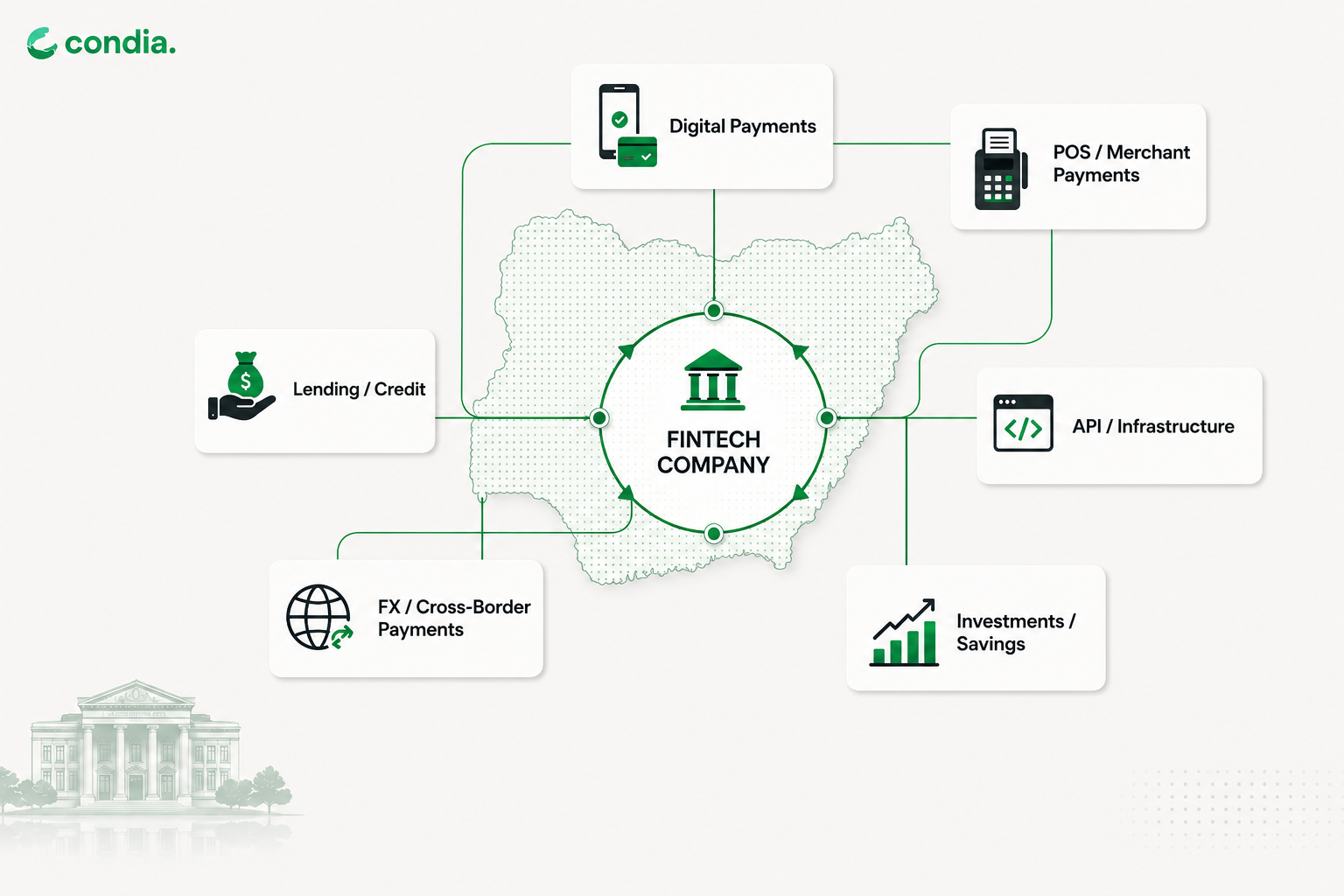
Nigeria’s fintech industry has grown into a major part of the country’s financial system. In 2026, Nigeria has more than 430 active fintech companies, while the country’s digital financial services market has reached an estimated 76 million active users. Electronic payments have also grown rapidly, with annual electronic payment value exceeding $703.58 billion in 2024.
But there is a question behind all this growth: how do fintech companies make money when many of their services are free?
Some fintech apps offer free transfers, cheap payments, and attractive savings rates. Yet these companies still have to pay for technology, staff, compliance, licences, cybersecurity, customer support and infrastructure.
Fintech companies do not depend on one revenue stream. Instead, they build different ways to make money around payments, merchants, lending, financial infrastructure, foreign exchange, subscriptions, savings and investments. In some cases, the customer may not be the one paying for a service even though they benefit.
What is a fintech business model?
A fintech business model is simply the way a financial technology company creates value for customers and turns that activity into revenue.
Fintech companies can operate as multi-sided platforms. A customer may use a service for free while another party pays for access to the financial infrastructure behind it.
For example, a customer buying goods online may pay no payment-processing fee. The merchant receiving the money, however, may pay the payment gateway a processing charge.
The same principle applies to financial data. A consumer may give permission for a fintech company to access their bank information without paying anything. A lender or business using that information through an API may pay the fintech for every data request.
Traditional commercial banks have historically relied heavily on net interest income from lending, account-related fees and large banking operations. Fintech companies often operate with more technology-driven, asset-light models. They can monetise individual transactions, API calls, merchant activity, lending, foreign exchange and other financial services.
So when asking how fintech companies make money, it is not enough to look at what users are charged directly. You have to look at the entire financial flow.
How do fintech companies make money in Nigeria?
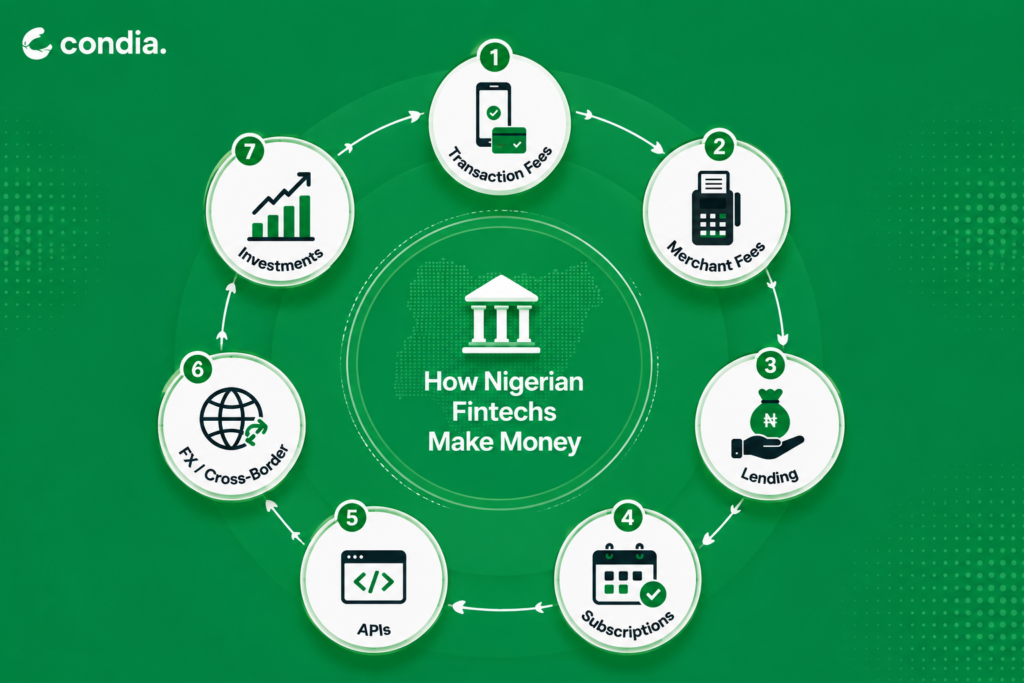
There are seven major revenue channels behind Nigeria’s fintech industry.
1. Transaction fees
Transaction fees are one of the most straightforward ways fintech companies make money.
Payment companies process transactions between customers and businesses. When a customer pays a merchant by card, bank transfer, USSD or another digital payment method, the payment provider can charge a fee for processing the transaction.
This is how payment infrastructure companies such as Paystack and Flutterwave generate revenue. The fee may be a percentage of the transaction, a fixed charge, or a combination of both.
Paystack, for example, charges 1.5% plus ₦100 on standard local card transactions, although the ₦100 fixed fee is waived for transactions below ₦2,500. Local card processing fees are capped at ₦2,000. Its international card fees are higher, with international Visa and Mastercard transactions charged at 3.9% plus ₦100.
Flutterwave also earns from payment processing. Its local card fees are around 1.4%, while international processing can attract higher charges. It also generates revenue from other payment channels, including USSD and international payouts.
Transaction fees depend on volume to be sustainable. Suppose a fintech processes thousands or millions of transactions every day. It does not need to charge each customer a large amount. A small fee on a very large payment volume can produce significant revenue. However, the amount a fintech charges is not the same as the amount it keeps.
Payment companies have to share part of the transaction economics with card schemes, banks, switching networks and other infrastructure providers. This means the final margin can be much smaller than the headline fee.
2. Merchant fees
Instead of making money directly from consumers, fintech companies can charge businesses for the infrastructure they use to receive and manage payments.
This includes POS terminals, merchant acquiring, business banking tools, payment gateways and other services.
Companies such as Moniepoint, OPay, PalmPay and Paga operate in this part of the market. Their merchant businesses can generate revenue from terminal sales, payment processing and agent banking activity.
The important point is that the fintech is not simply selling a machine. The terminal creates an ongoing financial relationship with the merchant.
Every time that merchant processes a payment, the fintech can potentially earn a fee. The more transactions the merchant processes, the more revenue the fintech can generate. This is why merchant acquiring can be more valuable than simply selling POS hardware.
3. Lending income
Companies such as FairMoney, Carbon and Branch can generate income by providing loans and charging interest on the money they lend.
Digital lenders may also earn money from loan origination fees, processing charges, late-payment charges and other financial products linked to credit.
A lender does not earn money simply because it gives out loans. It earns money when customers repay those loans successfully.
If a significant number of borrowers default, the expected interest income can disappear. The lender still has to absorb the cost of capital, underwriting, collections, technology and operations, making credit risk management central to digital lending profitability.
Digital lenders therefore use customer transaction data and alternative data to assess borrowers. Machine-learning models can analyse information such as spending behaviour, telecom activity, POS cash flows and utility payment history to estimate repayment risk.
4. Subscription fees
Not every fintech makes money from individual transactions. Some sell software and financial tools, earning through recurring subscriptions.
A fintech may offer businesses tools for accounting, payments, expense management, payroll, reporting, developer access or other financial operations. Instead of charging only when a transaction happens, it can charge the business a monthly or annual fee.
A transaction-based business may have revenue that changes with payment volume. A subscription business can build recurring revenue from customers that pay every month.
5. API and financial infrastructure fees
An API allows two software systems to communicate. In financial services, APIs can allow a company to verify a bank account, access financial information, confirm identity, assess creditworthiness or initiate payments.
A fintech infrastructure provider can charge businesses each time they use an API. In this case, a fintech does not necessarily need millions of individual users. It can instead serve banks, lenders, HR platforms, businesses and other financial companies.
The more businesses integrate the API and the more frequently they use it, the more revenue the infrastructure company can generate.
6. Foreign exchange and cross-border payments
When money moves between currencies, fintech companies can earn from foreign exchange spreads and payment fees.
The spread is the difference between the rate at which the fintech obtains currency and the rate at which it sells or settles that currency for the customer.
For example, if a fintech obtains dollars at ₦1,500 per dollar but settles a recipient at a rate of ₦1,550, the ₦50 difference represents a spread captured by the provider.
Fintech companies can also charge additional fees for international payouts. Paystack, for example, charges higher rates for international card payments, while cross-border payment providers can also earn from international transfers, currency conversion and settlement services.
LemFi, Flutterwave and Kora operate in areas connected to this cross-border payment opportunity. The rise of stablecoins could also change how this business works.
Fintech companies are increasingly exploring stablecoins such as USDT and USDC as settlement rails for cross-border transactions. This can reduce some of the friction associated with traditional international transfers while creating new opportunities to earn from conversion spreads, treasury services and B2B settlement.
7. Investment and savings products
Platforms such as PiggyVest, Cowrywise and Bamboo can generate revenue from savings, investments, asset management and brokerage services.
One way this works is through the spread between the return generated from pooled customer funds and the return paid to customers.
Fintech companies can also earn commissions from distributing investment products. Investment platforms facilitating access to foreign stocks can also earn trading commissions and currency conversion margins.
So a customer may think they are simply saving money through an app. Behind that product, the fintech may have several ways of generating revenue from the customer’s financial activity.
Why do some fintech apps offer free services?
Free transfers can be used as a customer acquisition strategy. A fintech gives customers a useful service at little or no direct cost, builds a large user base and then makes money from other activities.
A customer may use free transfers, but the fintech can later monetise that relationship through merchant payments, lending, income from deposits, insurance or other financial products.
How different types of Nigerian fintech companies make money
Payment companies
Payment companies such as Paystack and Flutterwave primarily earn from transaction processing, merchant fees, international payments and related payment infrastructure. Their revenues depend heavily on transaction volume.
Digital banks and wallets
Digital banks and wallet providers can combine several revenue streams. They may earn from lending, merchant payments, interchange-related income, subscriptions, deposit float and other financial services.
Free consumer services can help them acquire users, while business products and credit generate revenue from those users later.
Wealth and investment platforms
Wealth-tech companies can earn through investment commissions, asset management fees, brokerage fees, currency conversion and spreads generated from managing or distributing financial products.
Infrastructure companies
Infrastructure fintechs can earn from API calls, software subscriptions, enterprise contracts and financial technology services provided to other companies. Their customers may be banks, lenders, businesses, HR platforms, merchants or other fintechs.
Why some fintech companies struggle despite growing users
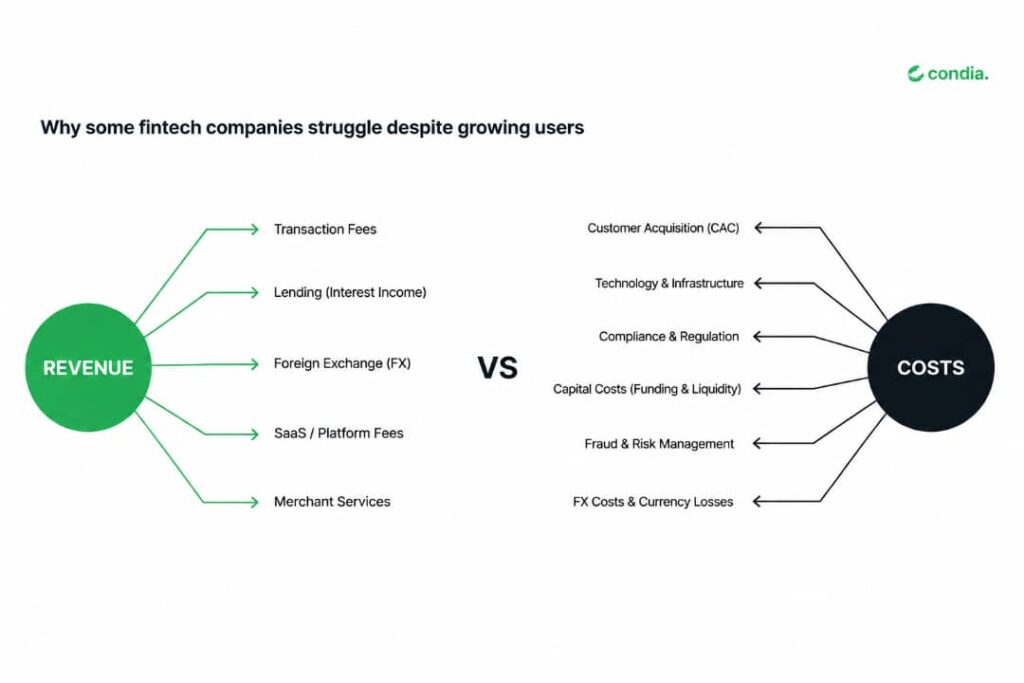
A fintech can have millions of users and still lose money. Fintech companies often spend heavily on promotions, referral bonuses and free services to attract customers. But users attracted mainly by incentives may leave once those incentives disappear.
If those customers maintain low balances and rarely use profitable services, their lifetime value may not cover the cost of acquiring them.
Many fintechs earn revenue in naira while paying for cloud infrastructure, security software and international technology services in US dollars. Naira depreciation can therefore increase costs even when local transaction volumes continue to rise.
When interest rates rise, the cost of obtaining capital for lending also rises. The CBN Monetary Policy Rate was above 27.5% in the period examined, increasing funding pressure on digital lenders. Higher borrowing costs can force lenders to increase customer rates, which can also increase credit risk and defaults.
Regulation adds another layer. Fintech companies have to maintain licences, comply with consumer protection rules, protect customer data and meet reporting requirements. Payment processing is particularly competitive. Local transaction fees are capped, while fintechs must share revenue with other parts of the payment system. This can leave companies with very thin margins even when their gross transaction volumes look impressive.
Why Nigerian fintechs are moving toward B2B services
Between 2024 and 2026, the sector increasingly moved toward merchant acquiring, business banking, B2B SaaS, infrastructure APIs and merchant lending.
Consumer payments can be high volume but low margin. Businesses can generate several sources of revenue from the same relationship.
A fintech serving an SME can provide payment processing, POS hardware, payroll, tax tools, inventory management, business accounts, corporate cards and working capital loans. Instead of earning one small transaction fee, the fintech can earn from several products.
The future of fintech revenue models in Nigeria
The next phase of Nigerian fintech will likely be less about giving consumers another standalone payment app and more about embedding financial services into businesses.
Embedded finance
E-commerce companies, logistics businesses, ride-hailing platforms and other non-financial companies can integrate payments, credit, wallets and settlement services directly into their platforms.
Fintech infrastructure providers can monetise these integrations through API licensing, setup charges and revenue-sharing agreements.
AI-powered financial services
Lenders can use machine-learning systems to assess borrowers using alternative data. Payment companies can use AI to detect fraud and improve transaction monitoring.
If these systems reduce defaults, fraud losses and operating costs, they can improve margins without requiring the company to charge customers more.
Cross-border payments
Cross-border payments are likely to remain an important revenue opportunity as African businesses and consumers become more connected. Africa’s cross-border payment market is projected to triple from $329 billion to $1 trillion by 2035.
Stablecoins, faster settlement systems and new payment infrastructure could reduce some of the friction around international payments while creating new revenue opportunities for fintech companies.
Nigerian fintech companies make money through transaction processing, lending, subscriptions, APIs, foreign exchange, remittances, and savings products. But the strongest players are learning that growth alone is not enough.
Last updated: August 13, 2026