

Anchor, the YC-backed banking and payments infrastructure company, has launched an MCP server. This Model Context Protocol (MCP) allows AI agents and coding tools to access its full API resources. This makes development and integration with Anchor’s infrastructure more seamless, as most developers already augment their process with AI coding tools like Codex, Claude, and Cursor.
Anchor’s MCP server is one of the first on the continent, putting it in the league of global fintech giants like YC-backed Stripe, which launched its official MCP server last year.
“API documentation has always been written for humans. We’re living through the moment where there also needs to be infrastructure for AI systems,” Olamide Sobowale, cofounder and CTO of Anchor, told Condia. “We think being early on this curve matters, not just for developer experience, but for how we are positioning ourselves on the global stage. We’re not building for a local market. We’re building for the world.”
Why does an MCP launch matter
AI adoption has skyrocketed, especially amongst developers. A 2025 survey by Stack Overflow reveals that 4 in 5 professional developers use AI tools as part of their workflow. These AI tools help with development activities like code completion, code generation, and unit testing. However, a known limitation of AI large language models (LLMs) is that it’s only as good as the data it was trained on and the context it has. A by-product of the lack of data and sufficient context is that AI hallucinates. Thus, it’s not surprising that about half of all the professional developers from the survey distrust the accuracy of AI tools.
MCPs provide context directly and in real-time to these AI tools, including AI agents, in a machine-preferred format, thereby speeding up their information retrieval and enhancing their output.
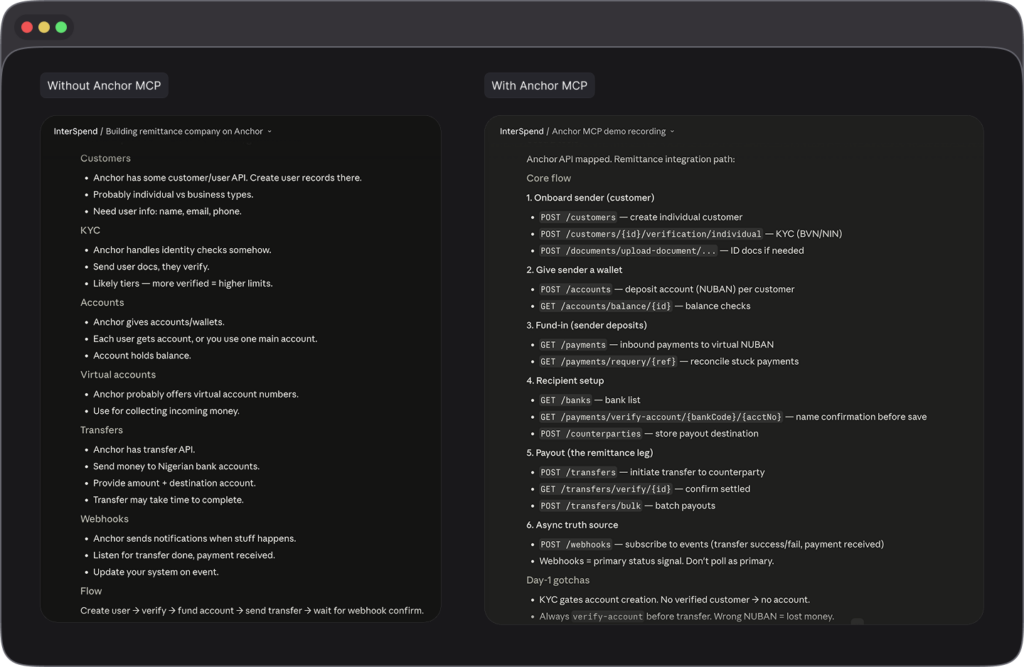
With Anchor MCP, developers can move from reading generic advice about payment API integration to specific guidance on how to integrate Anchor’s payment disbursement API, for example. AI coding assistants can read current endpoint specifications, request and response schemas, authentication rules, and product workflow relationships across accounts, transfers, payments, bills, and webhooks.
Developers can start using this by visiting Anchor docs MCP using any MCP-compatible client, such as Claude, Cursor, VS Code with the MCP extension, or ChatGPT.
MCPs: A gateway for African Startups in the AI era
African startups are indeed lagging in the mainstream conversation about AI as a standalone industry. This lag is due to the massive capital and infrastructure investments required to build LLMs. Africa accounts for less than 1% of global data centre capacity and has received a pittance of the $188 billion raised by AI startups in the first quarter of 2026.
It is also due to the corporate and cultural conservativeness towards emerging technologies. For instance, while Anchor has an MCP server, like Stripe, it does not yet support agentic payments.
Speaking on why Anchor MCP does not facilitate agentic payments, Sobowale said, “Leveraging AI in financial services requires a progressive and careful approach. Agentic payments are susceptible to security breaches, automated fraud and money laundering, which is unacceptable for us as a regulated financial institution. However, rather than wait idly, we have decided to ship a safe product that lets builders enter the agentic era with confidence.”
Anchor holds two licences from the Central Bank of Nigeria: a Microfinance (MFB) bank and an International Money Transfer Operator (IMTO) licence. As of August 2025, the platform had processed over $2.5 billion.
If every African fintech launches an MCP server, the ecosystem will be AI-charged and ready for future product innovations leveraging AI.
For more information on Anchor MCP, read Anchor’s announcement.
Last updated: June 1, 2026