


On July 20, 2026, Becca Oluwabukola, a Nigerian content creator who previously worked at Zenith Bank, disclosed that she had been advised to resign after posting videos about her job.
According to her account, in 2022, two years after joining the bank, a video she made about a salary increase drew a query from management. The video, which suggested that the raise she received was too small, initially led to a pay bump and a promotion. But the queries kept coming.
She would be called before a disciplinary panel more than once over the next four years before eventually being asked to leave. Zenith Bank has not issued a public statement at the time of writing.
Around the world, more employees are turning aspects of their jobs into content, filming “get ready with me” content, day-in-the-life clips, and office vlogs. In Nigeria, this is forcing human resources departments, some for the first time, to re-examine the rules for what staff can and cannot post about work.
HR teams are paying attention
Jane Okorie, an HR consultant, has had to draft a comprehensive social media policy for her organisation in the wake of the Zenith Bank incident.
“This is not because we want to limit employee creativity,” she tells Condia. “It’s because we have more Gen Z staff who want to show everything. The content shouldn’t interrupt workflow and shouldn’t put the company in a bad light, especially if you’re wearing something affiliated with the company.”
At Lotus Bank, Oyeyinka Banjo, the bank’s Chief Human Resources Officer, said a policy already existed inside the bank’s wider communications framework. But it has been refined as more employees build personal brands online.
“We’re treating this as an evolving priority rather than a one-off policy,” Banjo said. “Social media behaviour changes quickly, so we review guidance periodically rather than treating it as concluded.”
According to Toingrick Byanyiko, an HR consultant who has advised multiple companies, most organisations have never had a standalone social media policy in the first place. Guidance was usually folded into a broader internet use policy focused on confidentiality.
“What has changed is that many organisations no longer treat social media as a standalone policy area,” she shared. “As conversations around data privacy, confidentiality, and information security have become more prominent, social media expectations have naturally become part of those broader policies.”
What the policies actually say
A corporate social media policy shared for this story shares some insight into how HR teams are navigating this development. Employees are barred from using identifiers such as the company logo, name, branded items, or office premises as the main setting for personal content without approval.
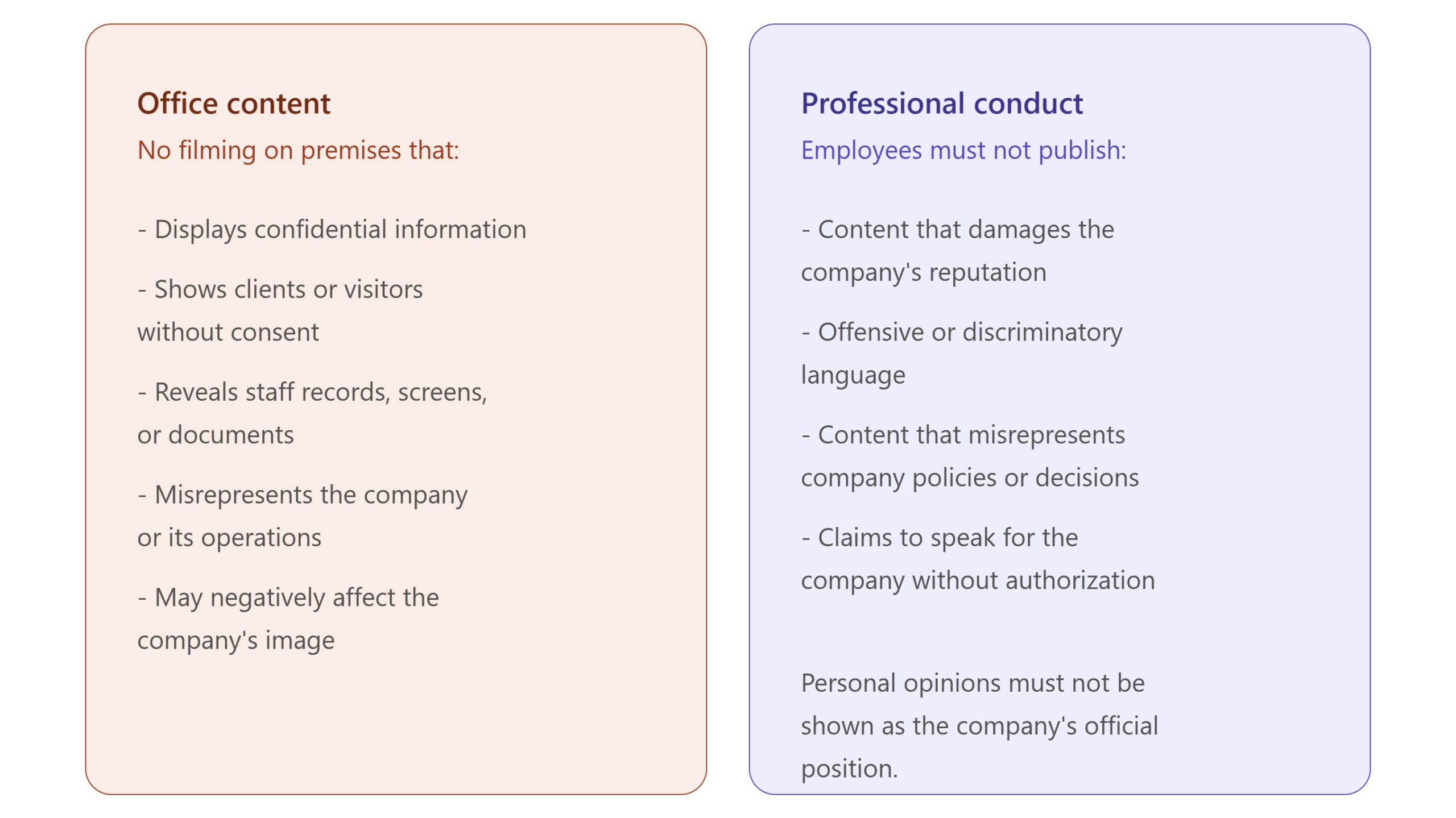
They are also prohibited from filming on company premises in a manner that shows confidential information, clients or visitors without consent, staff records, computer screens, or anything that could damage the company’s image.
As a financial institution, Lotus Bank naturally draws the line at confidential customer or deal information, statements that could be mistaken for the bank’s official position, especially on Shariah-compliant products, and content that goes against the bank’s values. Outside of that, staff are free to speak about their work and their industry.
General career updates and industry commentary do not need approval. However, anything that names specific products, partnerships, or figures has to go through the bank’s Brand Marketing and Communication team, then its Shariah Compliance Unit.
Okorie’s policy stops staff from posting branded materials without approval and from sharing photos or footage that reveal sensitive information. What is harder to police, she said, is language that could damage the reputation of the company or misrepresents company policies, services, or decisions, since employees do not always know when they have crossed that line.
What the law says
Employers have a natural interest in protecting confidential information, brand reputation, and the privacy of customers and coworkers, Uchechi Anyanele, a corporate and disputes lawyer, shared.
In that sense, Nigerian law gives companies some room to raise concerns or discipline employees over their social media activity. But that room is not unlimited.
Any assessment of wrong, she noted, would begin from what an employee’s contract states as well as existing workplace policies. With Nigerian labour law moving away from a rigid application of common law, employees are not simply commodities before the law. Consequently, any disciplinary action must follow a fair process.
“A policy you never gave an employee cannot automatically bind them,” Anyanele said, pointing to Mrs. Eluemuno Olumagin v Total E&P Nigeria Limited, a case in which the National Industrial Court voided the termination because the employer failed to follow its own disciplinary procedure.
In the event that an employer’s policies are not backed by law, such policies would not be enforceable. Anyanele also referred to the Nigeria Data Protection Act 2023. Under the law, she said, any content that captures a colleague or customer counts as processing personal data and doing that without a lawful basis could pose legal problems, separate from whatever the employer’s internal policy covers.
On whether a company can force staff to get approval before posting anything about their job, Anyanele argued that would go too far.
“A blanket pre-approval requirement covering all personal expression, including content that has nothing to do with the employer, would likely be held by the court as unreasonably broad,” she said. Approval requirements hold up better only when the content identifies the company, its clients, its products, or its premises. Else, employees reserve the right of self-expression.
Companies with no policy at all are exposed. Without a documented policy, it is hard for an employer to prove an employee had fair notice of what was expected, which opens the door to unfair labour practice claims.
At the same time, employees are left guessing at what is acceptable, and that uncertainty can be used to selectively punish people whose content becomes inconvenient while others doing the same thing face no consequences.
The hidden cost
Exposing confidential information or sharing opinions that could be damaging to an employer are just some of the consequences of this trend. Okorie has seen some of this content triggering awkward conversations.
“I have seen people come up to me at HR to say, ‘Increase my salary, I was in this company before this person, and she is being paid so and so.’”
Both Okorie and Byanyiko said the phenomenon is most common among customer-facing staff, such as front-desk and sales teams, and skews heavily toward younger employees. Byanyiko added that traditional companies have generally had some form of guidance in this area for years, even if it was never labelled a social media policy, while startups tend to be reacting to the trend for the first time by drafting policies as it happens.
What employees can do
All HR leads interviewed agreed that employees are not banned from posting about their jobs, and most organisations do not require formal approval for general content. What matters, they said, is drawing a hard line between a person’s professional identity and their personal life.
Okorie pointed to creators who post regularly about their jobs without ever naming their employer or showing a company logo, framing that as the safest approach.
Byanyiko said a small number of industries carry stricter expectations regardless of how careful an employee is.
“Some industries, such as intelligence, security, defence, and certain financial or politically sensitive organisations, operate under much stricter confidentiality requirements,” she said. “In those environments, employees often sign agreements that significantly limit what they can share publicly, and in some cases, their social media activity may be heavily restricted.”
For most other workers, the advice is to be honest about your job, avoid confidential details, keep company identifiers and premises out of anything controversial, and, when in doubt, ask the marketing or communications team before posting.
As Anyanele put it, the organisations that handle this well are the ones writing clear rules now, rather than reacting after a story goes viral.
Last updated: August 7, 2026