


Paystack acquired Allawee, a Nigerian no-code card issuing startup, in late 2025. On August 31, the news became public after Allawee told its business and individual customers that their accounts would be closed by December 1, 2026, in emails seen by Condia.
In an exclusive chat, the startup told Condia why it sold to Paystack. However, there’s a regulatory spanner in the wheel of how far Paystack’s recently acquired card-issuing capabilities can spin.
But first, let’s examine what Paystack bought.
What Paystack bought and didn’t buy
Paystack did not acquire Allawee for its customer base or brand leverage. It has that in abundance. Allawee had 400 customers, while Paystack has over 300,000 in its database.
“We had reached an inflexion point,” an Allawee representative told Condia. Allawee had proven its infrastructure could operate at a meaningful scale, but the next phase required far more distribution, regulatory capacity and capital than it could raise or build on its own within a reasonable timeframe. Paystack already had much of that machinery in place.
What Paystack bought was tech that could complement its product ecosystem and accelerate its Go-To-Market (GTM). “We weren’t just selling a company. The technology and ideas we spent years building were going to continue inside one of the most important financial technology companies on the continent,” an Allawee representative told Condia.
Paystack’s product ecosystem includes local and international acquiring via payment gateway and PoS devices, finance automation and SaaS, and Banking-as-a-Service (BaaS). Allawee’s card issuing capabilities enable Paystack’s BaaS to offer card issuing alongside its account issuing and famed acquiring solutions.
A card programme requires the issuing business to: find a sponsor bank that works well with their preferred card scheme, be adequately licensed for card authorisation, integrate with the issuer processors, and manage risk and fraud. While Paystack has the bank and card scheme relationships, payments licence, integrations and fraud models, it still needs to couple them together to make a card issuing programme.
In the case of a physical card, the business has to partner with a certified card printing company, produce compliant card artworks and prepare them, obtain multi-party approval including from the card scheme, handle actual production including personalisation and then ensure safe delivery to customers. With credit cards, a credit decisioning model is required to underwrite how much credit a card requester should be given.
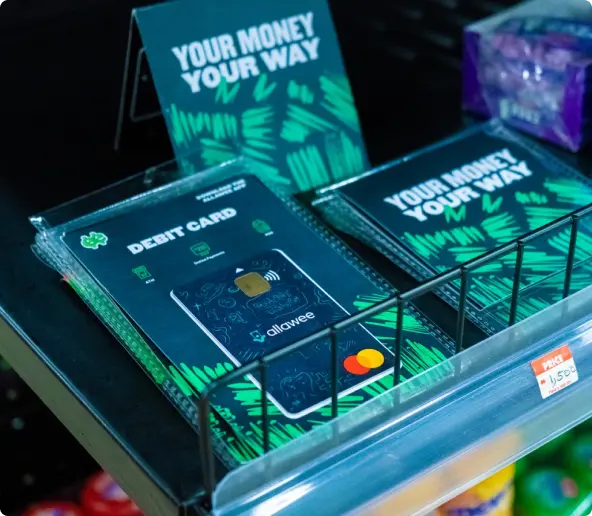
Allawee had already built all these. In December 2024, Condia announced that Allawee launched a credit card in partnership with ProvidusBank (BIN sponsor) and Mastercard (card scheme). Credit cards are a rarity in Nigeria; only 2% of adults own one.
The company built integrations with Apple Pay and Google Pay that enable contactless payments alongside other capabilities like spend controls.
The timing lines up with Paystack’s own expansion beyond payments. Earlier this year, Paystack acquired Ladder Microfinance Bank and used it to launch Paystack Microfinance Bank, giving the company a regulated banking vehicle it can use to offer services well beyond its original payments business.
Upon Allawee’s acquisition in 2025, the entire team joined Paystack. However, over the course of the last 12 months, some of the team members have left.
Balances, transaction histories, and other account information will not migrate automatically, which buttresses the point about not acquiring Allawee for its customer base. Interested customers are welcome to open accounts on Zap or PaystackMFB as individuals or businesses, respectively.
A regulatory spanner in the wheel
In June 2026, the Central Bank of Nigeria, the apex regulator for all financial institutions, issued an anti-competitive circular that prevents a dominant merchange acquiring player from owning substantial market share in the issuing space and vice-versa.
The value of such early-stage M&As in Africa
Deals like this also carry weight beyond the two companies involved. Every acquisition of this kind reinforces confidence that locally built tech can become valuable enough for a larger player to acquire, which, in turn, encourages other founders to keep building rather than settle.
It puts liquidity in the hands of investors, limited partners, founders, and teams who can then back more builders or be rewarded for years of work in a market where exits remain rare.
And it thins out the congested middle of the ecosystem, moving companies out of a holding pattern where they would otherwise remain ordinary businesses with no exponential upside.
Allawee raised about $1 million from investors including Rali Cap Ventures, Voltron Capital, ODX OnDeck Fund, Golden Square Capital, PiggyVest, Carbon’s co-founders, Charles Oppenheimer, Shane Curran and a group of other strategic VC-backed founders and angels.
Last updated: September 5, 2026