


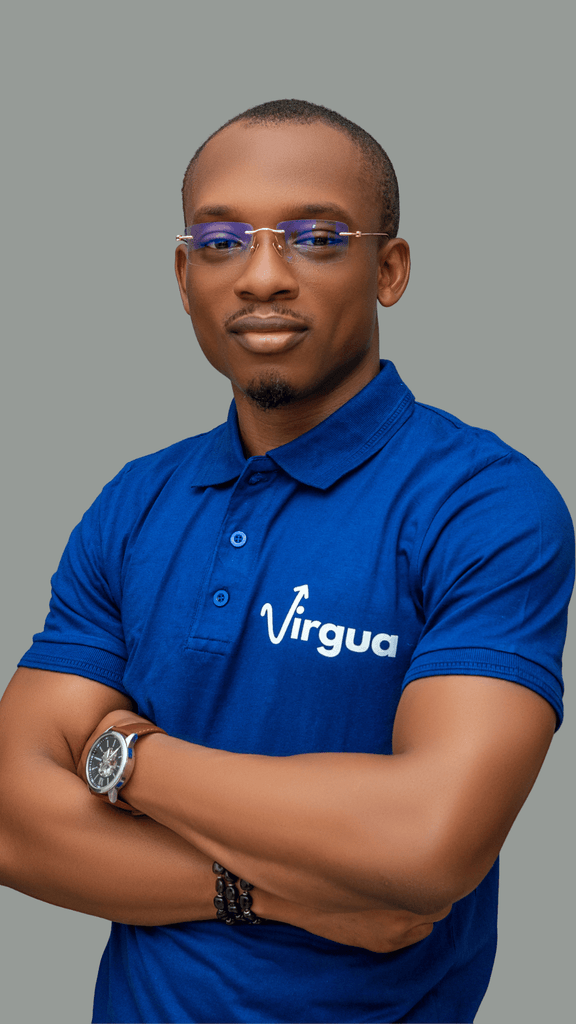
Every smartphone in Nigeria already powers connections — calls, messages, and social media. Franklyn Eluagu’s argument about Virgua, the app he’s building, is that a phone that only connects you to people is doing half the job.
“Technology should do more than connect us,” he says. “It should protect us.”
How Virgua works in practice
To see what that means in practice, picture a romantic date going wrong. Not dramatically and not right away, just a text that stops coming, a location that stops updating, a person who was supposed to check in and hasn’t. On most nights, nobody notices until it’s too late to matter. On Virgua, those moments start a clock.
Before the date begins, the app asks you to pick who should be informed if something goes wrong and how long you expect to be out. While you’re out, the app pings intermittently, you tap a private PIN only you know, it resets, and it waits.
Miss a check-in, and it doesn’t panic; it gives 15 minutes of grace in case a phone is face-down at the bottom of a bag. Miss that too, and it sends an SMS to the people you named, saying only that you haven’t checked in and may need attention.
No alarm, no location, just a nudge to reach out. Another 15 minutes of silence, and the warning becomes an SOS, with a live location, a short recorded clip of ambient audio, and a link to a private page where the people you trust can watch, in real-time, whether you’re moving or still.
It is, deliberately, a slow build. “There’s a tendency for the system to be destabilised, shocked by the message,” Franklyn says of jumping straight to sirens. The soft warning exists to give the people around you time to prepare for an emergency instead of being blindsided by one.
And if the phone itself disappears, maybe broken, stripped of its SIM, or switched off by someone who wants it to look like nothing’s wrong, the app takes it as the loudest possible signal. “It’s not built to assume,” he says. “If a mobile device is turned off, it is only logical to say that something is wrong.”
The same 15-minute clock runs, the same alert fires, except now the location isn’t live; it’s the last one the phone reported before it went dark. Even with no internet at all, a physical SOS button routes the same alert through the mobile network as an SMS.
Eluagu doesn’t like to talk about the specific incident that started him on this journey. What he volunteers is that a loved one was involved in late 2022, and having some information could have changed the outcome.
Even the police need a starting point, he notes, adding that most families are unable to offer information that could help because they lack it.
“That’s the initial state of confusion that then leads into the rest of the chaos that follows where everybody says ‘I have not seen, I have not heard, I don’t know,’ and you cannot take it out of them, because there is no information regarding it.”
He’s careful to say this doesn’t change what the product needs to be. “The product has to be good, it has to be trusted, it has to be valuable.”
The experience doesn’t get to stand in for functioning software. But it’s why the questions he kept returning to weren’t about kidnappings or muggings specifically.
Virgua isn’t built with a special mode for extreme scenarios. It’s built on the belief that the actual gap, in almost every case is that nobody has first-hand information to act on.
Families have gone years not knowing what happened to someone, he says, sometimes unable even to claim a body from a mortuary because there was nothing to connect it to them. Virgua doesn’t promise to prevent any of that. Instead, it promises that if something does go wrong, someone will know where to start.
Trust, privacy, and building the right product
Eluagu, a marketing executive with no engineering background, thinks he’s the right person to build a safety company. He spent a decade getting people to trust products they hadn’t seen from brands they may have been unfamiliar with, from EbonyLife Films and Studios to client work with the Bank of Industry.
“My entire job has been getting people to trust things they have not seen yet,” he says. “So when people ask why a marketing person is building a safety company, I tell them that trust is the real product here, and the app is only the delivery mechanism.”
With Virgua, that meant sequencing the building of the company backwards: certification before code. Eluagu engaged a licensed data protection compliance organisation and secured certification from Nigeria’s Data Protection Commission (NDPC) before the product was finished.
Data encrypted in transit and at rest, servers separated so no single point of failure exposes everything, a completed risk assessment with a conditional go-ahead to launch, and a compliance audit already scheduled for a year out.
“I cannot have access to that data — all information, user locations, live locations,” he says of his own build team. “Nobody who develops or runs the application can see these things.”
Users can end a session, delete their history, or walk away entirely, and Virgua stops holding anything on them the moment they do.
It’s also why, for now, there’s no direct line from Virgua to the police. Alerts go to the people you chose, not to any authority. That is a deliberate boundary, while partnerships and integrations remain, in his words, a conversation still to be had. The app isn’t positioned to replace investigative work; it’s positioned to make sure that work, if it’s ever needed, doesn’t start from zero.
Before Virgua had a single line of code, it had a waiting room. Rather than build an email waitlist, Eluagu started WhatsApp groups across Nigeria’s six geopolitical zones — more than 500 people now — close to 400 of them in Lagos alone, sharing exactly the kind of real-time information the app is built around: accidents, road closures, and curfews.
People ask each other before they leave the house, whether it’s safe out there. The community didn’t wait for the product. In some sense, it is the product’s argument, already running in public months before launch: that people already feel the gap Virgua is trying to close, and will organise around it themselves if nothing else exists.
A market validation survey of 225 Nigerians, spanning employees, students, and entrepreneurs, told him this was a product people wanted and were willing to pay for.
That has landed at a flat ₦2,500 fee for the premium tier, priced against what people already spend on mobile data. “Everybody can actually utilise Virgua,” he says. “It was important to ensure that safety is not put into a cycle” where only people who can already afford security get to have it.
If you can afford data for your phone, the logic goes, you can afford to turn that same phone into a safety device instead of just a social one.
Virgua has been in development since September 2025, fully self-funded. Eluagu, who still holds a full-time role as Communications Manager at Planet Bottling Company, builds the company after hours, deliberately avoiding outside investment for now so that if equity conversations happen later, they happen from a position of traction rather than need.
“I am financing it myself,” he says, “and I’ll need to balance this with my 9-to-5.” 50 beta testers are currently using the app ahead of a public launch targeted for the fourth quarter of 2026, timed so people can start using it before the festive season, historically one of the periods people worry about most.
Ask him what success looks like, and he says it’s 100,000 users in the first year, but the number that matters more is people recommending Virgua to each other the way you’d tell someone to install a location-sharing app before a trip.
“It’s supposed to help the individual move from instinct to confidence,” he says.
He thinks that confidence has a second-order effect too: a would-be bad actor who realises a person has been logging details all night has a reason to think twice, whether or not anything ever goes wrong.
Every app on his phone, he points out, already does one of two things: it helps him work, or it helps him connect. None of them, until now, was built to ask whether he was safe. That’s the gap he’s spent a year, and a decade before that, in other people’s industries, trying to close.
“Technology should do more than connect us,” he says again, at the end, the same way he started. “It should protect us. That’s the heart of Virgua.”