

Last year, the UK received 1,303 Nigerian applications for its Global Talent visa in digital technology. Tech Nation endorsed only 42 of those applications, a 3.2% success rate, according to a Condia analysis of Home Office data released upon request under the Freedom of Information Act.
The Home Office appointed Tech Nation to oversee the process of determining what tech workers and founders qualify for the Global Talent visa. The Global Talent visa is Britain’s main route for people who want to work in the UK without a job offer.
Tech Nation must endorse applicants before they can apply for the visa. The UK’s reporting year runs from April to March, so the data obtained covers April 2025 to March 2026.
Nigerians made up almost one in three of the applications Tech Nation decided last year. The 1,261 rejected applicants paid £561 each in non-refundable Home Office fees, a combined £707,421. At ₦2,000 to the pound, which is the parallel market rate for the period, that works out to approximately ₦1.41 billion or ₦1.12 million for every application turned down.
The figures land as the government makes Global Talent one of the last short routes to permanent residence in Britain, and as its migration advisers call for tighter checks on who gets endorsed.
Key facts
- 3.2% of Nigerian applications were endorsed by Tech Nation from April 2025 to March 2026: 42 of 1,303. The year before, it was 13.3% (164 of 1,237).
- Lowest of any nationality in the Home Office data, below Sri Lanka (4.0%) and Pakistan (4.7%). The rate for all applicants was 14.4%.
- About ₦1.46bn (£730,983) in endorsement fees paid by all 1,303 Nigerian applicants, at ₦2,000 per pound. About ₦1.41bn (£707,421) of that was paid by the 1,261 who were rejected, and is not refunded.
- Endorsement fees only. These figures count only the £561 Home Office fee charged to apply for endorsement. They exclude the visa fee, the Immigration Health Surcharge, medical tests and adviser fees.
- £17,404 in fees per successful Nigerian endorsement, against £1,818 for Americans, according to Condia’s analysis.
- 82% of Global Talent grants to Nigerians in the year to June 2026 went to people already in the UK, up from 38% three years earlier.
Sources: Home Office FOI2026/08464; Home Office Immigration system statistics; Condia analysis.
What is the Tech Nation success rate for Nigerians?
Tech Nation’s success rate for Nigerian applicants was 3.2% in 2025-26, the lowest of any nationality in the Home Office data. It was below Sri Lanka (4.0%) and Pakistan (4.7%), and well below the 14.4% rate for all applicants.
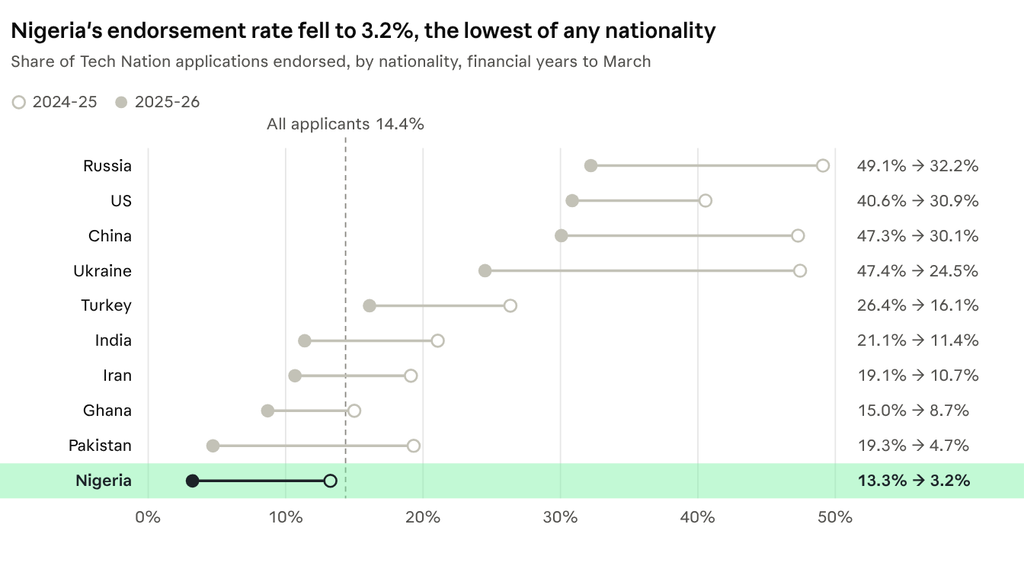
Nigerians filed 1,303 applications, more than India and the US combined, yet received barely half as many endorsements as either. According to Condia’s analysis, they made up 32% of all applications, 7% of endorsements and 36% of rejections.
How 2025-26 compares with the previous year
Nigerian applicants were already struggling in 2024-25, but not on this scale. That year, Tech Nation endorsed 164 of 1,237 Nigerian applications, or 13.3%. It was about half the 26.6% rate for all applicants, but Nigeria still received more endorsements than any nationality except Russia.
A year later, the picture had changed sharply. Nigerian applications rose 5% to 1,303, but endorsements fell 74% to 42. Nigeria dropped from the second most-endorsed nationality to the fifth, behind Russia, the US, India and China.
| Nigerian applicants | 2024-25 | 2025-26 |
|---|---|---|
| Applications | 1,237 | 1,303 |
| Endorsed | 164 | 42 |
| Success rate | 13.3% | 3.2% |
| Success rate for all applicants | 26.6% | 14.4% |
| Share of all applications | 34% | 32% |
| Share of all endorsements | 17% | 7% |
The gap with other applicants widened too. In 2024-25, a Nigerian applicant was half as likely to be endorsed as the average applicant. By 2025-26, they were less than a quarter as likely, according to Condia’s analysis. Excluding Nigerians, Tech Nation’s success rate fell from 33.6% to 19.6%; for Nigerians it fell from 13.3% to 3.2%, a far steeper relative drop.
Other African applicants fared better, though in far smaller numbers. Ghana and Kenya each had 8.7% of applications endorsed, South Africa 15.8% and Egypt 26.1%.
The cost of a rejected Global Talent application
A rejected Global Talent endorsement application costs £561 (₦1.1 million) in Home Office fees, which are not refunded. Every applicant pays the £561 endorsement fee before Tech Nation looks at their case, and it is kept if they are turned down.
Nigerian applicants paid £730,983 in such fees in 2025-26, about ₦1.46bn. Condia’s analysis found that works out at £17,404 (₦34.8 million) in fees for each Nigerian who was endorsed.
| Nationality | Fees paid | Endorsed | Fees paid per endorsement |
|---|---|---|---|
| Nigeria | £730,983 | 42 | £17,404 |
| Pakistan | £107,151 | 9 | £11,906 |
| India | £384,285 | 78 | £4,927 |
| All applicants | £2,292,807 | 587 | £3,906 |
| US | £150,909 | 83 | £1,818 |
| Russia | £200,277 | 115 | £1,742 |
That is nearly ten times the cost per successful application paid by Americans. Nigerians accounted for 36% of all rejections, and for more than a third of the roughly £2 million in fees the Home Office kept from refused applicants.
The true cost is higher. Many applicants pay advisers or agents to prepare their evidence, and some law firms charge several thousand pounds for a Global Talent application. Those costs are not recorded anywhere.
Two Nigerians who switched to the Global Talent visa from inside the UK in 2023 told Condia that consultants had approached them. One was quoted between £1,000 and £3,000 to prepare the application but chose to do it alone. “I felt I could do a better job than them preparing my application,” he said. “How does a consultant understand what exactly was happening in some random company you were in back in 2020? Or what $20m ARR means in the context of this specific industry?”
For endorsed applicants, the endorsement fee is only the first cost. Applicants pay a £205 visa fee and the Immigration Health Surcharge of £1,035 for each year of their visa, as well as the cost of a tuberculosis test, which UK visa applicants living in Nigeria must take. For one person on a three-year visa, official fees alone come to £3,871, about ₦7.7m at ₦2,000 to the pound. A five-year visa costs £5,941, about ₦11.9m. Partners and children each pay £766 plus the surcharge.
For most Nigerian applicants, the £561 bought only a decision. In 2025-26, 97% of those decisions were no.
Why are so many Nigerian applications being rejected?
This story is free for Condia Insiders only.
Keep reading free. Join the community at the forefront of African tech.
Already an Insider? Sign in