

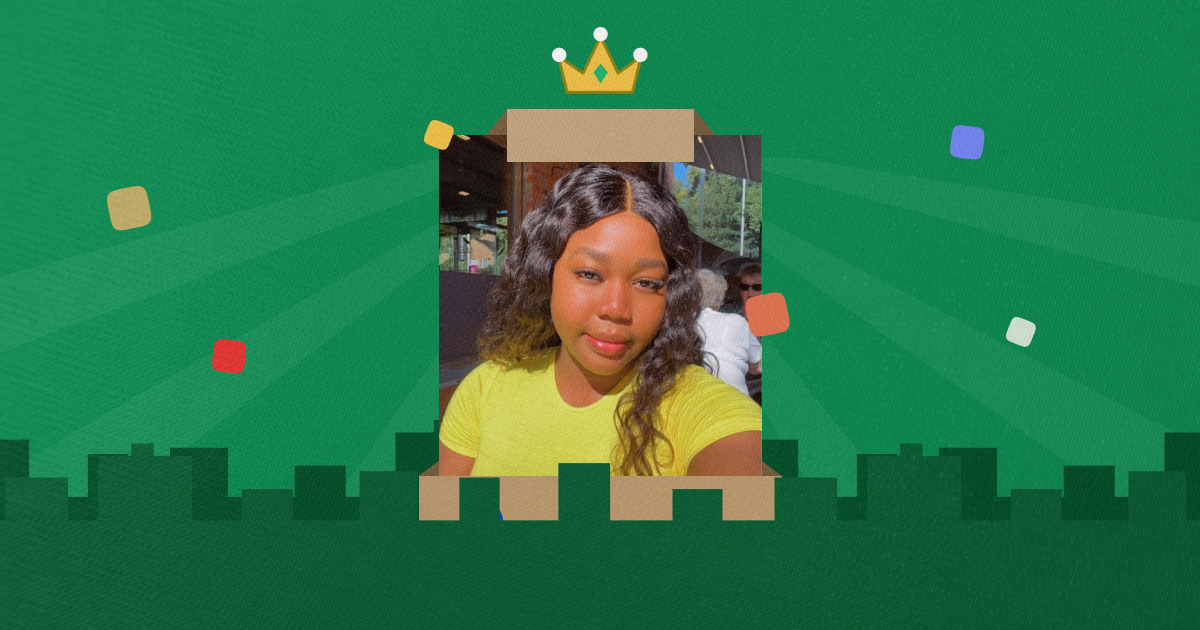
When Shalom Mathew, a Nigerian developer living in the UK, came across Lagos Run on X, she had no plans to build a game. By the time she logged off that evening, she had decided to build one.
Lagos Run, created by Nigerian developer Opeyemi Adeniran, puts players behind the wheel of a danfo, navigating familiar Lagos roads, traffic, and passengers. The game quickly attracted thousands of players, prompting a wave of Nigerian developers to experiment with games inspired by everyday life in the country.
For Mathew, however, the game triggered a more personal idea. She had grown up playing The Sims, the popular life-simulation franchise, and seeing Lagos Run brought back memories of spending hours building virtual lives.
That evening, she downloaded The Sims again and began thinking about what the game might look like if it reflected the world she knew.
“I love Sims, and that same evening I downloaded Sims and thought of creating a version where anyone can do anything,” she told Condia.
Less than 12 hours later, Lagos Life was built. The result is a multiplayer life-simulation game set in a virtual Lagos, where players can work, earn money, furnish homes, travel around the city, and interact with thousands of other players.
Building Lagos in one night
The game has now hit 2 million users, according to Mathew, after attracting more than one million users within its first three days. The speed of that growth is striking, but perhaps more interesting is what Mathew built around the game.
Lagos Life is not simply a Nigerian version of The Sims. It attempts to turn the peculiarities of everyday Lagos living into gameplay.
Players can buy gadgets and household essentials, invest in home gyms and music equipment, and navigate the city’s unreliable electricity supply by purchasing generators or solar inverters. They can move around using taxis, motorcycles, tricycles, and danfos, or simply drive themselves. There are also homes, jobs, businesses, sea plots, and a functioning political system.
In the game’s virtual Lagos, there is a governor whose tenure is nearing its end, alongside commissioners overseeing areas such as health, transport, works, and finance. There is also a senator who doubles as president, adding another layer of absurdity to an already familiar city.
This morning, I logged in as a smooth-talking nepo baby whose father paid the rent and provided a luxury SUV. My character works as a branch manager at a commercial bank owned by a friend of his father. At almost 6am, more than 23,000 people were online.
Before heading to work, I went to the gym, spending ₦300 on the treadmill and roughly ₦1,000 on a personal training session. Other players were already moving through the city.
That social element explains much of its appeal, Mathew tells Condia. People who grew up playing The Sims recognise the basic mechanics, while Nigerians recognise the world surrounding them. For Mathew, the combination was enough to make the game immediately relatable.
“I’ll say it’s the fact that I built something people love,” she says when asked about its rapid growth.
There was little conventional marketing behind that growth. Mathew had no significant advertising budget, and the game’s early distribution came largely through social media and word of mouth.
Artificial intelligence also played a significant role in getting the game from idea to launch so quickly.
Mathew, who has nearly a decade of software-development experience, used AI throughout the build and now uses AI agents to help identify bugs, fix problems and prioritise feature requests. That allowed her to compress work that might ordinarily have taken considerably longer.
Adeniran has described a similar acceleration with Lagos Run, noting that AI significantly reduced the time required to create his game.
From viral game to gaming company
For Mathew, though, building the game is only the beginning. The first few days of Lagos Life were particularly demanding. She survived largely by taking naps as she tried to keep up with the game’s rapid growth, technical problems, and player requests.
That is beginning to change. She has assembled a core team of fewer than six people, supported by a somewhat larger group working across operations, marketing, product and customer support. The additional help is allowing Mathew to step away from some of the day-to-day responsibilities and, importantly, get some sleep.
The growth has also attracted advertisers. Businesses can buy virtual billboards and other advertising placements inside Lagos Life, while musicians have begun using the game to promote new releases.
Billboard placements can start at around ₦50,000 for seven days, creating an advertising model that benefits from the game’s unusually concentrated audience.
Chowdeck, the Nigerian grocery and delivery startup, has also signed on, appearing as an app inside the game’s simulated smartphone.
That phone is more than a decorative feature. It is another layer of monetisation, with characters carrying smartphones whose home screens contain applications that can be used for advertising and other commercial opportunities.
A few hours after our conversation, she announced that Lagos Life had generated more than $46,000 in revenue.
That early traction matters because Nigeria’s gaming industry has long faced a difficult commercial equation. The country has a large population of gamers, but disposable income remains limited, making it challenging for developers to rely solely on players paying for games.
Mathew is instead testing whether a large relevant audience can support a broader business built around advertising, partnerships and virtual experiences.
So far, the audience is also proving larger than Nigeria. Although Lagos Life is built around Nigerian experiences, Mathew says players have joined from Ghana, South Africa, the UK, the US and Togo. There have also been requests to create versions based on other Nigerian cities.
That interest could give Mathew a path beyond Lagos. The game’s initial success was rooted in its specificity, one filled with details that Nigerian players immediately understood. But that same approach could potentially become a template for other cities and markets.
For now, Mathew is focused on turning what began as a spontaneous experiment into something much bigger. What started with a developer seeing another Nigerian game on X and deciding, almost impulsively, to build her own has already become a fast-growing virtual city.
Now, she wants to turn it into a proper gaming company. And if the first few days of Lagos Life are any indication, she may have found a market willing to come along for the ride.
Last updated: October 6, 2026