
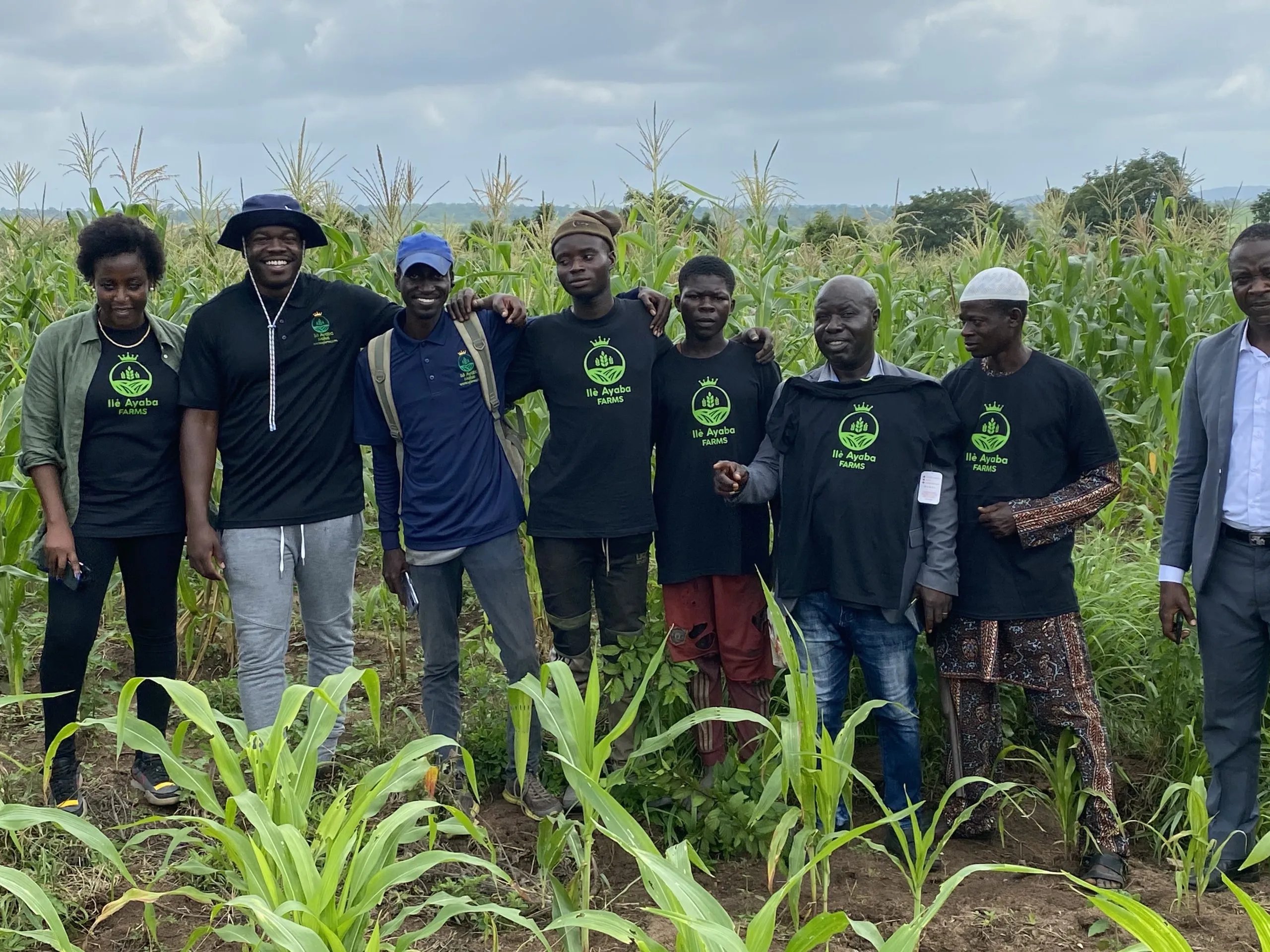
Alexander Zanders did not set out to build a fintech. In the middle of the COVID pandemic and encouraged by his then fiancée, he began cultivating 100 acres of farmland in Nigeria.
It was partly a personal project and partly in honour of his grandmother, who had gifted him the land. There, he planted cassava, maize and soybean. The first seeds for UfarmX were sown at harvest.
Neighbouring farmers working the same soil and in the same season produced far less than he did. When he sat with them to find out the reason, he discovered they could not get the seeds or fertiliser his farm could afford, and no lender would give them the capital to buy either.
The majority of Africa’s farmers are smallholders, cultivating just a few acres of land. For many, these farms produce enough to feed their families, with the surplus sold to generate income.
Expanding the scale and productivity of their operations depends in part on access to improved seeds and other essential inputs, including fertilisers and crop protection products.
The benefits of these inputs are well documented. A 2025 randomised controlled trial in northern Nigeria, for example, found that farmers using promoted improved varieties achieved 16–25% higher maize yields and about 70% higher cowpea yields than farmers using traditional varieties, with the yield gains persisting into the following season.
Yet access to these inputs is often constrained by access to finance. African farmers receive less than 3% of the continent’s commercial lending, in part because traditional financial institutions have struggled to develop scalable ways to assess the creditworthiness of smallholder farmers.
For farmers operating on just a few acres, the result is a difficult cycle: limited access to finance restricts their ability to purchase the inputs that could increase productivity, while low and unpredictable farm incomes make them harder for conventional lenders to serve.
A farm helping other farms

UfarmX started as an attempt to close that gap on one farm before it became a company built to close it across Africa. Initially, it extended inputs on credit to the farmers around it and saw the results show up rapidly.
Yields tripled and revenue doubled for most farmers. That initial pilot became the evidence UfarmX leans on today.
“We were a farm helping other farms before we were anything else,” Zanders says. “Everything we’ve built since exists because that first season proved something the banking system had never bothered to test: these farmers pay their debts when someone gives them a real chance to.”
Over the next few years, UfarmX aggregated data from farmers, which it converted into credit scores that local agro-input retailers now use to extend inventory to farmers, backed by a UfarmX guarantee on every approved loan.
Its retailer channel, which launched in June 2025, allowed the company to stop lending from its balance sheet and now has over 2,000 individual farmers scored. Approximately 2,000 credit facilities have been issued, and nearly a million dollars in credit has been deployed without requiring collateral from the farmers.
Read also: Soilless Farms Labs is building a new model for Nigerian agriculture
The model has performed impressively on the field: 5.86% of UfarmX’s loan book has gone into default. After the company’s insurance partner absorbs its share of that defaulted value, the net rate lands at 1.17%.
Even accounting for the company’s early days, when it was still training its data models, its default rate has remained below 10%, at 9.03%.
“The gross number is the honest test of our scoring, and it already outperforms what institutions in our markets assume smallholder lending has to look like,” Zanders said.
Since inception, nearly $7 million in transactions has moved through the company’s rails. This includes inputs financed through its direct-lending seasons, inputs extended on credit through its current retail network, and the farmer sales those inputs have generated.
Today, UfarmX does not lend directly to farmers. Instead, it provides the infrastructure and credit-scoring tools that enable its partners to extend credit to farmers using its data and scoring models to assess their ability to repay.
The inventory belongs to the retailers at every stage. UfarmX’s role sits underneath the transaction rather than inside it, scoring the farmer, guaranteeing the credit, and backing the arrangement with insurance.
That structure is also what answers the harder question: who actually loses money when a farmer cannot pay?
The retailer never does, Zanders shares. An insurance partner covers 80% of any defaulted value, UfarmX absorbs the remaining 20%, and the company’s team pursues recovery on the ground rather than writing the loss off immediately.
The premium that funds that coverage comes out of the transaction itself, paid by retailers and farmers at the point the credit is drawn down and disclosed in the term sheet rather than later.
What that leaves UfarmX carrying is a capped, uninsured sliver of risk on every loan in the system.
Looking to the future
The next phase of the business involves turning its infrastructure into something other institutions can plug into directly.
A credit scoring API is due by the end of the year, intended to let banks and financial institutions run agricultural loan applications against UfarmX’s data. For that, the company points to Equifax and Experian as models.
Two licensed microfinance institutions are already using the underwriting engine manually, running portfolio analytics against their own agricultural loan books in Nigeria ahead of the API automating that process.
“The pattern in every conversation is the same: institutions want to see the engine prove itself on their own book first, and that is exactly the door the API opens.”
UfarmX is also in early conversations with commercial banks and development finance institutions. A Q4 expansion into Kenya, UfarmX’s first move into East Africa, is planned alongside the launch.
Zanders has carried the underlying argument well beyond Nigeria, into rooms from Davos to Oxford and into recognition that includes the Black Ambition Grand Prize, the programme founded by Pharrell Williams to back under-represented entrepreneurs.
In every room, the pitch remains the same. “The world is going to need this land to work,” he says. “The US is losing farmland every year, Europe is shrinking, and Asia is maxed out. Africa holds the majority of the world’s remaining uncultivated arable land.”
“The question is whether the financial infrastructure catches up in time. We didn’t come to this problem through a spreadsheet. We came to it through the soil, and that’s why our data works.”