

The International Monetary Fund (IMF) has highlighted the surging use of stablecoins in Nigeria as a means of exchange, noting the positives while raising concerns about the development.
The IMF, through its Mission Chief in Nigeria, Axel Schimmelpfennig, noted that stablecoins are rapidly filling gaps left by traditional finance as money moves across borders via smartphones and digital wallets. This is happening at an unprecedented scale. It addresses long-standing issues with cross-border transactions while testing the limits of Nigeria’s financial regulatory frameworks.
The Numbers
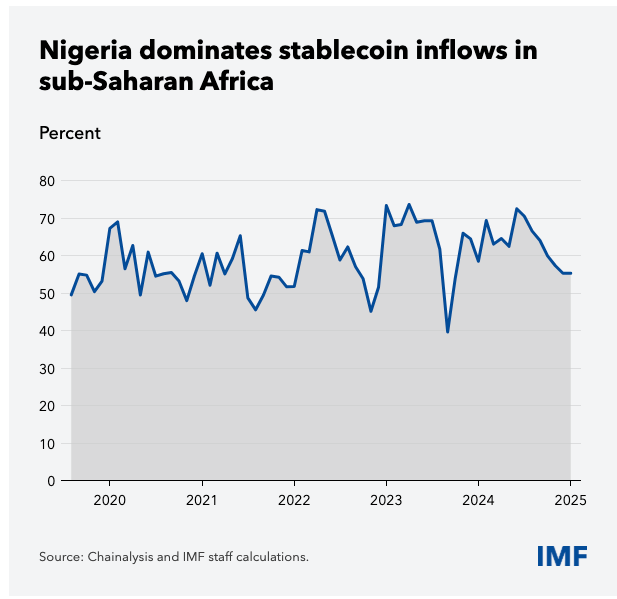
According to the IMF, Nigeria leads sub-Saharan Africa in stablecoin flows, aligning with Chainalysis’s earlier reports. The numbers are quite staggering for a population in which 26% remain unbanked.
- Between July 2023 and June 2024, Nigeria received about $59 billion in crypto-asset inflows, ranking second globally on Chainalysis’s 2024 Global Crypto Adoption Index, and sixth in 2025.
- Nigeria has topped stablecoin inflows in sub-Saharan Africa since 2019, accounting for roughly 60 percent of the region’s stablecoin inflows.
- Stablecoins are increasingly bridging the world of crypto and traditional finance in Nigeria, according to the IMF’s latest annual economic health check report
Stablecoins are gaining a foothold in Nigeria for a couple of reasons. First, a stablecoin is usually pegged to the value of an asset, most often fiat money. Dollar-backed stablecoins like Tether USDT and Circle’s USDC are quite common in Nigeria. For a country with a weak local currency, stablecoins serve as a hedge against inflation, allowing users to save and receive money in dollars.
Aside from the FX value, moving money in stablecoins is a lot faster and cheaper compared to traditional methods, a no-brainer for any tech-savvy person. For instance, the World Bank reports that the average cost of sending $200 to sub-Saharan Africa via conventional channels is about 9%. This is a different scenario on Binance, where you can move the same amount of money for less than $2 or for free in some cases.
Finally, stablecoins bypass the long arms of Nigeria’s regulatory bodies, a bonus for fast-moving transactions, but a grooming ground for all sorts of illicit activities.
In Nigeria, stablecoins are widely used by the country’s youthful demographic, who work as freelancers and receive payments from foreign firms. Stablecoins are also being introduced to new industries, such as retail, through innovative crypto platforms.
The Downsides of Nigeria’s Surging Appetite for Stablecoins
The IMF is well aware of the benefits of deeper integration of stablecoins into Nigeria’s financial ecosystem. Fast cross-border transactions, Inflation hedge, cheaper transactions, etc. However, there is concern that the development will entail trade-offs that the country’s financial structure is not yet mature enough to handle.
First, Most stablecoins are dollar-pegged. An increased use of such stablecoins can lead to what the IMF described as the ” Dollarisation effect”. The increased use and demand for stablecoins will reduce demand for Nigeria’s local currency, leading to weaker transmission of domestic monetary policy.
Secondly, Stablecoins are part of the decentralised financial ecosystem, which is built on the premise of bypassing centralised and traditional financial systems. This means that the bulk of stablecoin-powered transactions happen under the radar, bypassing Nigeria’s regulatory frameworks.
This is a breeding ground for illicit activities like money laundering, terrorism financing, and high-level corruption. The autonomy of decentralised crypto platforms was put to the test in the Nigeria-Binance saga, in which a Binance staff member was detained in Nigeria for up to 7 months.
Tracking transactions with stablecoins can be tricky for Nigeria’s regulatory bodies. This is a huge concern for a country with deep corruption issues like Nigeria.
The IMF suggests a Balanced Approach
Stablecoin use in Nigeria comes with many benefits despite the concerns raised. So instead of an outright crackdown by the Nigerian state, the IMF proposes a balanced approach that encourages innovation while managing risks.
Restore Confidence in the Naira
To stem the threat of dollarisation, Nigeria’s financial regulators and policymakers must work together to ensure that effective macroeconomic reforms and tighter monetary policy help restore confidence in the naira. The IMF thinks this is already in effect and should be sustained.
Reinforce Oversight
Nigeria’s regulatory bodies, such as the Securities and Exchange Commission, can strengthen their oversight. They can update their framework for virtual asset providers, while the CBN guides VASPs on their interactions with banks. There is also a need to engage with stablecoin issuers and align them with international frameworks and standards.
Data
Nigeria’s regulatory body could use a deeper understanding of how stablecoins work. Leveraging Blockchain analysis and other proprietary studies could be very helpful. It can help regulators to understand Naira–stablecoin conversions, enabling early risk identification and more effective responses.
Fix gaps with great payment infrastructure
The demand for stablecoins is driven by gaps in traditional financial systems. The Nigerian state has taken steps toward a better payment infrastructure. Initiatives like the Pan-African Payment and Settlement System are good examples of emerging infrastructure that supports payments in Nigeria.
More state-backed platforms with better features will reduce the reliance on stablecoins. Despite the surge in stablecoin users in Nigeria, there are still downsides. Nigerians will opt for a more transparent, regulated, and safer means of cross-border payments if it presents itself.
Last updated: June 16, 2026