


Africa’s cross-border payment problem is often described in the language of the platforms trying to solve it.
But for the businesses moving money across borders, the problem looks different. It looks like a container waiting at a port because a supplier has not received payment. It looks like an auction deadline approaching while a transfer is still processing. It looks like a business absorbing late-payment fees because money did not arrive when expected.
The payment is rarely the objective. The business outcome is.
That distinction is at the centre of how Oneremit, a cross-border payments platform built for African businesses, approaches the problem.
The infrastructure problem businesses experience
Cross-border payments in Africa remain among the most expensive in the world. According to the World Bank, sending money to Sub-Saharan Africa costs 7.9% on average — nearly double the global average and more than twice the United Nations Sustainable Development Goal target of 3%.
Read Also: OPay named digital bank and financial inclusion leader at BAFI 2026
For businesses paying suppliers, contractors, and partners abroad, the picture is often worse, with the costs extending beyond the headline fee.
International bank transfers can take several business days to settle. FX spreads can be embedded in quoted rates. Payments can encounter delays as they move through correspondent banking networks before reaching their destination.
The consequences are commercial, not merely financial.
For an importer paying a supplier in Guangzhou, a delayed transfer can mean a container held at port. For a car dealer clearing an auction, it can mean losing the bid to a buyer whose payment arrived first. For a parent paying tuition abroad, it can mean a placement forfeited.
Hammed Adewumi Afenifere, CEO and Co-Founder of Spark Tech Hub, the parent company of Oneremit, believes that gap — between how the sector describes the problem and how businesses experience it — is why the problem remains structural rather than solved.
“Most cross-border payment companies introduce themselves by describing their platform,” Afenifere says. “But nobody moving money across borders wakes up thinking about platforms. They wake up thinking about the container waiting at the port, the supplier who won’t pick up, the deadline that won’t change. The industry has been trying to solve the wrong problem for a long time.”
The challenge is no longer whether African businesses can participate in global commerce. It is whether the financial infrastructure around them can move at the same speed.
Building around the business outcome
For Oneremit, the starting point is not the transfer itself.
The company is built around a simple observation: businesses do not move money because they want to make a payment. They move money because something else needs to happen.
That changes what payment infrastructure needs to optimise for. Speed matters, but only because time matters to the underlying business. Rate transparency matters because the amount a business ultimately pays affects whether a transaction remains commercially viable. Reliability matters because a failed transfer can create consequences far beyond the payment itself.
Oneremit has built its infrastructure around these realities, with the aim of making international payments less of an operational variable for businesses operating from Africa.
“We’re not building payment infrastructure,” Afenifere says. “We’re building for the moment when a business either does or doesn’t get to move forward. The payment is one part of that. The infrastructure has to hold up around it.”
A different way to measure the money
Oneremit says it has deliberately chosen to count its payment volume conservatively. The company has processed $150 million+ since its inception in April 2025, counting only outbound payments from Africa, rather than combining inbound and outbound volumes to produce a larger headline number.
“Most companies in this space count both directions — money moving in and money moving out — to make the numbers look bigger,” Afenifere says. “We only count what we have sent out of Africa. It’s a smaller way of describing what we’ve done. But it’s the honest way.”
The distinction reflects a broader approach to measurement: prioritizing what a customer can verify over what looks impressive in a presentation.
Oneremit also points to 99% uptime across its live payment corridors, settlement in minutes rather than business days, and mid-market FX rates shown alongside transactions before confirmation.
The company operates across 100+ countries, including market in Europe, the UK, Canada, Turkey, Hong Kong, China, South Africa and other African markets, with licensing and regulatory coverage across its operating jurisdictions.
For Afenifere, the metrics are useful because they describe what the infrastructure delivers rather than simply its theoretical capabilities.
The Executive Roundtable
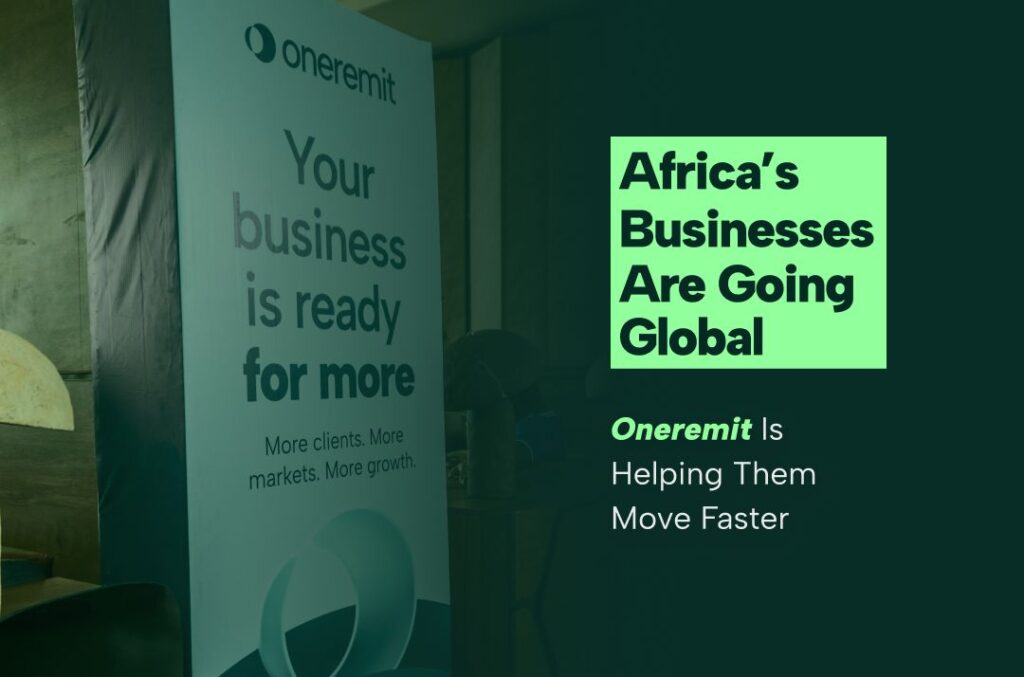
On Thursday, August 6, Oneremit brought together forty of Nigeria’s consequential finance leaders in Lagos for an invitation-only Executive Roundtable about what cross-border payments cost Nigerian businesses.
Bayo Adedeji, Group Chief Executive Officer of WakaNow, and Omotunde Bajo, Group Chief Financial Officer of Wakanow Group, joined the conversation alongside other senior CFOs, finance directors, treasury leads, and heads of operations.
The event was designed to examine the practical realities of cross-border payments from the perspective of the businesses using them: where friction occurs, what the financial consequences look like, and what needs to change as African businesses become more global.
Much of what was discussed will remain in the room. But several experiences illustrated why payment infrastructure matters at an operational level.
One car dealer described a customer making an international payment through Oneremit while still at his office. The funds arrived within minutes, before the customer had reached their destination.
Another business had switched providers after repeated payment delays began generating lateness fees. A third said they had never encountered a problem fulfilling large-value orders through Oneremit, regardless of the amount.
The examples are different, but they point to the same requirement: businesses need payment infrastructure they can rely on and build business decisions around.
“The room made something clear that’s easy to lose sight of when you’re running infrastructure,” Afenifere says. “These aren’t company-specific problems. Every business in that room had a version of the same story. Different industries, different scales, same feeling.”
Building for the businesses using it
For Oneremit, responding to these problems has meant making deliberate product and operational decisions.
The platform shows the mid-market rate alongside quoted rates before confirmation, giving customers visibility into the economics of a transaction before they commit. Its infrastructure is designed to settle payments in minutes rather than days, while payment routes are monitored for reliability.
Oneremit also maintains a human-support model alongside its platform, with direct escalation paths for enterprise customers. Its licensing and regulatory coverage across operating markets is treated as foundational to the business.
“Compliance is how you build for the long term,” Afenifere says.
The approach reflects a broader principle: the infrastructure should absorb complexity, so the business does not have to.
The next phase of African commerce
African businesses are already global. They source from international suppliers, sell into foreign markets, pay overseas partners, participate in global supply chains and increasingly operate across multiple jurisdictions.
The payment infrastructure supporting those activities needs to reflect that reality. That does not mean eliminating every complexity in cross-border finance. It means ensuring that the complexity of the infrastructure does not become the complexity of running the business.
The Executive Roundtable is one part of a broader conversation Oneremit is convening with the businesses and finance leaders who depend on cross-border payments.
The opportunity extends beyond any one company. As African businesses become more connected to global commerce, the quality of the financial infrastructure supporting those connections will increasingly determine how easily they can compete.
“Cross-border payments in Africa work when the businesses using the infrastructure are at the centre of how it’s built,” Afenifere says. “Thursday’s conversation brought together people who’ve been waiting for that to be true. The work over the next few years is making sure it becomes true — one story, one corridor, one honest number at a time.”
African businesses have crossed the border. Oneremit’s infrastructure helps them cross even more borders.
Last updated: August 11, 2026