

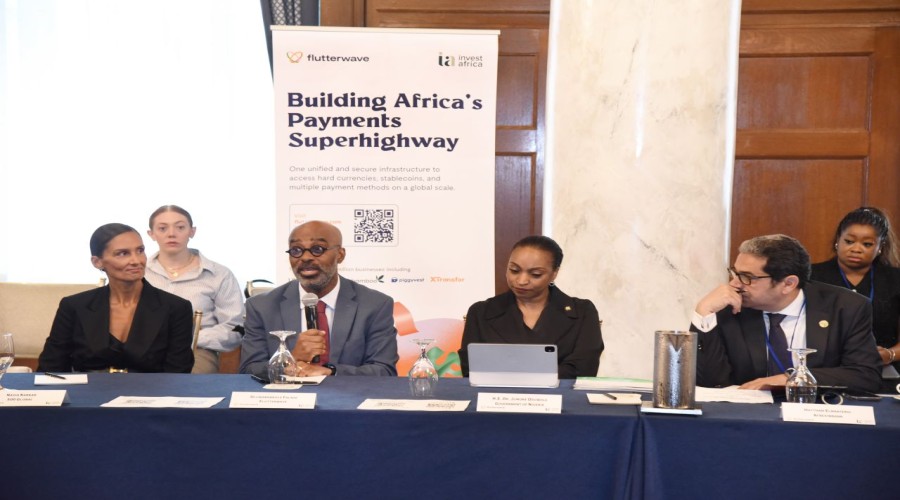
Flutterwave convened a private roundtable with Invest Africa on April 14, bringing together policymakers, investors, and development finance institutions to examine investment and infrastructure gaps in Africa’s digital economy.
The session took place on the sidelines of the IMF–World Bank Spring Meetings in Washington, D.C., an annual gathering that shapes global economic policy and influences capital flows into emerging markets.
The meeting drew senior stakeholders from finance and policy, including Nigeria’s Minister of Industry, Trade and Investment, Dr. Jumoke Oduwole, as well as executives from Afreximbank, Bank of America, Citibank, and Chapel Hill Denham. Their presence reflects the growing intersection between public policy, global capital, and Africa’s technology sector, particularly as governments seek to position digital infrastructure as a driver of economic growth.
Flutterwave’s leadership framed the discussion around three priorities: scaling cross-border payment infrastructure, improving regulatory alignment, and unlocking investment capital. These themes mirror persistent constraints in Africa’s fintech ecosystem, where fragmented payment systems, currency volatility, and regulatory differences continue to limit seamless transactions across markets.
Founded in 2016, Flutterwave has built a payment infrastructure that enables businesses to accept and process payments across multiple African countries and currencies. The company, last valued at over $3 billion following its 2022 funding round, has since expanded its enterprise and remittance offerings while navigating increased regulatory scrutiny in some markets, including Kenya and Nigeria. It recently secured a national microfinance banking license in Nigeria.
At the roundtable, company executives emphasised the need for interoperable systems that connect African markets internally and to global financial networks. One proposal discussed was “regulatory passporting,” a model that could allow fintech companies licensed in one African jurisdiction to operate more easily across others. While similar frameworks exist in regions like the European Union, regulatory fragmentation remains a major barrier to scale on the continent.
The timing of the discussion is significant. The IMF–World Bank Spring Meetings serve as a platform where finance ministers, central banks, and development institutions set priorities that shape lending, reforms, and investment flows into developing economies. For African countries, outcomes from these meetings often influence fiscal policy, debt restructuring, and infrastructure financing.
Africa’s digital economy is projected to reach $1.5 trillion by 2030, according to the World Bank Group. However, scaling remains uneven. Cross-border payments in Africa are among the most expensive globally, averaging about 8–10% per transaction. This creates friction for businesses operating across multiple markets.
Investment trends also reflect a more cautious environment. After a record year in 2021, when African startups raised over $5 billion, funding has slowed significantly. According to reports by Briter Bridges, total startup funding on the continent fell by more than 30% in 2023 and remained subdued into 2025, with investors prioritising profitability and operational efficiency over rapid expansion. Fintech, which has historically attracted the largest share of funding, continues to lead but is facing increased scrutiny around business models and regulatory compliance.
Participants at the roundtable, including representatives from institutions such as the U.S. International Development Finance Corporation, British International Investment, and the Nigerian Sovereign Investment Authority, highlighted the role of blended finance and policy reform in de-risking investments. Development finance institutions, in particular, are central to crowding in private capital by providing guarantees, co-investments, and long-term funding for infrastructure.
The discussion also reflected a broader shift in investor sentiment. Rather than prioritising growth narratives, investors are increasingly focused on execution, governance, and the ability of companies to scale sustainably across multiple markets. For fintech firms like Flutterwave, this means demonstrating resilience in complex regulatory environments while building infrastructure that can support trade, remittances, and digital commerce at scale.
As African governments push for deeper regional integration under frameworks like the African Continental Free Trade Area (AfCFTA), payment interoperability and regulatory coordination are likely to remain central to unlocking the next phase of growth in the continent’s digital economy.
Last updated: April 16, 2026