
Fintech has always been the dominant force in Africa’s tech ecosystem, and every builder on the continent was either building a payment solution or something similar.
As the saying goes, “follow the money.” African builders latched onto Fintech because it was worth the funding provided by the big investors at the time. Then there was also the “Paystack Effect.” Paystack‘s success as a payment solution, raising $9.3 million within its first three years of existence, and ultimately being acquired by Stripe for $200 million.
The Paystack story was a major motivation for builders in Africa who felt they could replicate Shola Akinlade and Ezra Olubi’s success. From 2020, when Paystack was acquired, to the first half of 2024, Nigeria had more than 430 fintech companies, accounting for 28% of all African fintech companies and capturing roughly 36% of fintech funding across Africa.
From an investor perspective, Fintech was the only African tech sector worth the big bucks. Global investors such as Sequoia Capital, Tencent, and Tiger Global invested in this sector with varying levels of conviction.
Today, there has been a slight pullback in Fintech funding from this investor class, and other tech sectors in Africa are being looked at by investors.
Fintech’s funding monopoly is shrinking in Africa
A recent report by Condia revealed that Fintech lost 14% of its share of the funding market in Africa from 2023 to 2025. Fintech’s hold in the African funding market has been eroded by the rise of three existing tech sectors in the space, which are getting a new lease of life in investor funding.
Per the report, Cleantech, Healthtech, and Mobility all exceeded the $100 million mark in equity funding, a territory previously dominated by Fintech. The funding rounds in these sectors include
- CleanTech’s $308 million in Equity Funding: SolarSaver ($60M equity from Inspired Evolution, FMO, and Swedfund), Wetility ($27.8M from Jaltech), Arnergy ($15M Series B in Nigeria), and Plentify South Africa, Series A).
- HealthTech’s $149 million: This was dominated by a single transaction, hearX’s $100M merger funding in South Africa.
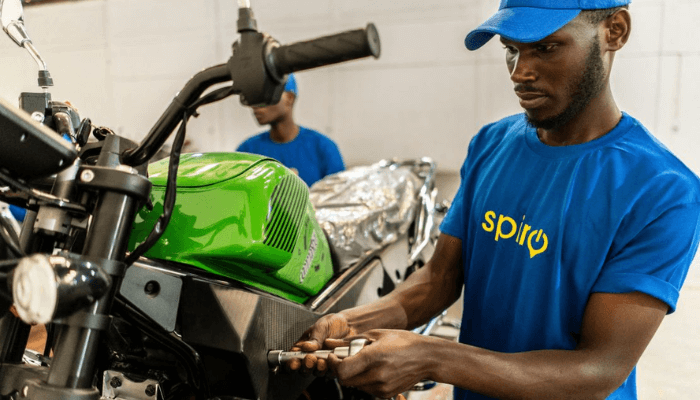
- Mobility’s $146 million: Funding in this sector was anchored by Spiro’s $100M Pan-African equity round for its electric motorcycle business. Smaller deals, such as Gozem’s $30M Series B in Togo and Ampersand in Rwanda, also played a role.
The three sectors of Cleantech, Healthtech, and Mobility commanded 20%, 10%, and 9% of African investor funding in 2025, cutting into Fintech’s dominance, which recorded just 34% of the 2025 share.
The three sectors highlight some form of investor fatigue in Fintech, prompting investors to look at other sectors. Mobility is already big in Nigeria, where many local mobility brands are trying to break into the highly lucrative transportation market.
Cleantech and Healthtech are not so pronounced on the continent and are new entries. The major deal in Healthtech occurred in South Africa, the largest economy in Africa.
Despite the above statistics, Fintech is still a dominant force on the continent, especially in Nigeria, where about 40 million citizens remain unbanked. Nigeria has two fintech unicorns in Moniepoint and Flutterwave.
Their success suggests that global and African venture capitalists will remain keen on fintech in Nigeria, at least, regardless of what the VC market looks like in other African markets.
People in this article

Last updated: May 26, 2026