

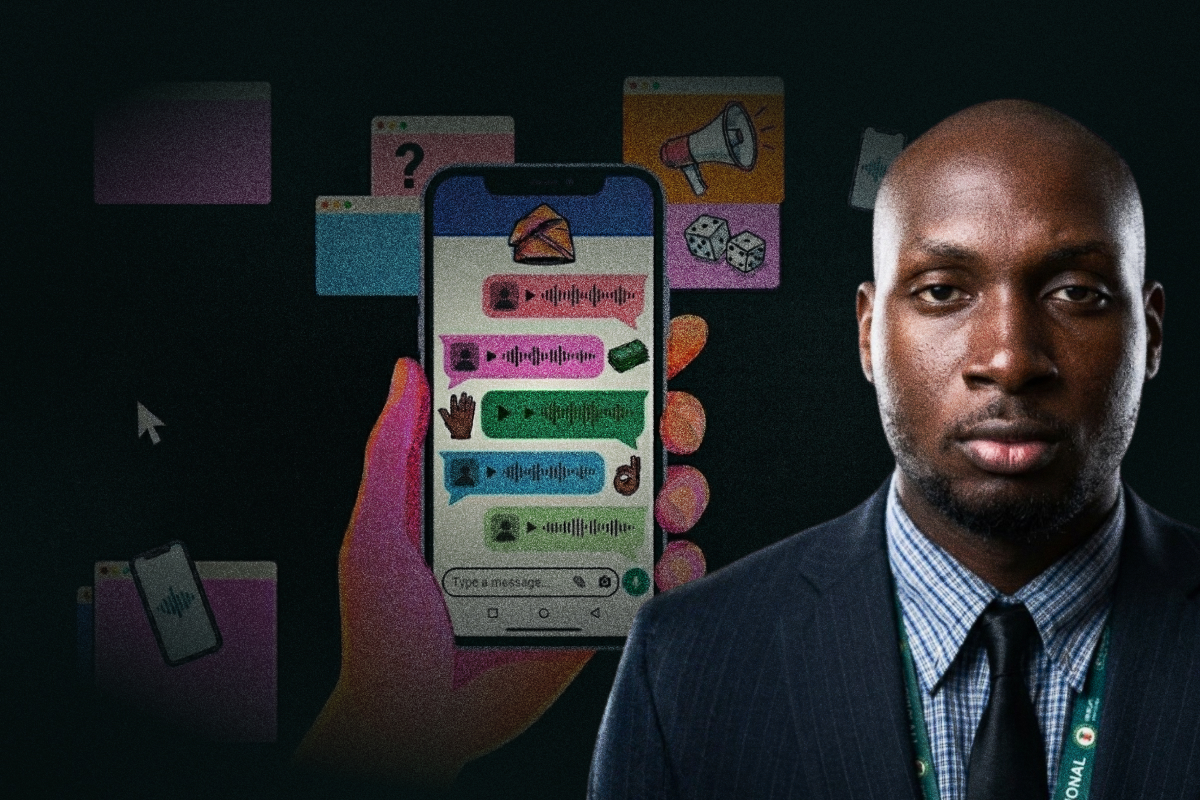
You know the clip that summarises everything you’re thinking when a friend is spiralling in the group chat. In February, it was ‘Yakubu Manage’—a few syllables from a viral video that became the universal response to half of Nigerian X. You hear it in your head and want to send it. Still, there is no clean way to move it into the chat. Instead, you screen-record your phone, find the original TikTok, and trim an imperfect file. By the time you hit send, the moment has passed.
It is strange that in 2026, we can surface a GIF for every niche emotion in seconds, yet viral audio remains stuck in a manual era. These sounds drive the conversation, but they live nowhere you can actually search for, grab, or share.
That’s the gap Omu Inetimi, an electrical engineering student at the University of Port Harcourt, is trying to close, and he now has ₦50 million ($37,000) in equity-free government funding to do it.
His product is called Bicker, stylised as BickQR, named after the word “bicker,” meaning to move with a rapid, repeating sound. The name was chosen deliberately to mirror how GIFs loop, but for audio. It exists to make finding and sharing a short sound clip as frictionless as dropping a GIF (Graphics Interchange Format) into chat.
What BickQR is
BickQR functions as an audio meme library. It is a searchable repository of sound clips, capped at 12 seconds, designed for the specific speed of a group chat. The platform allows users to find, create, and drop those cultural beats directly into a conversation without leaving the app.
The mechanics involve pasting a link from TikTok, Instagram, or YouTube, selecting the slice of audio you want (the platform caps clips at 12 seconds, though most are closer to two or four), and that clip gets extracted and added to BickQR’s growing library. Any user can then search for it and share it either through the app or via a share sheet that drops it into WhatsApp, Instagram, or Telegram.
“There are times in a chat where I would want to respond with an audio I’d heard from social media,” Inetimi says, “but there’s no place I can go and search for that audio, or no simple tool I can use to create it quickly and send it.”
The unit of content here isn’t a podcast excerpt or a content creator soundbite. It’s a Bick — a short, searchable audio clip, the audio equivalent of what a GIF does visually. Short, expressive, and built to be repeated.
Read: Only 2 of the 32 identified S-VCG startups granted ₦50 million were led by women
The market BickQR is chasing
The playbook for BickQR is already well-documented. Giphy and Tenor built their businesses by hosting searchable libraries and distributing them through APIs embedded directly into messaging apps. Giphy’s eventual $400 million sale to Meta and Tenor’s acquisition by Google provide the roadmap Inetimi intends to follow.
“We want to eventually get to a point where every social platform allows you to send a Bick directly within their system,” he says, “just like we have GIF integrations now.”
But the existing tools for audio are a far cry from the seamless experience of a GIF keyboard. Most current soundboard sites are interface-poor and built for power users who already have audio files in hand. They require the user to do the heavy lifting of sourcing and uploading. BickQR’s approach simplifies the full journey, allowing users to pull audio directly from a video link rather than requiring them to hunt for a file.
While competitors like Voicy do offer similar functions, Inetimi believes they lack the cultural nuance that Nigerian meme culture requires. A platform built for a global audience will rarely prioritise a reference like “Yakubu Manage” with the speed it deserves. By the time a global site catalogues a local trend, the conversation has moved on. Building for the specific way local trends move through Nigerian messaging is the intended moat.
Building an audio keyboard
Inetimi applied to the Federal Government’s Student Venture Capital Grant (S-VCG) programme with three different ideas. BickQR was not the one he expected to win.
“I felt the other two ideas were more useful, more worthy,” he says. “I thought they made a mistake at first.”
That assumption was corrected by one of the program’s 12 judges, who told him that BickQR’s uniqueness was exactly why it was selected. Out of more than 30,000 applications from 404 institutions, it was one of only 45 ventures to receive the award. The funding is milestone-based, released in tranches as the venture hits defined targets. “A moving man will surely find his luck,” Inetimi says of the unexpected win.
The immediate priority is completing the product and starting the marketing push. The most critical item on the roadmap is a custom audio keyboard that allows users to search for and paste “Bicks”—short, viral audio clips designed for messaging—directly into a chat without switching apps. It is a play to replicate the behaviour that GIF keyboards have already normalised.
Once the keyboard is functional, API integrations with WhatsApp, Telegram, and Instagram are expected to follow, placing viral audio exactly where the conversation is already happening.
The path to one million
BickQR’s monetisation approach mirrors the path taken by GIF platforms: a free tier for general access paired with a paid tier for premium features like keyboard personalisation and advanced editing tools. At a $1 monthly price point, the business case relies entirely on volume. Converting 5% of a 100,000-user base generates roughly $5,000 in monthly recurring revenue. Scaling to one million users over three years moves that figure closer to $50,000. While the product has no revenue yet, the growth mechanism is embedded in the experience. Every person who receives a Bick in a chat is a potential new user. Naturally, their first question is where it came from.
“The users become the marketers,” Inetimi says.
The harder truth, which GIF platforms learned at a high cost, is that audio memes are difficult to monetise before reaching serious scale. Giphy operated for years without a sustainable ad business before its acquisition. BickQR is betting that cultural ubiquity must precede commercial returns. The Nigerian internet exports audio culture faster than any existing infrastructure can capture it, which makes it the logical place to build this kind of foundation.
The three-year target is one million users and a position as the default audio meme repository in Nigeria and eventually beyond. Regarding a potential exit, Inetimi points to Snapchat as the most culturally aligned acquirer.
Nigerian internet culture travels through sound. If BickQR becomes the place where those sounds are stored, tagged, and distributed, it stops being just an app. It becomes a cultural archive with a distribution layer on top. Whether that represents an opportunity or a persistent problem depends entirely on how quickly the habit forms.