

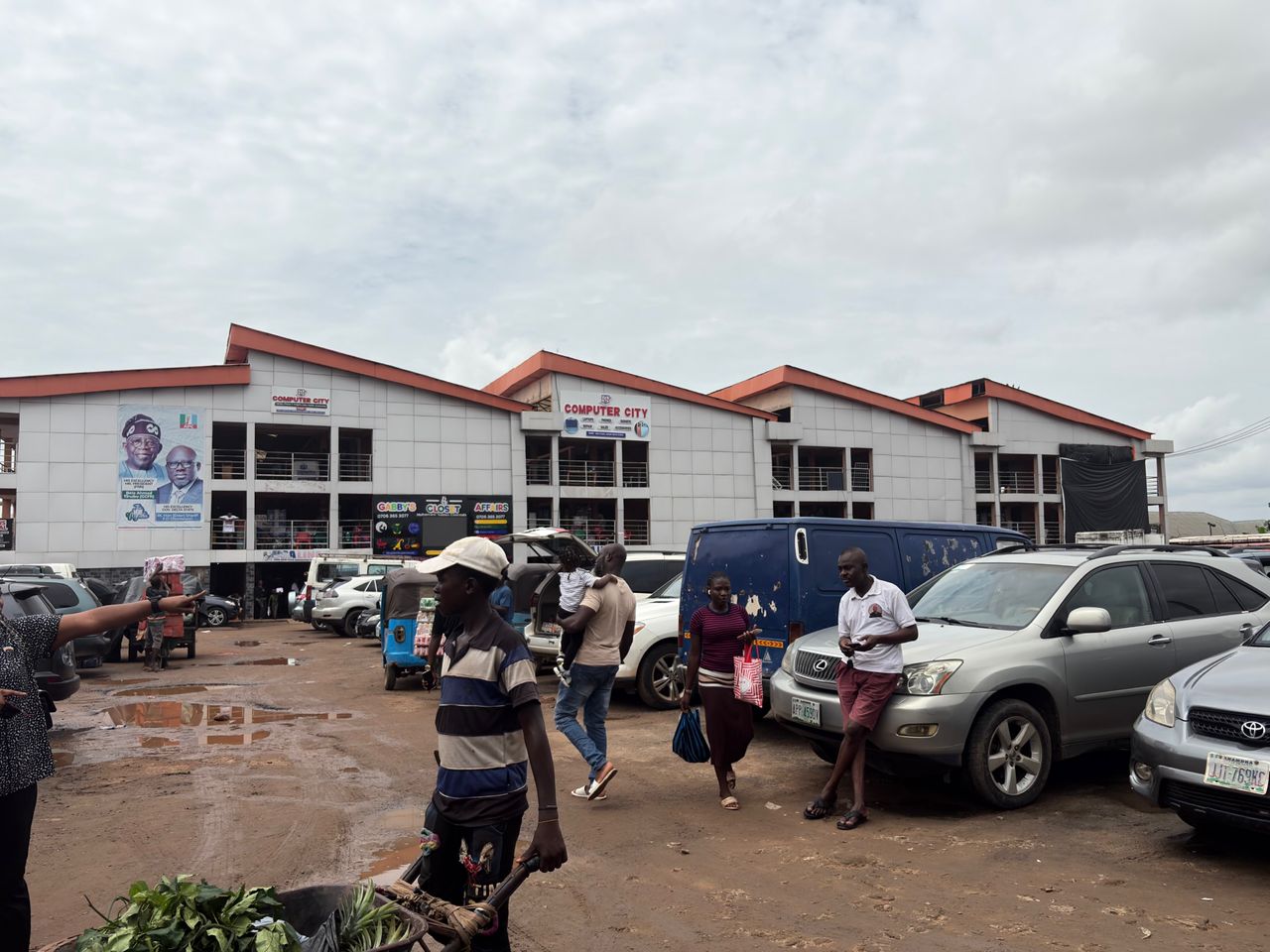
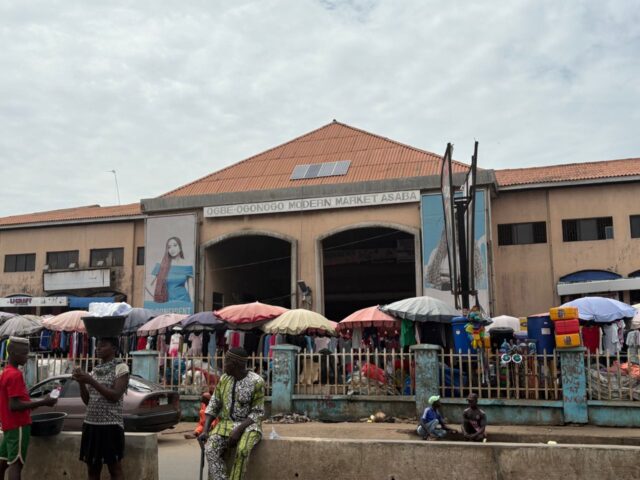
Daily, hundreds of customers troop into the famous Asaba Computer Village in the Ogbe-ogonogo market of Delta State’s capital city to buy and sell gold, exchange dollars, and, mainly, repair a faulty device.
When approaching the area, young boys would try to persuade you to buy a used phone or one of the aforementioned items. On a hot Wednesday afternoon, Anene Chinedu was seated on a bench, an earpiece connected to a Tecno Pop 5, placed on a higher plank attached to a wall that served as a table. At first glance, it looked like he was watching a movie, but on closer inspection, it turned out to be a YouTube tutorial on fixing a customer’s phone.
The Asaba phone repair market spans at least 150 stalls across the main market and its surrounding clusters. Nigeria’s electronic equipment repair market was valued at $785 million in 2024 and is projected to reach $1.12 billion by 2030.
Like most others in the market, his master’s stall was a small, cluttered space with a long workbench to sit on and a plank attached to the wall that served as a table. The space is only wide enough for one person to pass through at a time.
Like Chinedu, many other technicians were busy working on gadgets ranging from Androids to iPhones and even touchlights, beckoning to passersby who seemed like potential customers.
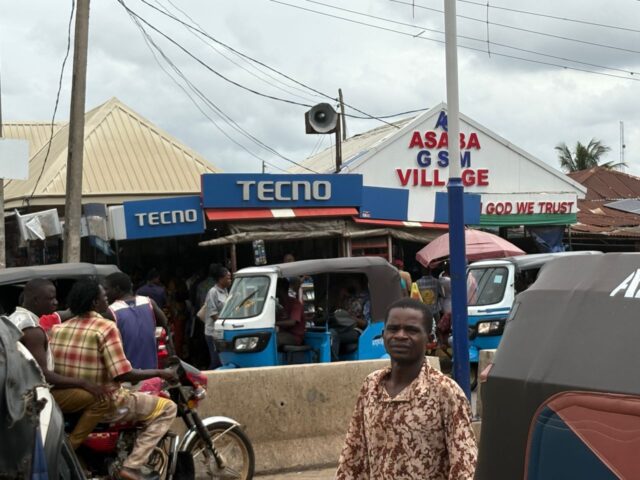
The early days of the market in Asaba
His neighbour, Obi Uche, on the other hand, was a veteran with over 33 years in the business. He remembers when the entire first cluster here had fewer than 10 people. “When I first started, we worked on Motorola, SAGEM, touchlight phones, flip-up phones, and Nokia 3310s. Now it’s mostly Android and iPhone screens,” he says, scanning the row of stalls that now surrounds him.
On a good day, then, he was taking home between ₦70,000 and ₦100,000. That was even before Kowen Plaza, a popular plaza known for phone and gadget purchases, opened farther into town along Okpanam Road.
Now, his WhatsApp union group has about 60 members in his cluster alone, he told Condia. The wider market across all its nodes — the row of shops opposite the market mall, the mall’s right wing, the open-air technicians working directly below it, and the newer Computer Village building nearby, mostly empty, used as a warehouse for other businesses runs well over 200 technicians. The daily take-home has dropped to around ₦20,000 on a good day. “I trained about 15 apprentices,” he says. “Some are here. Some have gone elsewhere.”
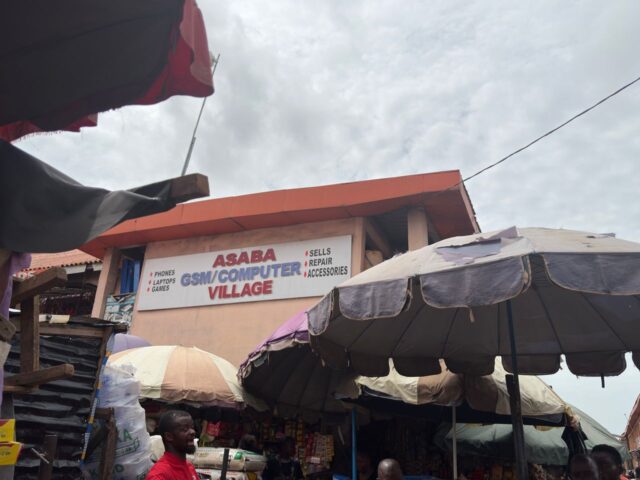
This is how informal economies reproduce themselves and also how they compress their own margins. The most expensive job Uche has ever done was an iPhone 15 screen replacement, which cost ₦1.1 million in 2026. The value shows that the stakes in the market are high: “If you crack a screen during a repair, it’s your loss,” he says flatly. “You pay for it from your own pocket and move on.”
He also tried to move on from the job when it got crowded to a fishing business, but couldn’t because of a lack of capital. He is still here in the first cluster he ever worked from.
Learning the trade on YouTube
Uche said that in his time, you needed patience to learn the job because you had to fix the parts, but now it doesn’t take as long. You just buy a new part and replace it. This is a sharp contrast with Chinedu learning via YouTube.
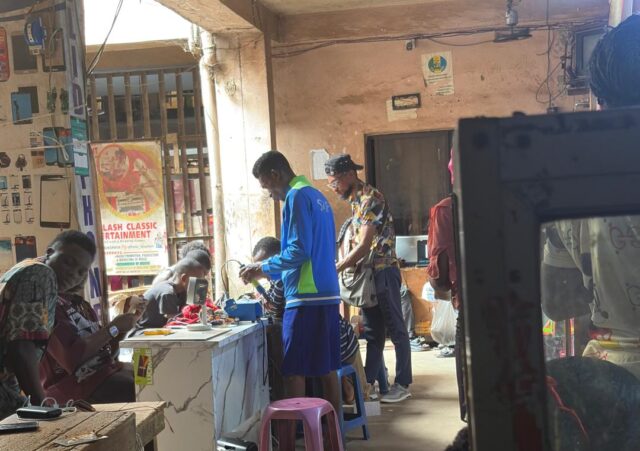
He had only been an apprentice for 3 months, but he claims to take home ₦13,000 on a very good day. On a very bad one, ₦3,000. He chose this because, according to him, “In this work, customers come to you,” he says, pulling the earpiece out briefly. “In most other jobs, you go looking for customers. When you are done with your apprenticeship, and you open your own stall, people will find you.”
The hardest phone to fix, in his view, is an iPhone. “iPhone has a lot of flex-thin, bendable wires that connect internal hardware components (like the display, battery, camera, and charging port) to the main motherboard,” he says.
He plans to open a phone accessories shop. “What I need to get there is a laptop for software upgrades and better tools,” he says. “If I have those, I can do more.”
How the market gets customers
The market here focuses on phone repairs and is a thriving business because it’s near several day-to-day activities. A constantly busy road in between, connecting blue- and white-coloured buses coming from Onitsha and leaving for Ibusa, and, in the opposite direction, a central market population of traders, with several others coming from neighboring towns such as Ogwashi, Ibusa, and Iselle-Asagba.
Ms Oge, a customer who came to have the screen of her Redmi phone repaired, says she has been a regular for 10 years. Repairs usually cost between ₦1,500 and ₦ 15,000 and take under 10 minutes. When asked why she repairs instead of replacing, her answer points to the economy: “Buying new will cost me ₦150,000 to ₦200,000. It’s cheaper to repair it. “
That calculation is the entire foundation of this economy. The naira fell by over 60% between January and September 2024 alone, and smartphone prices followed suit. New devices moved further out of reach for most Nigerians just as the country’s digital economy was being built on the assumption of mass mobile access.
Her presence here also confirms something Chinedu said earlier about customers finding you, which means trust runs between technicians and the communities they serve.
The supply market
The advantage is the Asaba-Onitsha corridor, which runs along their front. Technicians sometimes breeze off to Onitsha to get parts themselves rather than from the few parts dealers available. However, the supply chain for this market begins roughly 11,000 kilometres away in Guangdong Province in southern China, the world’s largest concentration of phone component manufacturers and distributors.
The parts dealer sources from two places: China for bulk purchases, Lagos for urgent, smaller orders. Parts from Lagos arrive in three to four days. Parts from China take one to two months.
The relationship with Chinese suppliers does not begin on a platform or through a broker; it starts with a one-on-one meeting in China. “The whole thing is easy,” One dealer explained. “You travel once to China to verify the supplier in person, see the stock, and build the relationship face to face. After that visit, everything will be moved to WhatsApp.”
The most popular parts moving through this dealer’s stock are phone screens and charging ports. The most expensive items he stocks are Samsung S-series screens. Logistics, he says, is one of the biggest challenges, whether you are buying from Lagos or China.
“Delays cost money,” he says. “And if you need something urgently from Lagos, you pay a premium for that speed.” And then there is the dollar.
In 2024, we bought two GB memory cards for ₦1,500. Now the same two GB is ₦4,000.”
The naira’s depreciation, which reached a historic 129% drop in 2024, pushing the exchange rate past ₦1,478 to the dollar, has worked its way through every layer of this supply chain. The parts carry the full weight of Nigeria’s currency crisis in their price tag, ultimately paid by the customer who could not afford a new phone in the first place.
In other cities like Abuja, formal platforms are beginning to emerge to connect these technicians with customers, but here, most say none exist.
At this time, rain began to fall lightly, and the market hummed on. Hawkers, usually young boys between the ages of 10 and 15, hawking sachet and bottled water, moving in and out, and older women hawking soft drinks, wandering around the place. Chinedu returns his earpiece and continues with his work.
Last updated: May 30, 2026