




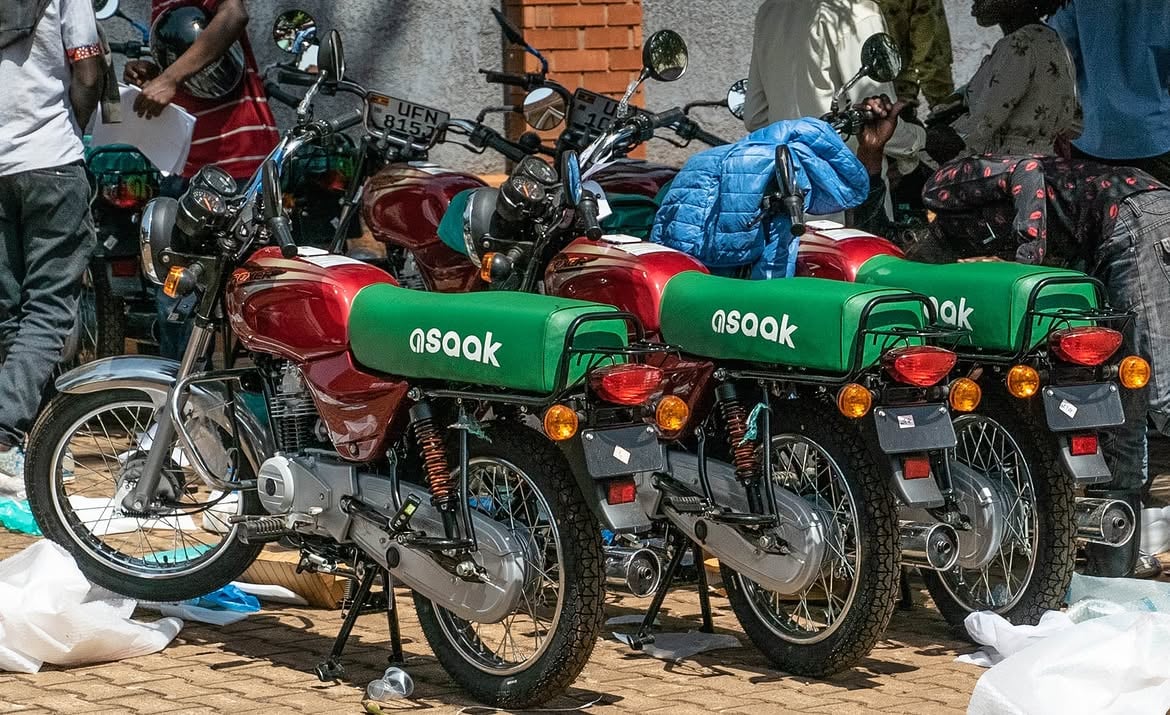
Asaak is possibly the most recognizable startup out of Uganda. Today, it provides loans that allow Ugandans to finance motorcycles used for transportation, but that was not its initial business model. Its present iteration is the result of lessons from a three-year experiment.
“What prompted the pivot to asset financing is we felt that this was a way to guarantee that the money was going to a productive use,” founder and CEO Kaivan Sattar tells Condia.
As a graduate student at Columbia University, Sattar visited Uganda a few times for a student-led project. The project, run by Engineers Without Borders, was meant to help improve agricultural productivity and brought him face-to-face with the country’s financing gap.
At the time, agriculture was the country’s largest employer of labor — it still employs nearly 40% of the population today — but services have since become the top employer of labor.
Asaak 1.0: The experimental years
The first version of Asaak saw him give out a total of $500 to smallholder farmers in Soroti, a city in Eastern Uganda. Across the border in Kenya, Branch and Tala provided microloans to customers and had raised capital from venture capitalists, so Sataar figured it was good business to replicate that business model.
Over the next three years, the startup would experiment with agricultural loans to farmers, working capital loans to SMEs, and payday loans to salaried employees.
But regardless of the loan category, they ran into the same challenge. People hardly used the loans for the purpose they had described during the lending process. That made it harder for them not to default and even harder for the young startup to collect on these loans. Eventually, the startup pivoted to asset financing for motorcycles.
Read more: The Moove pitch that became a debt trap for Lagos drivers
Asaak 2.0: Doubling down on boda-boda riders
Boda bodas have a long history in Kenya and Uganda. The name comes from “border to border” and originally described cyclists who transported goods across the Uganda–Kenya border.
Today, it refers to the motorcyclists who dot the Ugandan landscape, ferrying people and goods across the country. In Kampala, the country’s capital, an estimated 350,000 boda bodas are manned by men who often have few other employment options.
These are the men Asaak now serves. A brand-new boda boda can cost as much as USh3 million ($810), a sum that most aspiring riders would struggle to pay upfront. The alternative is to rent one, either through a rent-to-own arrangement or a standard rental scheme.
Sattar argues that both options are suboptimal. Under a standard rental scheme, riders have no path to ownership and remain trapped making payments indefinitely. A rent-to-own arrangement, on the other hand, could be abused.
Asaak, by contrast, offers a route to ownership. Riders submit an application and provide supporting documents, which Asaak reviews before approving a loan. Here, it breaks with a common industry practice by refusing to promise loans in minutes. Instead, approval can often take more than a day. Still, Sattar says riders who arrive with complete documentation can leave with a motorcycle within a few hours.
The tough business of lending
In its early days, Asaak borrowed from the playbook of competitors across the continent. It underwrote loans against assets, accepting land and machinery as collateral. But it soon realized that holding collateral was one thing; recovering the money owed by selling it was another. That realization reshaped the company’s lending model.
Rather than lending against traditional collateral, it ties each loan to the boda boda itself. Customers make daily repayments and can own the bike outright in as little as 12 months. But the most important part of the process begins long before the loan is disbursed.
Customers don’t receive instant loans. With many riders being illiterate or semi-literate, the startup has built an onboarding process around those realities. Contracts, for example, are often signed with fingerprints because many customers cannot write.
Before a bike is handed over, riders attend a financial literacy session conducted in a local language to ensure they understand the obligations that come with the loan.
The training is also a social commitment. Riders must attend with their guarantors, and if a rider is married, their spouse automatically becomes one as well. While this makes onboarding slower, the startup sees it as a worthwhile trade-off. The additional time upfront reduces the number of bikes it has to repossess and reassign later.
Asaak has now served more than a million boda-boda riders in Uganda and given out nearly $50 million in loans. It last raised $30 million in pre-Series A financing in 2022 and has also expanded its product suite. Riders can now finance smartphones, vehicle repairs, fuel, and personal loans based on their repayment history.
In 2023, it expanded to Mexico, acquiring the operations of Flexclub in the country. It has also expanded beyond lending. When it launched in Uganda, it struggled to find software that met its needs. Unable to find a suitable product, it built one in-house.
That software — Meza — has since been spun off into a standalone product for microfinance institutions, digital lenders, and banks in emerging markets. It has already signed its first customer: a Zambian lending company that uses the platform as a white-label solution.
Expanding to Mexico
When Asaak expanded to Mexico, the move was primarily driven by a need to manage the currency devaluation that affected many African economies between 2022 and 2023.
“We did it to mitigate our foreign exchange risk through diversified geographic presence and gain access to a much larger market in Mexico.”
Its 2022 fundraise left the company with significant dollar exposure, just as the Ugandan shilling lost considerable value. According to Sattar, his research showed that the Mexican peso held up better than most African currencies over the same period.
The acquisition of FlexClub’s Mexican operations was made easier by their shared investors. It also gave Asaak access to FlexClub’s partnership with Uber, including credit-scoring APIs that improve lending decisions.
To date, Asaak has financed nearly 600 vehicles for Uber and DiDi drivers, focusing primarily on cars in Mexico. Even so, the startup has no plans to expand beyond the continent.
“At our core, we’re a global company, and we’ll expand to new regions through our partners like Uber and DiDi.”
Get passive updates on African tech & startups
View and choose the stories to interact with on our WhatsApp Channel
ExploreLast updated: July 23, 2026