


Last year, Mark Zuckerberg launched a full-scale recruiting war for artificial intelligence talent as he sought to ensure Meta kept pace in the AI race.
His most significant move was a $14.3 billion investment in Scale AI for a 49% stake in the company, which also brought its co-founder and then-CEO, Alexandr Wang, to Meta.
Wang became the head of Meta’s newly established Superintelligence Labs, tasked with building a team capable of competing with the world’s leading AI research organisations. The team’s first major model, Muse Spark, arrived in April 2026.
Beyond Wang, Zuckerberg reportedly hosted top AI researchers at his home as part of a charm offensive that included compensation packages said to exceed $100 million annually.
OpenAI CEO Sam Altman even joked about the difficulty of competing with Meta’s offers, suggesting that some AI researchers were more motivated by their mission than money.
Regardless of what anyone thinks of Zuckerberg’s approach, it offers an indication of the value placed on AI talent today. As companies race to develop increasingly sophisticated models and products, having the right people on their teams has become a significant competitive advantage.
For African AI businesses, however, finding and competing for that talent is a different proposition.
African businesses cannot afford to compete
A $100 million compensation package is hardly the norm, even in the global AI industry. Such offers are reserved for a small pool of highly sought-after researchers and specialists. But they illustrate the scale of the competition African startups face when trying to recruit experienced AI professionals.
According to a recent report by Briter Bridges, the primary talent challenge for African AI businesses is the limited availability of qualified professionals. Beyond the shortage, these companies must contend with international technology businesses that can offer significantly better compensation and access to more established research environments.
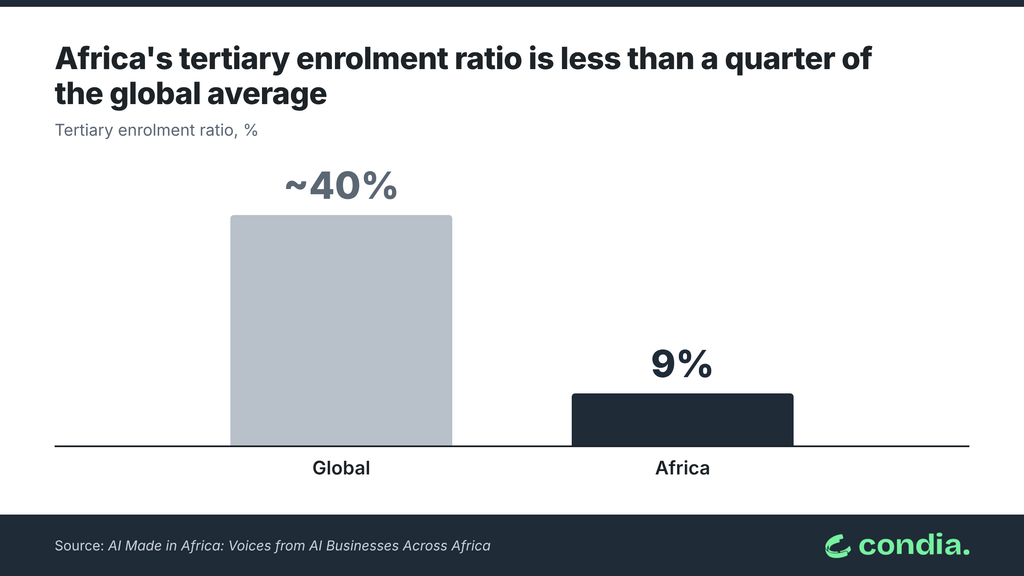
The problem is partly rooted in the continent’s education pipeline. Tertiary enrolment across sub-Saharan Africa is at approximately 9%, compared with a global average of more than 40%.
Other studies also point to a shortage of STEM graduates across the region, with fewer than 25% of higher education students pursuing STEM disciplines. This limits the pool of graduates from which technology companies can recruit, while specialised AI programmes remain relatively scarce.
Consequently, African businesses are often unable to find candidates with the specific skills they need.
“Because specialised AI academic pipelines are highly bottlenecked, African businesses are finding it more practical to hire from the broader pool of traditional engineering and business graduates and upskill them into adjacent roles like front-end engineering and AI product management,” the report explains.
The shortage is particularly acute in specialised technical positions. In the report’s survey, 51% of businesses identified AI research as the hardest role to fill. MLOps and infrastructure roles followed at 33%, while data engineering came in at 23%.
These are not necessarily skills that companies can develop through a few weeks of training. They require technical foundations, practical experience and, often, years of exposure to complex systems. That makes recruiting experienced professionals particularly important, and particularly difficult for companies that cannot match international compensation.
African startups are building their own talent pipelines
With their talent needs unlikely to disappear, African AI businesses are taking responsibility for developing the professionals they need.
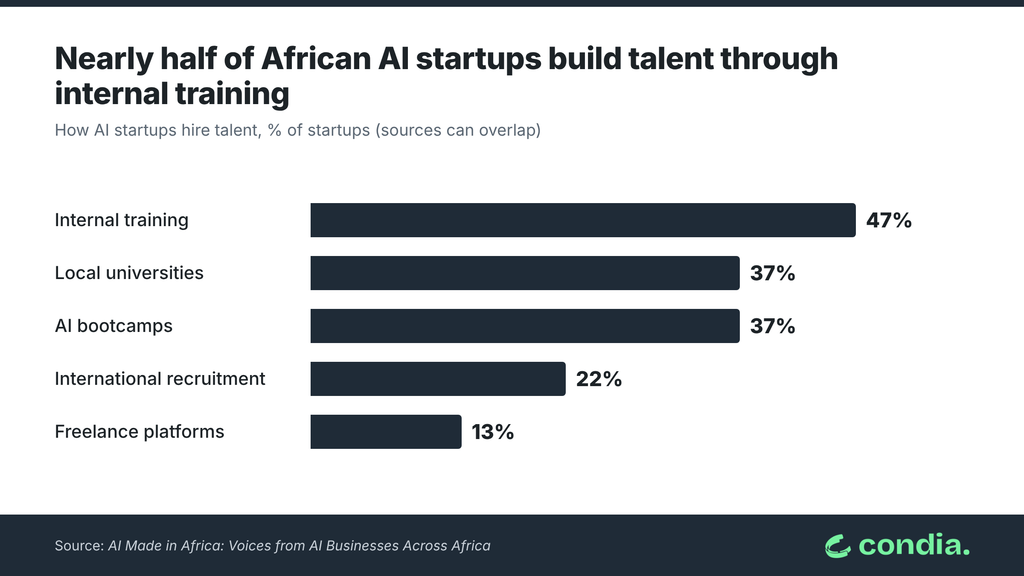
The Briter report found that 47% of surveyed businesses source talent through internal training. Local AI bootcamps and universities each accounted for 37%, while international recruitment accounted for 22%. These figures are not mutually exclusive, as businesses could identify multiple sourcing channels.
African technology startups have historically had to develop their own talent pipelines to reduce hiring costs and build teams with the skills required for their products. AI is extending that necessity into more specialised areas of technology.
The report highlights companies taking different approaches. Nigerian healthtech company MyItura recruits junior developers and puts them through continuous, structured training. Acre Insights trains local hires internally in specialised prompt engineering. Meanwhile, Côte d’Ivoire-based regtech company Danaya combines local recruitment with international expertise.
Danaya, for instance, recruited an African technology executive whose career had been built in France to lead its technical operations. At the same time, it has been developing the skills of young Ivorian engineers in generative AI, computer vision and machine learning.
These approaches show that internal training is not simply a fallback for companies unable to recruit experienced professionals. It also allows businesses to develop expertise around their specific products, infrastructure and operating environments.
However, there is a limit to how much individual companies can achieve. Training employees takes time and money, and startups must balance these investments against the resources required to build and commercialise their products.
There is also the risk that employees leave after receiving training, potentially taking valuable skills to better-paying international employers.
For smaller businesses, these are significant considerations. The decision to train someone is not just about identifying a skills gap; it is also about whether the company can afford to develop that person and retain them long enough to benefit from the investment.
Building Africa’s AI workforce must be a priority
AI is expected to play a significant role in the African economy, from financial services and healthcare to agriculture and industrial production. But that future could unfold without enough African professionals participating in the development of the technology itself.
Startups are already playing a part in building the continent’s AI workforce, but leaving the responsibility to them alone is neither smart nor sustainable.
Unless training is a core part of their business, companies will understandably develop only as many people as they need. Once their immediate hiring gaps are filled, there may be little commercial incentive to continue investing in additional training. This leaves the wider ecosystem with a persistent shortage, even as individual businesses become better equipped.
When every company must independently recruit, train and develop its own specialists, resources are duplicated across the ecosystem. Shared training programmes, stronger university-industry partnerships and accessible research facilities could help distribute some of that burden.
This makes it imperative for governments, tertiary institutions, technology companies and investors to work together. Universities need to strengthen specialised AI education, while businesses can help ensure that graduates develop practical skills relevant to the industry. Governments and development partners can support research programmes, technical training and the infrastructure required to develop local expertise.
Ultimately, African AI startups cannot be expected to compete with the world’s largest technology companies for talent on equal terms. But they should not have to build the continent’s AI workforce from scratch either. Developing that workforce requires a coordinated effort that extends beyond the hiring needs of individual businesses.