


The Central Bank of Nigeria, CBN, has opened up applications for Cohort 2 of its regulatory sandbox, and the industry is watching closely to see if the framework will open genuine pathways for innovation or simply reinforce the barriers that have kept local builders in the grey for years.
Senator Ihenyen, Lead Partner at Infusion Lawyers and Chair of the Ecosystem Growth & Advocacy Committee of the Virtual Asset Service Providers Association, has followed this evolution, and his reading of the CBN sandbox is both encouraging and cautionary.
“To be sure, the introduction of the CBN Sandbox, especially for VASPs, is highly commendable,” he says. “Considering where the Central Bank used to be on virtual assets, it is a major milestone.”
Yet he is quick to add that continually investing in building trust and confidence in the industry is critical and is why the CBN should endeavour to imbibe transparency in the entire sandbox process. Opacity, he warns, must be avoided.

Ihenyen identifies three reasons why the workings of previous sandboxes have stayed unclear. The first reason he identifies is regulators not fully comprehending that sandboxes should encourage competition while supporting disruptive business models.
Institutional challenges are another roadblock he identifies. Ideally, a sandbox should generate valuable data to inform regulatory decisions. However, a reluctance to leverage that data, driven in part by long-standing manual institutional processes, means many regulatory agencies are unable to fully capitalise on the insights generated.
Finally, he argues that the tendency to hoard data gathered through these processes is an impediment for the industry, limiting collaboration and ultimately hindering effective policymaking.
“A sandbox is only as useful as its shared insights. Keeping it opaque denies the broader ecosystem the benefit of regulatory learning, defeats the purpose of evidence-based policymaking, and leaves prospective applicants guessing about what the regulator actually wants,” he warns.
The CBN’s framework states that the list of firms in each cohort would be published on its website. However, no public list of participants from the first cohort or outcomes has ever been released.
Admittedly, the first cohort was in 2023 before the current CBN administration, but Ihenyen warns regulators must view transparency as a primary public benefit of running a sandbox.
At the minimum, the names of accepted companies, testing themes, and the general scope of the trials must be published. Also, periodic reports outlining broad market trends, observed risks, technical bottlenecks, and systemic barriers should be published.
The regulator must also keep the public updated about the status of each entity in the cohort and ensure that it publishes guidance notes. Otherwise, he says, it just ends up being an academic exercise.
Ihenyen notes a major difference between the CBN’s focus for this cohort and the first.
“The recognition of divergent risk profiles was visibly absent in the initial cohort. Consequently, there was a one-size-fits-all approach that did not distinguish between emerging crypto/VASP business models and traditional fintech solutions.”
This time, the CBN has adopted a dual track in the current cohort whereby VASPs are separated from Data-Enabled Financial Services, suggesting an understanding that both categories require distinct policy approaches.
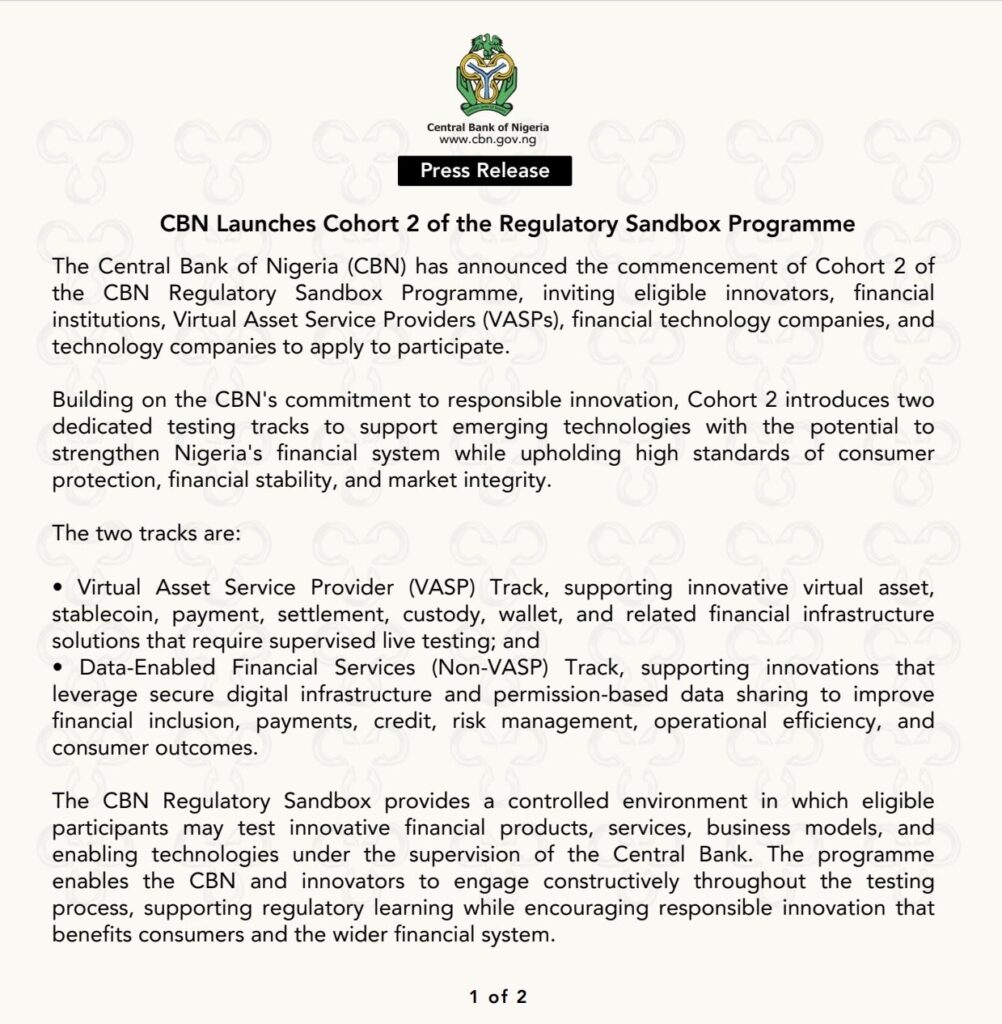

CBN sandbox promises formalisation, but structural barriers remain
The design of Cohort 2 reveals the gap between regulatory intention and regulatory effect. Ihenyen does not mince words about who the current structure actually invites through the door.
“A three-week window paired with heavy corporate governance and compliance thresholds naturally tilts the scales toward deep-pocketed banks, established fintechs, and foreign entities with dedicated compliance teams.”
The requirements, he notes, risk excluding local founders who have not built the compliance frameworks and depth that the sandbox requires. Instead, he argues for tiered compliance requirements and a rolling application model to give smaller local players a chance at getting into the sandbox.
“Local innovators who built through the grey years also have domain expertise, but many lack the capital to scale through institutional entry gates,” he says. “The CBN, consistent with Nigeria’s localisation policy, could adopt a policy that actively accommodates early-stage and homegrown builders to prevent local talents from playing underground or incorporating offshore.”
The inter-agency architecture created by the virtual asset executive order adds another layer of uncertainty to the CBN sandbox. While the virtual asset council is not designed to be a regulator, he notes that the potential for regulatory overlap risks creating friction, except boundaries are clearly codified.
Regardless, he remains optimistic that the Harmonised Implementation Framework would have been issued by the expiration of the 30-day period given by President Bola Ahmed Tinubu for regulatory coordination in the sector.
The CBN sandbox must deliver more than promises
Within the CBN sandbox, the most consequential tests will involve stablecoins. Not only has the industry thrown its weight behind its value for cross-border payments and remittances, even the CBN has identified and acknowledged the role stablecoins now play.
However, the CBN’s chief concern remains capital flight, currency substitution, and pressure on the naira. For dollar-denominated stablecoin issuers like Circle and Tether, Ihenyen argues that “the testing must centre on reserve transparency, 1:1 backing verification, run-risk prevention, mandatory periodic audit, and integration with local payment rails without destabilising monetary policy.”
Naira-denominated stablecoins such as cNGN require similar measures. He adds that Nigeria must genuinely balance innovation with regulation, rather than simply claim to do so.

On the big picture, Senator Ihenyen offers a closing assessment that frames everything the CBN sandbox must now prove. “Introducing the sandbox and the VAC framework is a pragmatic evolution, but still heavily anchored in risk containment and control,” he says. But shifting from containment to true enablement requires a change of mindset.
“Today, the framework proves the CBN is no longer in denial about virtual assets. Its success will be measured by how many viable products actually graduate into the real market with clear, predictable operational licences within a definite timeline.”
From the CBN to the SEC, the NRS to the NFIU and ONSA, he believes a mindset shift from viewing virtual assets largely as national risks to innovation is critical to the industry’s development.
The CBN sandbox is no longer a theoretical exercise. Cohort 2 is here. The only question left is whether it leads somewhere or whether the founders who built this market in the dark will find themselves standing at the mouth of a tunnel, still waiting for the light.
People in this article


Last updated: August 17, 2026