
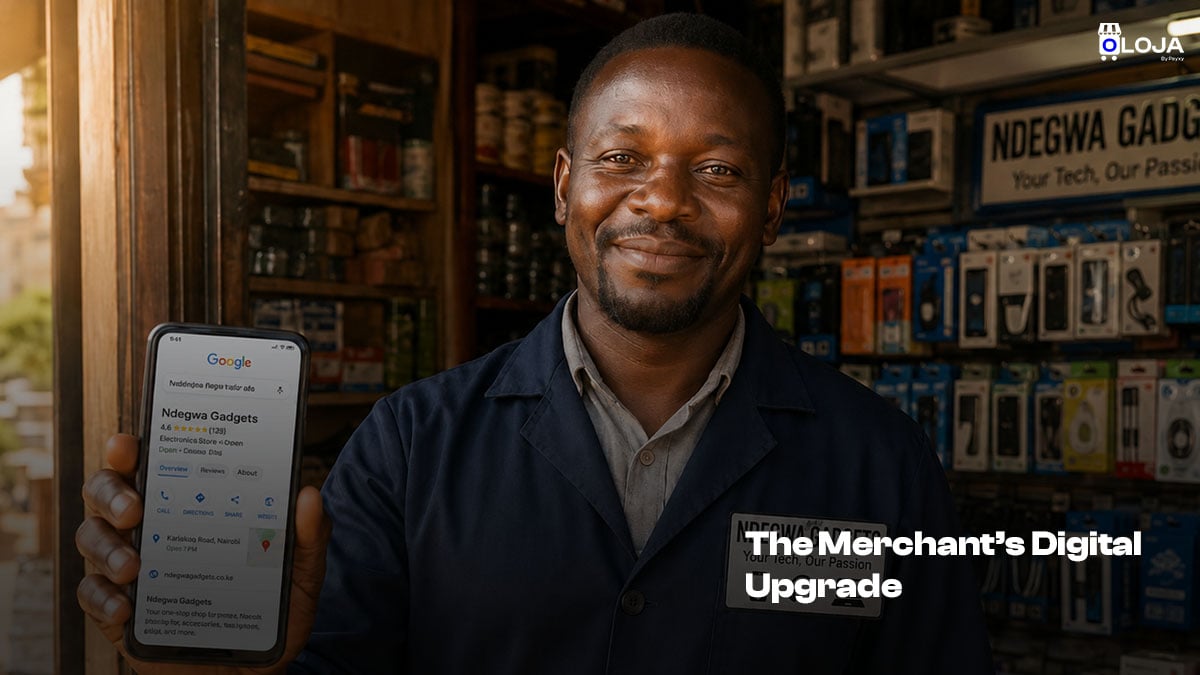
Oloja by Payxy is helping small and growing businesses across Africa ditch manual processes and fragmented tools for one seamless platform where they can sell online like big brands, receive payments, manage inventory, and track performance, all in one place.
Ask any small business owner in Nigeria how they run their operations, and the answer will sound familiar. Orders come in through WhatsApp. Payments arrive as bank transfers that have to be manually confirmed. Stock levels live somewhere between a notebook and memory. And at the end of every month, reconciliation becomes a part-time job.
This is not a failure of ambition. It is a failure of infrastructure. The tools that power commerce in more developed markets were never designed with the Nigerian merchant in mind, their pricing, complexity, and assumptions all point elsewhere. So Nigerian entrepreneurs did what they have always done: they improvised, adapted, and made fragmented systems work through sheer determination.
But improvisation has limits. And right now, a growing number of those limits are showing up in missed orders, payment disputes, stockouts, and operational chaos that quietly caps how far a business can grow.
Oloja, a new free commerce storefront platform developed by Payxy, is a direct answer to that problem.
Read Also: OPay named digital bank and financial inclusion leader at BAFI 2026
The Problem with Patching Things Together
The WhatsApp + Bank-transfer model works, until it doesn’t. A customer sends a message that gets buried. A payment comes in with no reference. A product sells out before the owner realises it. A team member shares account details that shouldn’t have been shared.
None of these are catastrophic on their own. But compounded across hundreds of transactions, they represent real money lost, real customers frustrated, and real growth deferred.
What Nigerian merchants need is not another workaround. They need a system, one built for the realities of their market, accessible without technical expertise, and free enough to remove any barrier to entry.
What Oloja Actually Does
Getting started takes minutes. Merchants sign up with an email address, complete a brief verification, and their account is live. Registered businesses can link their CAC number to auto-populate their business name. Those without formal registration can get started with a mobile number alone.
Digital Storefront: Every merchant gets a branded online store, where customers can browse products, select items, and pay directly. The store runs around the clock without requiring the owner to be present or online. Orders arrive with full customer details and delivery information, triggering an instant notification.
Secure Payment Links: Rather than sharing personal account details with every buyer, merchants can also send payment links that process transactions directly. Amounts are fixed by the seller. Customers cannot underpay or overpay. The result is fewer disputes, no fake alerts, and payment records that reconcile themselves.
Real-Time Inventory Tracking: Stock levels update in real time as orders come in. Merchants set a threshold, and Oloja sends an alert before the stockout happens. Customers never land on a product page only to find it unavailable.
Order Management and Reporting: All orders sit in a single organised view. Deliveries can be marked as completed, order lists can be downloaded as PDFs for team use or record-keeping, and weekly performance reports give merchants a clear picture of what is working.
Team and Access Controls: For merchants with staff, Oloja allows multiple users with defined access levels. A sales assistant sees the orders they need to fulfil. A finance team member accesses payment records. The owner sees everything. No shared passwords, no security gaps, no operational confusion born from everyone having access to everything.
Business Account: Upon completing onboarding, merchants receive a business account in their company name, an instant credibility upgrade that requires neither a bank visit nor a paper form.
Why This Matters Beyond the Feature List
The tools a business runs on, shape the ceiling it can grow toward. Merchants managing operations manually, even very successfully, are making a trade-off: they are spending cognitive and operational energy on work that a platform should be doing for them. That energy has a cost. It is time not spent acquiring customers, improving products, or building the brand relationships that create long-term value.
Oloja does not change what a business does. It changes how efficiently it does it, and in doing so, it expands the ceiling.
That is not a small thing in a market where operational friction is one of the most consistent reasons promising businesses plateau before they scale.
It is FREE to get started on Oloja. There is no steep learning curve. The onboarding does not require a technical background or a dedicated IT resource. And the operational difference, consolidated orders, secure payments, live inventory, team controls, and a digital storefront.
For Nigerian merchants who have spent years making fragmented tools work through creativity and effort, Oloja is not a disruption to the way they operate. It is simply a better version of it.
Oloja is available now at no cost. Merchants can sign up and create their storefront in under 3 minutes.
Last updated: June 12, 2026