

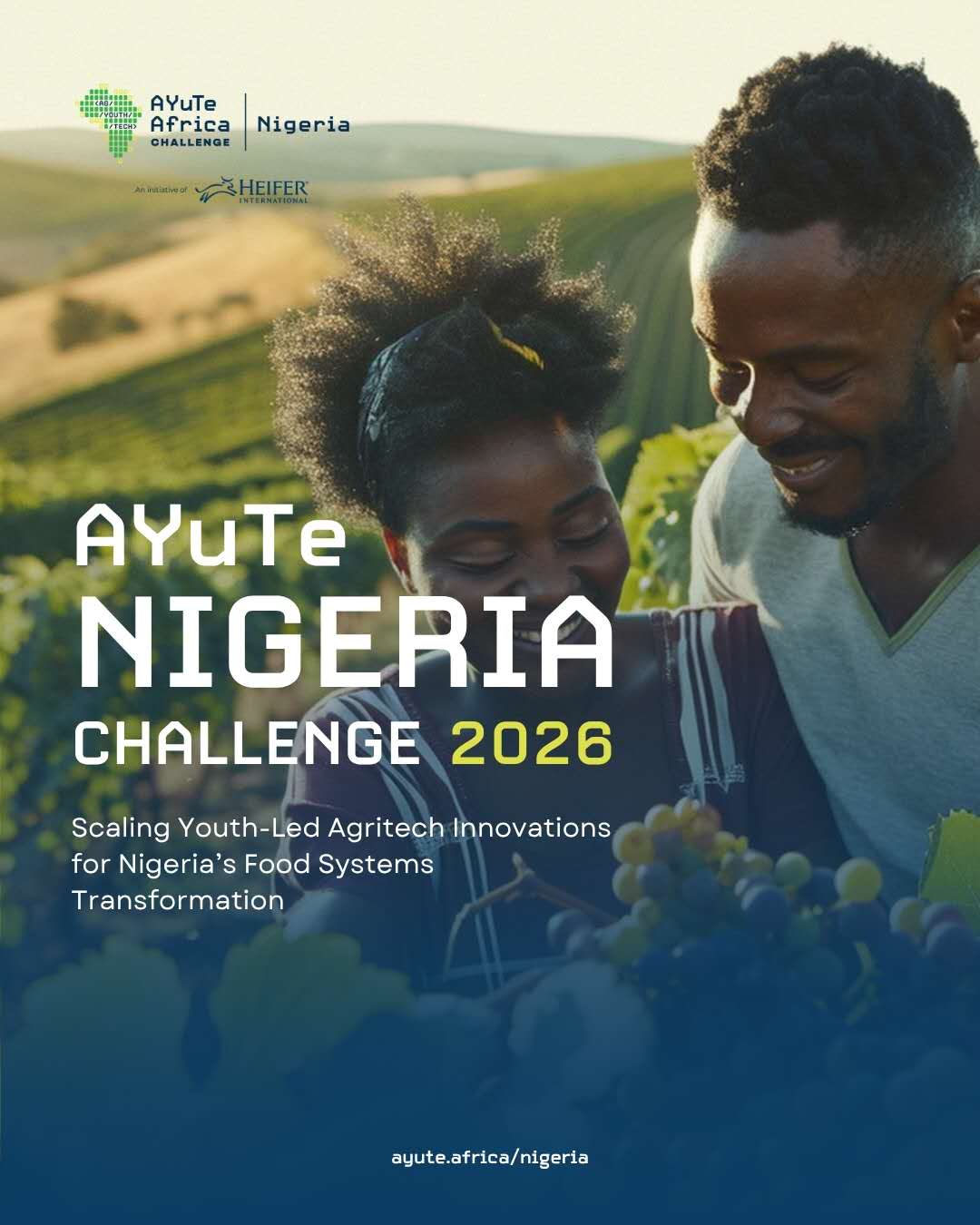
Nigeria’s conversation about agriculture has long centred on production. Food security, productivity, financing and market access remain among the country’s biggest agricultural priorities. Increasingly, young entrepreneurs are becoming part of that conversation by developing businesses that address some of the constraints that have limited smallholder agriculture for decades. They are improving access to finance, connecting farmers to markets, using artificial intelligence to strengthen climate resilience and creating new opportunities for value addition. Their success will depend not only on the strength of their ideas, but also on access to investment, strategic partnerships and an enabling environment that allows those ideas to grow.
Supporting entrepreneurs like these has become an important part of Heifer International’s approach to agricultural development in Nigeria. Heifer’s work is grounded in the belief that lasting food security is built by strengthening livelihoods, creating functioning markets and investing in people rather than delivering short-term assistance. One expression of that approach is the AYuTe (Agriculture, Youth and Technology) Nigeria Challenge.
Introduced in Nigeria in 2021, the annual AYuTe Challenge identifies promising agribusinesses developing solutions for smallholder farmers and helps them move beyond the startup stage. Through catalytic investment, mentorship, technical assistance, strategic partnerships and investor engagement, the Challenge is designed to strengthen promising businesses and prepare them for commercial growth.
This year’s finalists illustrate both the diversity of Nigeria’s agricultural challenges and the ingenuity of the entrepreneurs responding to them.
- Yemert is helping farmers access crop insurance, markets and climate finance through a USSD platform that works on basic mobile phones, making these services accessible even without internet connectivity.
- Farm Monitor Africa is helping farmers better manage climate risks while generating digital records that improve access to finance through artificial intelligence and satellite weather data.
- XChangeBox is addressing delayed payments through trade finance that improves farmers’ cash flow and helps ensure more value remains with producers.
- Agrigoo Trades and Commodities Limited is connecting farmers directly with buyers through a digital marketplace that improves price transparency and product traceability.
- Kiyoko Foods Ltd is creating more value from Nigerian cocoa by sourcing locally, training farmers to improve quality and processing more cocoa within the country.
Rather than searching for a single breakthrough, these businesses are tackling the financing, market, information and value-addition constraints that have limited the productivity and profitability of smallholder farmers for decades. Every enterprise that improves access to finance, strengthens market access or reduces post-harvest losses contributes to a more resilient agricultural system and a stronger rural economy.
Keep Reading: OPay named digital bank and financial inclusion leader at BAFI 2026
The next challenge is ensuring these businesses do not remain promising pilots. Government, development finance institutions, investors and development partners all have a role in helping successful enterprises reach the scale needed to serve millions of farmers. Commercially viable businesses create lasting impact
long after project funding has ended, but getting there requires patient capital, strong partnerships and an enabling policy environment.
That is where initiatives such as AYuTe can make a lasting contribution. Since its launch in Nigeria, the Challenge has gone beyond recognising promising businesses to helping them become investment-ready enterprises. Through their affiliation with the AYuTe Nigeria Challenge, alumni have been connected to a wider ecosystem of opportunities — gaining access to investors, development finance institutions, market networks, and strategic partnerships that have accelerated their growth. Beyond their own enterprise development, alumni have deepened their work with smallholder farmers, developing new innovations that directly address the persistent challenges faced at the farm level and across Nigeria’s food systems. From digital tools that improve access to credit, to platforms that reduce post-harvest losses, to supply chain solutions that connect farmers to reliable markets, alumni are actively building the infrastructure Nigeria’s agriculture has long needed.
As alumni grow, they are reaching more farmers, processing more produce, expanding access to finance, and creating employment across the country. The AYuTe Nigeria Challenge does not simply surface great ideas — it creates the conditions for those ideas to survive, scale, and transform Nigeria’s agricultural landscape for generations to come.
As Nigeria pursues greater food security, increased domestic production and meaningful employment for its growing youth population, supporting agricultural innovation should become an integral part of agricultural policy rather than a parallel conversation. The businesses already exist. The ideas are already being tested. The opportunity now is to create the investment, partnerships and policy environment that allows proven solutions to reach more farmers.
On 20 July 2026, policymakers, investors, development partners and entrepreneurs will gather in Abuja for the AYuTe Nigeria Challenge Grand Finale. One startup will be named the 2026 AYuTe Nigeria Champion, but the significance of the event extends beyond selecting a winner. It is an opportunity to recognise that many of the solutions Nigeria’s agricultural sector needs are already being built, and to decide how those solutions can be given the support they need to scale.
Last updated: July 19, 2026