



Nigeria’s tax system is changing in January 2026. Social media is full of panic and half-truths about what the new Tax Act means. Even roadside vulcanizers know something’s coming, but few understand what to do.
We spoke with Olufunso Ola-Ojo, a tax consultant who’s spent over 15 years of experience at global accounting and advisory firms Deloitte and Forvis Mazars. He now heads the tax team at StarTimes Nigeria, a multinational media and pay-TV company, while also running his own advisory practice, Primo Consulting.
The new tax system isn’t as scary as Twitter makes it seem. But it does require preparation. Here’s what you need to know.
How the new tax system works
From January 1, 2026, Nigeria’s tax rules shift into a more structured system designed to enforce compliance. First, let’s clear up who actually pays tax under the new system.
If you earn a gross income below ₦100,000 ($66) a month or ₦1.2 million ($1,482) a year, you are now officially exempted from the Pay As You Earn (PAYE) bracket. The new structure protects low earners and adjusts rates upward across income bands instead of using a single flat percentage.
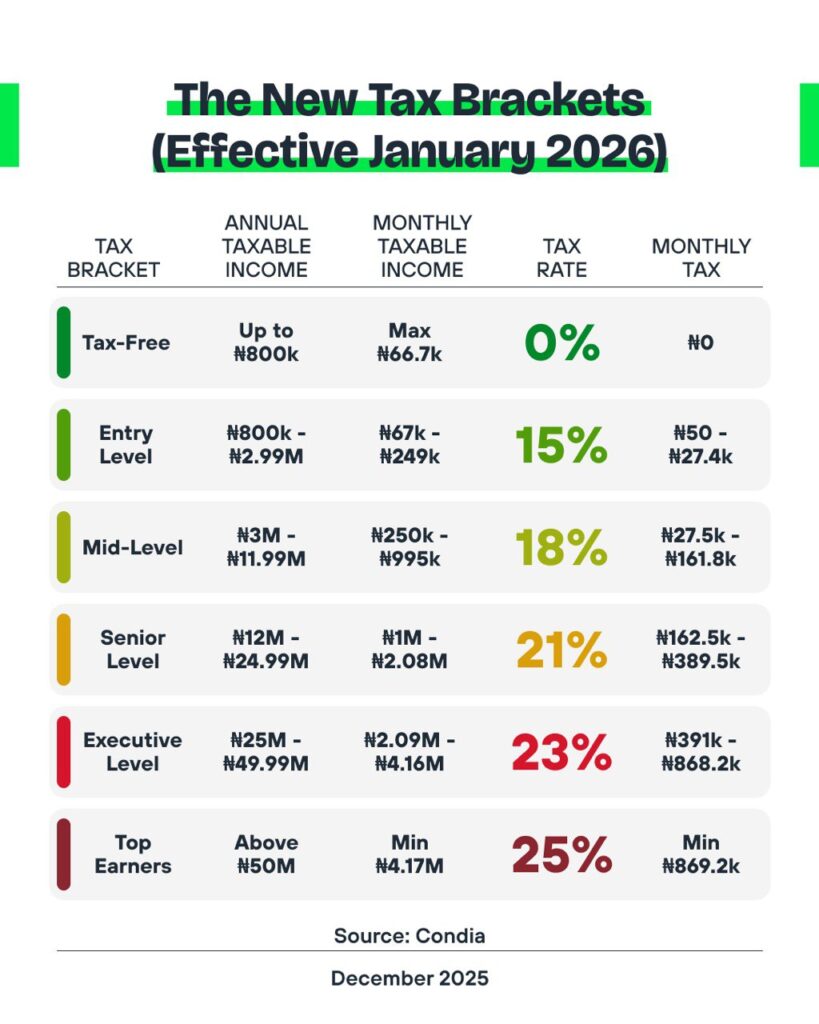
Here’s how those bands work:
The first net income of ₦800,000 is always tax-free. Then:
- Next ₦2.2 million: taxed at 15%
- Next ₦9 million: taxed at 18%
- Next ₦13 million: taxed at 19%
- Next ₦25 million: taxed at 21%
- Everything above ₦50 million: taxed at 25%
In practice, that means a person earning ₦24 million ($16,206) pays lower rates on most of their income, and only the top layer attracts higher tax.
Essential items like food, housing, transport, education, and healthcare remain zero-rated for VAT, so nothing changes there. What’s new is the attempt to tighten administration and refunds for producers who already operate under that rule.
For small businesses, the same thresholds apply: companies making under ₦100 million a year with assets below ₦250 million continue to be exempt from company income tax and certain levies. Investors keep their old capital-gains exemptions too, covering modest property sales, personal assets, and small-scale share transactions under ₦150 million a year.
“There will never be a situation where somebody is subject to tax based on one singular rate,” Olufunso explained. “You run the person’s salary through the table.”
The only tax relief you should care about
Tax reliefs are the legal deductions that reduce how much of your income the government can tax. In short, they shrink your taxable income: not the amount you owe directly, but what the tax is calculated on.
Under the new system, the Consolidated Relief Allowance (a flat percentage everyone used to get) is gone. It’s been replaced with specific reliefs, like rent relief, which only applies if you’re renting your home.
Here’s how it works: you can deduct up to ₦500,000 or 20% of your annual rent—whichever is lower—from your taxable income. So, if you pay ₦3 million in rent, 20% would be ₦600,000, but the maximum you can claim is ₦500,000. If your rent is ₦1 million, you can deduct ₦200,000.
Olufunsho explains that proof will matter more than ever in 2026. To claim the relief, taxpayers will need rent receipts, a tenancy agreement, and evidence of payment through bank transfers. Rent paid by a spouse or relative doesn’t qualify. “It has to be your payment, from your account,” he said.
7 steps to take before January 2026
Now that you understand what’s changing and why, here’s your action plan. These steps are sequenced to build on each other—start with your records, then structure, then compliance.
1. Get your records together
Records are the foundation for taxation. Start by gathering proof of all your income and related expenses. For most people, this means:
- Income: Pay slips, invoices, rental agreements, or bank statements showing money you received.
- Expenses: Receipts, bank transfers, or bills tied to your work or rental properties.
- Organisation: Keep documents by month and by income type — salary, business, rent, or freelance work.
You don’t need fancy software. A folder on your phone or computer, or a simple spreadsheet, is enough. If you want digital bookkeeping, start with low-cost tools like Wave or QuickBooks, or a local Nigerian app. The point is consistency. Record transactions as they happen so you have an audit trail.
For example: If you earn a salary and rent out a property, keep your pay slips, your tenant’s bank transfers, and receipts for any expenses related to the property. This gives you the numbers you need to calculate taxable income and claim deductions.
If you don’t have the time or experience to do this yourself, talk to your accountant or financial advisor or hire a professional to help. The important part is that your records are complete and accurate so your filings and deductions are correct.
2. Do a Tax Health check
With your records organised, the next step is to understand your tax position. Even if you haven’t filed before, reviewing your past six years of income and expenses helps you spot what could be taxable and what deductions or reliefs you can claim.
How to do it:
- Go through all your income—salary, freelance work, rental income, investments—and note amounts received.
- Check any payments or contributions that may be deductible, like rent, pension, NHIS, or insurance.
- Identify where personal accounts may have been used for business purposes.
If it feels complex, a tax professional can help identify gaps, suggest proper documentation, and flag areas to address before filing. This step helps you know your obligations and ensures your filings are accurate from the start.
3. Review your business structure and separate accounts
Even though this guide is focused on individuals, if you run a business alongside your personal income, your business setup can affect how much tax you pay and what reliefs you can access.
Why it matters:
Operating as a sole proprietorship or business name while earning above ₦800,000 could mean you’re missing out on key exemptions and allowances. Limited liability companies (LLCs) benefit from incentives such as:
- Exemption from company income tax for businesses with turnover under ₦100 million.
- Capital allowances on business assets.
- The ability to carry forward losses.
- Eligibility for development and economic growth incentives.
As you review your structure, keep your finances clean. Stop mixing business and personal money.
Next steps to take:
- Open a dedicated business account and use it only for business transactions—receive payments there, pay suppliers from it, and then pay yourself a regular salary into your personal account.
- If your turnover is nearing ₦50 million or more, consider converting your business to a limited liability company.
- This involves registering with the Corporate Affairs Commission (CAC), preparing incorporation documents, and transferring your operations to the new entity.
- Consulting a lawyer or business registration service ensures the process is done correctly and you can maximise available tax benefits.
Taking this step positions your business to legally reduce its tax burden while aligning with the new 2026 tax framework.
4. Determine whether you need a Tax Identification Number
A Tax Identification Number (TIN) isn’t required for personal bank accounts used solely for private spending. You only need one if your account is involved in business or economic activity, such as selling goods or services, receiving client payments, or paying suppliers.
Starting January 2026, banks will check taxable accounts and may request a TIN.
How to know:
Review your bank transactions. Multiple customer payments, regular supplier transfers, or amounts beyond typical salary deposits signal that you need a TIN. Tax authorities can detect these patterns through BVN data.
Next step if you need a TIN:
Register online through your state tax authority or the FIRS portal. You’ll need your BVN, NIN, proof of address, and business registration documents if applicable. Registration is free and usually processed in a few days. We’ve explained the process in detail here.
Once you have a TIN, you’ll be ready to report business income and claim applicable reliefs, keeping your filings compliant.
5. Gather proof for specific reliefs (rent, pension, NHIS)
If you will claim rent relief, collect three items: tenancy agreement, rent receipts, and bank transfers showing payment. For pension, NHIS and other deductions, gather receipts or employer records. Put these in a labelled folder so you can attach them to your return.
The documentation proves you personally paid, not someone else.
Next steps to take:
- Contact your landlord for copies of your tenancy agreement and all rent receipts for the year.
- Print bank statements showing rent transfers. If you paid cash, get signed receipts with dates.
- Organise these in a folder labelled “Rent Relief 2025.”
6. Calculate what you’ll owe and save
Now that you’ve reviewed your income and deductions, it’s time to estimate your actual tax bill. The new system taxes most types of income: salary, rent, freelance work, interest, dividends, and investment gains. Income from government-backed instruments like FGN Savings Bonds and Treasury Bills remains exempt, while most private investments already have withholding tax deducted at source.
Next steps to take:
- Start by listing all your income sources: Salary or business earnings, Rental income, Investment returns and dividends, Freelance or side jobs etc.
- Then, note how much tax (if any) has already been withheld on each. Request annual statements from banks, investment platforms, and tenants where applicable—these help verify what’s been paid or declared.
- Next, use a reliable tax calculator, such as the free tools from the Presidential Committee on Tax Reforms or Primo Consulting to estimate your total annual liability.
- Enter your income, allowable reliefs (like rent, pension, or insurance), and deductions. The calculator will show the amount due for the year.
To stay ahead, Olufunso advises dividing that figure by 12 and setting aside that amount monthly. This approach helps you avoid a large lump-sum payment in March and demonstrates voluntary compliance if records are ever reviewed.
If you prefer a manual method, you can use a simple spreadsheet to track monthly income, deductions, and taxes withheld.
7. File returns and keep evidence
Once you’ve calculated what you owe, the final step is filing: the formal declaration that confirms your income, deductions, and tax due for the year.
If you’re employed by a registered company, your HR or payroll department handles this for you. Employers must file Form H1 with the tax authorities by January 31st each year, showing what was deducted from employees’ salaries and remitted.
If you’re self-employed, run a business, or earn income from investments or rent, you file your own returns. The deadline is March 31st. You’ll need a basic financial statement that summarises your income, expenses, and profits for the year.
Next steps to take:
- Confirm with your employer/HR that your PAYE deductions have been filed correctly. For self-employed individuals, check if your state supports online filing — Lagos residents can use the LIRS e-filing portal.
- If your state doesn’t have an online option, prepare a simple spreadsheet showing your income and expenses, calculate your total tax, and submit physically to your state tax office before the deadline.
- Keep copies of everything: receipts, acknowledgements, bank payment slips, and digital files. They serve as your proof of compliance if any questions arise later.
Filing on time and keeping evidence doesn’t just close your tax year properly — it protects you during audits and ensures your records are always verifiable.
The bottom line
What’s different about 2026 is the system behind it. The government finally has the tools to see how money moves. BVN, TIN, and NIN data now talk to each other, and the tax service can cross-check bank records, invoices, and filings in real time. That’s what Olufunso meant when he said, “The only thing that changed is technology.”
And this might not be about chasing everyone down at once. Enforcement will start where the data is cleanest: salaried workers, registered businesses, and people already in the system. The informal economy will take longer to capture, but the direction is clear: records matter now.
It also means the line between legal avoidance and evasion is sharper. You can reduce your taxes with the right deductions and structure, but hiding income or mixing accounts will backfire. “We can avoid tax legally, not evade tax,” Olufunso said.
Right now, the best move is preparation. Get your records in order, separate business and personal accounts, and know your tax ID.
Happy Holidays!
FAQs
Q: Do I need a TIN for my bank account?
A: Only if you use it for business. Personal accounts for salary or savings don’t require a tax ID. But if money from customers or suppliers flows through that account, you’ll need one. The tax service can see business patterns through BVN data.
Q: Can I pay my personal taxes in instalments?
A: Not officially, but you can plan ahead. Divide your estimated tax for the year into 12 parts and pay monthly into a separate account. When filing season comes, you’ll already have the money set aside.
Q: What happens if I’ve never paid tax before?
A: Authorities say they’ll focus on bringing people into the system, not punishing everyone for the past. If you start filing and paying from 2026, you’re unlikely to face retroactive penalties unless you’re running a business that’s been avoiding taxes entirely.
Q: How will FIRS know what I earn?
A: Through connected systems. BVN and TIN data now feed into digital tracking tools that match payments, invoices, and returns. Businesses that use accounting software are already linked directly to FIRS.
Q: Can I still file manually?
A: Yes, but most states now have online portals. Lagos residents, for example, use the LIRS e-filing platform. Even if you file offline, your data eventually enters the same system.
Q: Are small businesses really exempt from company tax?
A: Yes, if your annual turnover is under ₦100 million and assets below ₦250 million. You also won’t pay the 4% development levy or withholding tax on supplier payments.
Get passive updates on African tech & startups
View and choose the stories to interact with on our WhatsApp Channel
ExploreLast updated: January 7, 2026


