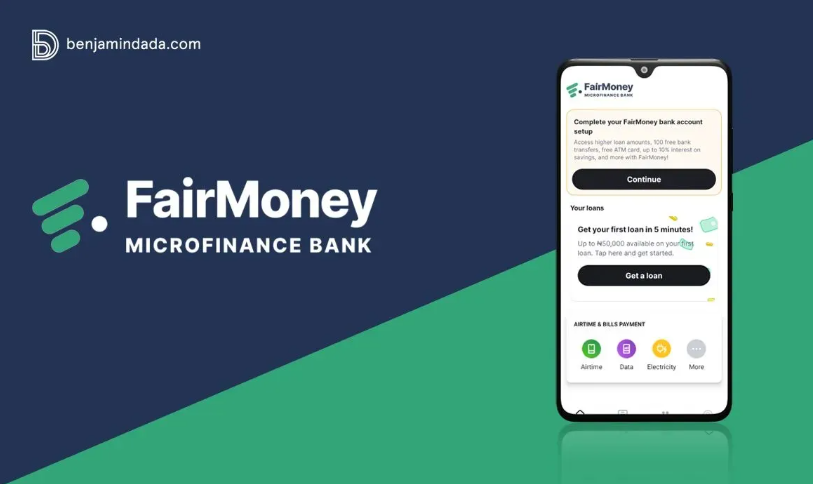
For a long time after FairMoney launched in Nigeria, it was a lending app most people opened only when they needed a quick loan.
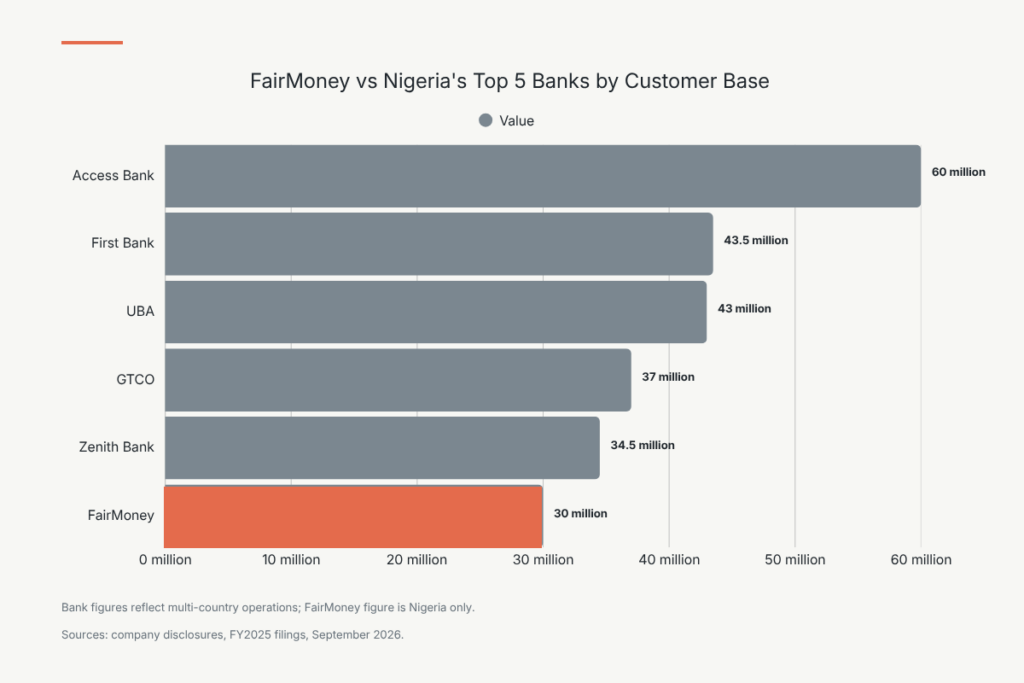
Having surpassed 30 million registered users, the digital bank has now built a customer base that compares favourably with the country’s oldest and largest commercial banks.
FairMoney announced the milestone on September 3, 2026, describing it as a reflection of the increased trust reposed in it by Nigerians.
“Surpassing 30 million registered users is an important milestone for FairMoney, but its greatest significance is the trust millions of Nigerians have placed in us to support their everyday financial lives,” Henry Obiekea, FairMoney’s Managing Director said.
Where FairMoney stands against FUGAZ
First Bank, United Bank for Africa, Guarantee Trust Bank, Access Bank, and Zenith Bank are Nigeria’s largest banks by customer base and assets. But unlike FairMoney, all five banks have been operating for more than twenty years.
First HoldCo, the parent company of FirstBank, says it currently serves over 43.5 million customer accounts, including digital wallets, spread across Nigeria, the United Kingdom, and several African markets.
United Bank for Africa’s audited 2025 annual report puts its customer count at 43 million across 24 countries, while Guaranty Trust Holding Company, GTCO, states that it serves over 37 million customers across 10 African countries and the United Kingdom.
Access Bank, the largest of the five by customer count, serves over 60 million customers across 24 markets, a figure its group chief executive has more recently put at 65 million.
Read also: EXCLUSIVE: FairMoney in M&A talks with Shara
Zenith Bank, with the narrowest international footprint of the five, reported roughly 34.5 million customers in its 2025 financial year, up from 33 million in 2023. Most of those customers are also concentrated in Nigeria.
Every one of those numbers took decades, and in four of the five cases, operations spanning 10 to 24 countries, to accumulate. FairMoney reached 30 million in less than a decade, inside one country, and without physical branches.
The FairMoney evolution
FairMoney’s evolution followed a clear sequence rather than a sudden pivot. It launched in Nigeria in 2017 as a loan app, using smartphone data to underwrite small, collateral-free credit for Nigerians that traditional banks would not serve.
That single product ran for four years before the company secured a microfinance banking licence from the Central Bank in 2021. That let it begin opening current accounts for the same customers it was already lending to.
Its chief executive at the time, Laurin Hainy, described the licence as the mechanism that let FairMoney start offering accounts at scale using infrastructure it had already built for lending.
The following year, Global Credit Rating Company assigned FairMoney a national-scale long-term rating. This showed that its underwriting model had earned outside confidence.
By 2023, the bank had rolled out banking and lending services built specifically for small businesses and merchants. This completed a run from a single lending app to retail banking, business banking, and merchant services inside six years.
The financial effect of that sequence shows up in the balance sheet too. Customer deposits, which barely funded FairMoney’s loan book in 2021, covered 56% of it by 2024, meaning the bank increasingly lends out money its own users have saved with it.
Algorithmic credit worked as the trust-building step in that sequence. It let FairMoney convert repeat borrowers into deposit holders once regulation allowed it, and it let business banking follow once the retail deposit base was large enough to fund merchant lending internally.
Each stage adds another financial task that a customer can complete inside the same app.
FairMoney’s rapid growth compared to commercial banks has been aided by its ability to eliminate onboarding friction but perhaps, more importantly, building a product that served an underserved market.
Traditional commercial banks historically required physical branch visits, manual documentation, and multi-day verification cycles. FairMoney leveraged phone-number-linked account generation and automated KYC to onboard users within minutes.
Operating without a heavy brick-and-mortar footprint allows digital MfBs to redirect operational capital into zero-fee offerings and competitive savings yields.
Automation has also played a major role. Human loan officers cannot efficiently evaluate thousands of daily micro-loan requests. FairMoney’s automated underwriting engine allowed it to manage credit risk at volume.
FairMoney’s rise to 30 million registered users shows how quickly Nigeria’s financial landscape is changing.
While the country’s oldest banks still command larger customer bases, they have had decades — and extensive branch and international networks — to build that scale.
FairMoney, by contrast, has reached comparable numbers in less than a decade by combining digital onboarding, automated credit assessment, competitive savings products, and services tailored to underserved consumers and small businesses.
Its growth suggests that the real competition is no longer simply between banks with the most branches but between institutions that can earn trust, remove friction, and meet customers’ everyday financial needs most effectively.
Last updated: September 10, 2026