

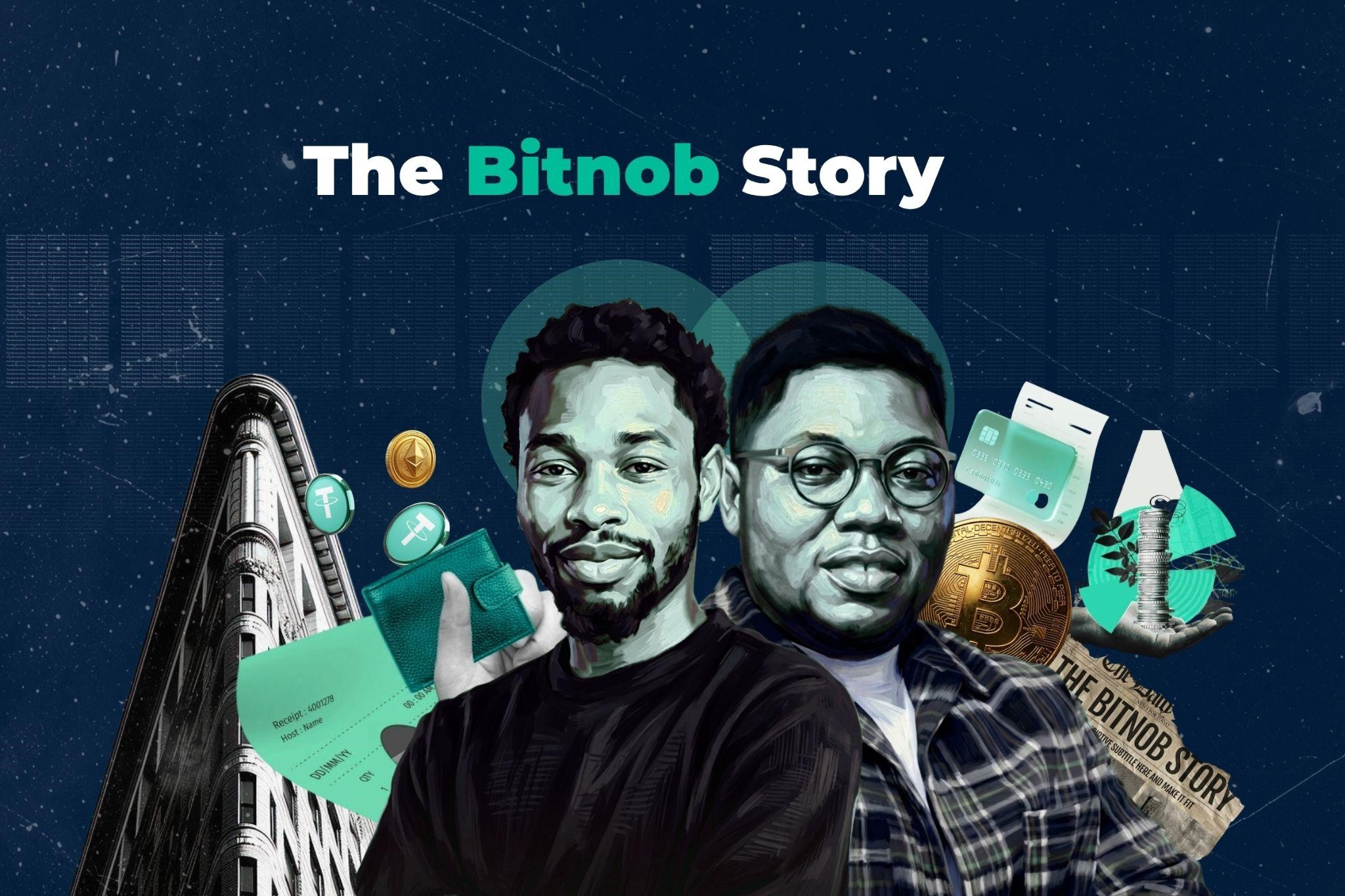
A five-part feature on Bitnob, Bernard Parah, and the inversion of the global financial map
Part I. The room, the city, the calculation
Bernard Parah is sitting at a window in an Abuja office that does not announce itself. There is no signboard, no signal that the building hosts a company whose infrastructure has carried more than four and a half billion dollars across a hundred and ten countries in the past six years.
He is not, as the question is sometimes put to him, a Bitcoin maximalist. “It’s the only protocol I could trust,” he will say later, “in the sense that I didn’t have to trust other people.”
Outside, across the city, naira holders are running daily calculations the rest of the world does not run: What does the dollar cost today? What will it cost on Friday? Will the bank release the wire? Will a cousin in Abu Dhabi accept USDT instead?
The naira has lost roughly half its value in eighteen months. Salaries are revalued by the hour against an asset most Nigerians have never been formally allowed to hold.
This is not the picture of a peripheral economy adopting a marginal technology. According to Chainalysis’s 2025 Geography of Cryptocurrency report, Sub-Saharan Africa received over $205 billion in on-chain value between July 2024 and June 2025, a 52% jump from the previous year.
Nigeria alone moved $92.1 billion, nearly triple the next country in the region. Stablecoins now account for roughly 43% of crypto transaction volume in Sub-Saharan Africa, woven, in Chainalysis’s phrasing, into “everyday financial survival.”
The continent is already running on a parallel monetary substrate. The question is no longer whether crypto will be used here, but whose pipes the use will travel through. Bitnob is one of those pipes, and by several material measures, the largest.
***
Part II. Two engineers, a hostel, and a hypothesis
The company began in 2017 as a thought experiment. Parah and his earliest collaborator Edward Amewu, both in their early twenties, studying in Ghana registered the domain ‘bitnob.com’ and ran a barebones over-the-counter Bitcoin site from a hostel in Koforidua.
There was no product, only a hypothesis: that the market most acquainted with monetary fragility would be the first to adopt the most monetarily honest asset humans had built. A year later, Parah lost thirty thousand dollars to trading and a peer-to-peer scam, more than a year of professional salary at his age.
The lesson has shaped every product since. Build the rails. Do not build the bets.
Bitnob did not become a company in the proper sense until 2020. Its first commercial product, a consumer Bitcoin app for Nigerian women saving five and ten dollars a week through a Paystack auto-debit, launched in May.
Four months later, Parah turned down a path at Paystack itself, making it clear to his interviewers that Bitnob would remain a priority if they employed him. They eventually didn’t. For Bernard, that was cue to focus squarely on Bitnob.
In February 2021, the Central Bank of Nigeria banned the country’s banks from servicing crypto companies overnight. Most peers folded or fled. Bitnob’s founders rebuilt the payment rails in a week with a voucher-and-agent model, an innovative play that was soon validated by the now defunct Bundle. They too, struggling under the chokehold of regulations, innovated Cashlink, a crypto transaction product built on the P2P model.
“By the time most of our competitors discovered crypto in Africa,” Parah says, “we had already failed at it twice and rebuilt.”
The CBN ban was meant to be terminal. Instead, it became Bitnob’s moat. Six months later, Bitnob became the first African company to integrate the Lightning Network end-to-end, drawing interest and investment capital from the Lightning Team.
In December 2022, Strike’s Jack Mallers stood on stage in Accra and announced Send Globally with Bitnob as the African counterparty. Nine months later, Btrust — the endowment Dorsey and Jay-Z had seeded with 500 BTC — acquired Qala, the developer-talent firm Parah had co-founded. Tether took a position on the cap table. By 2025, Bitnob’s enterprise platform was the route through which tier-one institutions were quietly launching stablecoin products.

***
Part III. What the company actually does
It is unromantic and difficult to misrepresent. It is plumbing. Bitnob ships wallets, swaps, payouts, virtual cards, treasury, an order-routed trading engine, an OTC desk, RPC nodes, and a non-custodial enterprise platform — all under one company, one API, one operational discipline.
A fintech in Nairobi can integrate the stack in five minutes and offer customers a USD virtual card, a USDT savings product, and instant payouts to thirty African corridors without writing a line of underlying code.
A company that would take an enterprise sales cycle of weeks on Fireblocks or Coinbase Custody can be live the same afternoon.
The numbers are not provincial. Cumulative volume of more than $4.5 billion. Single-day on-chain capacity up to $2 billion. A $100 million USDT-to-USDC swap that settles in minutes from internal liquidity. Asset mix: 56% Bitcoin, 44% stablecoins. 110+ countries, 25+ currencies. Hundreds of business clients; through them, millions of end users.
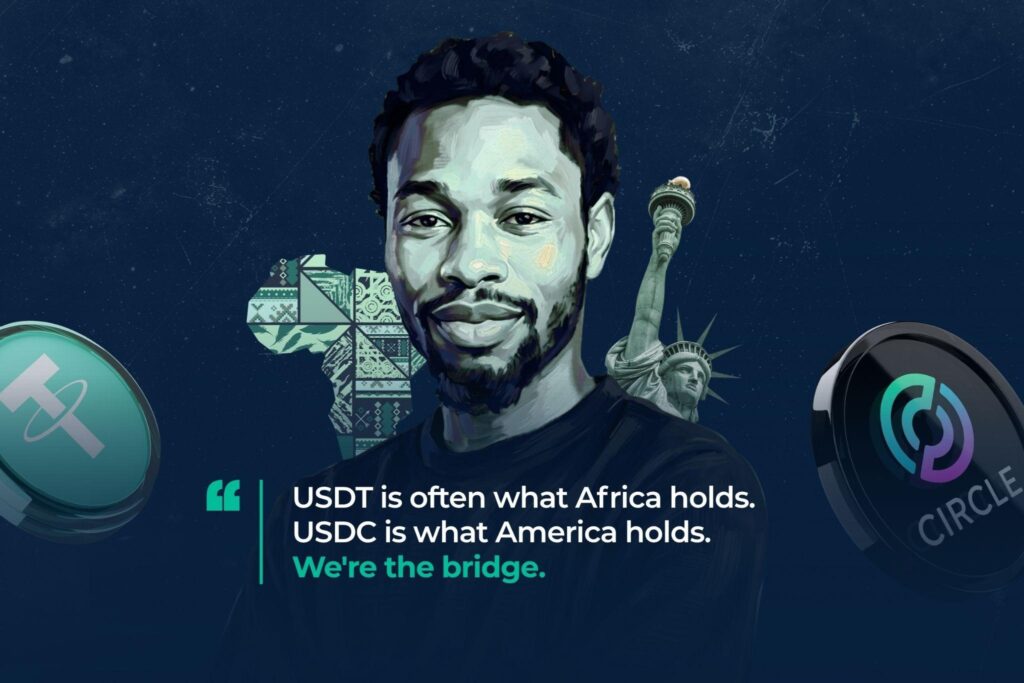
“Stablecoins aren’t speculation in Africa,” Parah says. “They’re salary. Supplier payment. Inventory financing.” He pauses. “USDT is often what Africa holds. USDC is what America holds. We’re the bridge.”
The tailwinds are not subtle. In its September 2025 Stablecoins 2030 report, Citi raised its global stablecoin issuance forecast to $1.9 trillion by 2030 (base case) and $4 trillion (bull) — supporting up to $200 trillion in annual transaction activity. The bank framed 2025 as blockchain’s “ChatGPT moment.”
Africa’s piece is structurally larger than the world has acknowledged. Per a May 2025 Oui Capital report, the continent’s cross-border payments market is on track to triple from $329 billion to $1 trillion by 2035.
Average remittance fees in Africa remain the world’s highest, at 7.4–8.3%; stablecoin rails can cut these by up to 60%. The IMF and World Bank now acknowledge that the dollar-shaped reality of emerging-market savings is mediated through stablecoin infrastructure no central bank issued.
***
Part IV. The pattern, inverted
For three decades, the African startup playbook was a colonial echo: replicate proven American or European solutions for African customers, get acquired or list on a Western exchange. The most consequential African fintechs of the 2010s built on this template.
Bitnob case is the reverse.
Software shaped by problems Wall Street has not had to solve: currency volatility measured in weeks, capital controls that change without warning, dollar-account access rationed, turned out to be more flexible, cheaper, and more capable on the dimensions that matter.
A no-float treasury model. RPC nodes in Lagos rather than Frankfurt. A virtual card funded directly from a USDT balance.
Companies that built for Wall Street are now learning how the South solved problems the West has not yet seen. And as Bitnob grows its list of Western customers, especially those from Silicon Valley, there is no gainsaying this reality.
Caleb Nnamani, founder of Blacktrigger, the Lagos storytelling agency working with Bitnob and a long-time crypto operator, frames the moment in terms the African tech ecosystem has been waiting to hear.
“For thirty years, the conventional wisdom was that African companies had to leave to be taken seriously,” he says. “Bitnob shows the gravity has reversed. Currency volatility, capital controls, regulatory uncertainty are not handicaps; they are the conditions under which the next generation of global financial infrastructure is being forged. Companies building crypto from outside are about to find themselves competing with people who have nine years of operating texture they cannot replicate at any price.”
***
Part V: The largest stablecoin economy nobody has named
Africa is the largest stablecoin economy in the world the world has not yet named. The naming is the work of the next twelve months. Bitnob’s competitive position—as the global crypto infrastructure provider for companies enabling commerce for the next four billion, will be clearer as the company continues to demonstrate its unique capabilities that makes it the true leader in the B2B crypto space.
Bernard Parah, still in his mid-thirties, now occupies the same stages as Mallers, Dorsey, and Ardoino. He possesses that rare, hard-won distinction: a builder whom architects of the new financial system across two continents recognize as a peer.
For him, the view outside his window is not merely a landscape but a continent that must be rescued by technology where the state has defaulted. And so, with a quiet, operational discipline, he builds.
Inside the room, an engineer monitors a swap between USDT on Tron and USDC on Solana. It clears in under sixty seconds. Somewhere on the continent, a small business has just settled with its supplier, bypassing the friction of legacy banks and moving value without seeking the permission of any state.
The architecture of the next financial system is being written in places like this. The story has not been told because no one had told it. That is starting to change.
Get passive updates on African tech & startups
View and choose the stories to interact with on our WhatsApp Channel
ExploreLast updated: May 12, 2026