
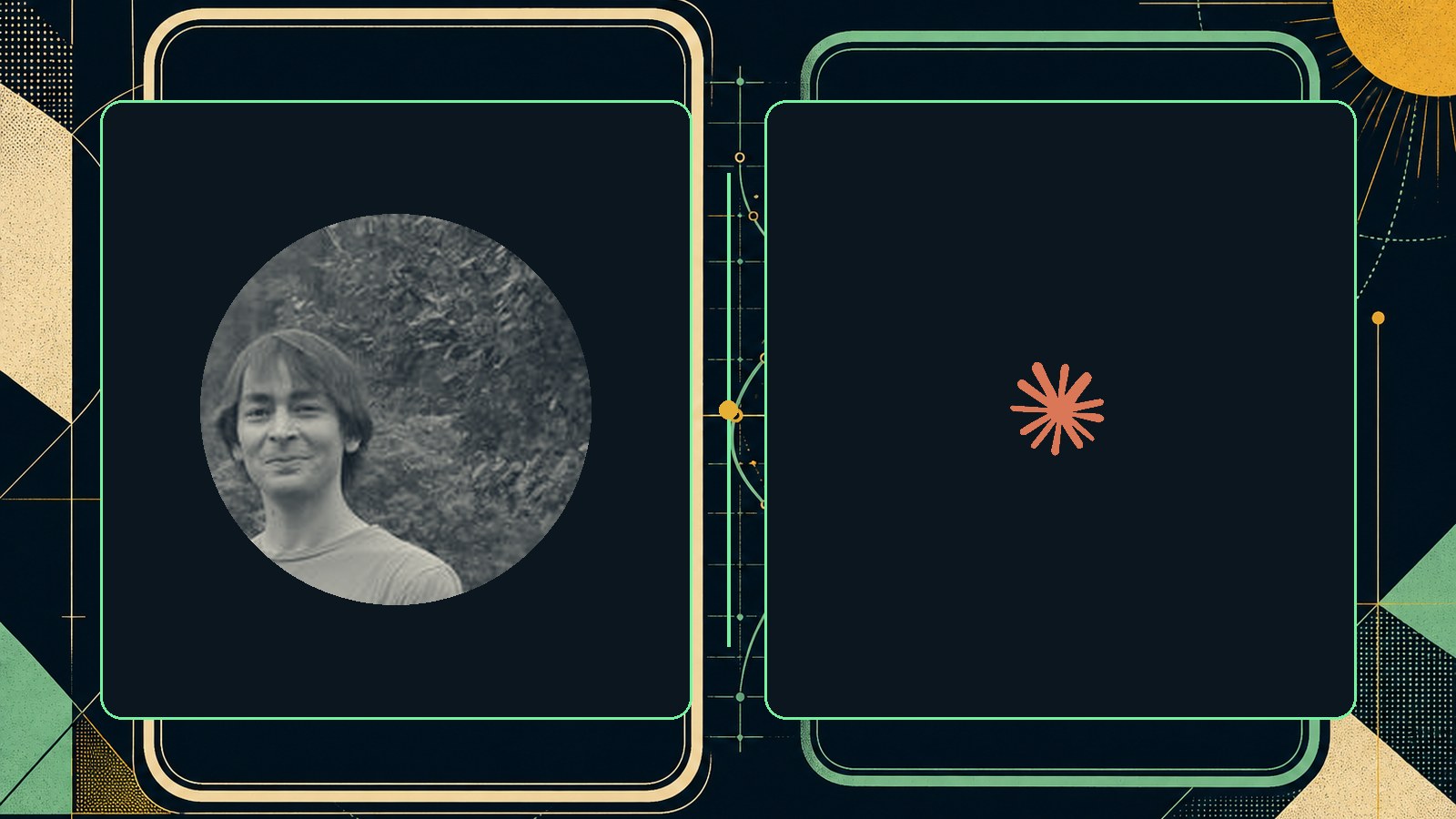
Anthropic mathematician Levent Alpoge claimed earlier today that he had used Claude to prove the Riemann hypothesis, the most famous open problem in mathematics. Hours earlier, Alpoge and Tristan Buckmaster published a paper claiming that smooth initial conditions can make the unforced three-dimensional Navier-Stokes equations blow up in finite time. If both claims survive review, they would settle two famous open problems, one of them more than 160 years old.
The announcements did not arrive as finished work with settled results. Alpoge posted a four-page note on his website and a Lean formalisation split across 14 compressed files. The Navier-Stokes team published a 79-page paper and a GitHub repository , but the numerical certificate behind the result is still missing. Both claims are serious. Neither is settled.
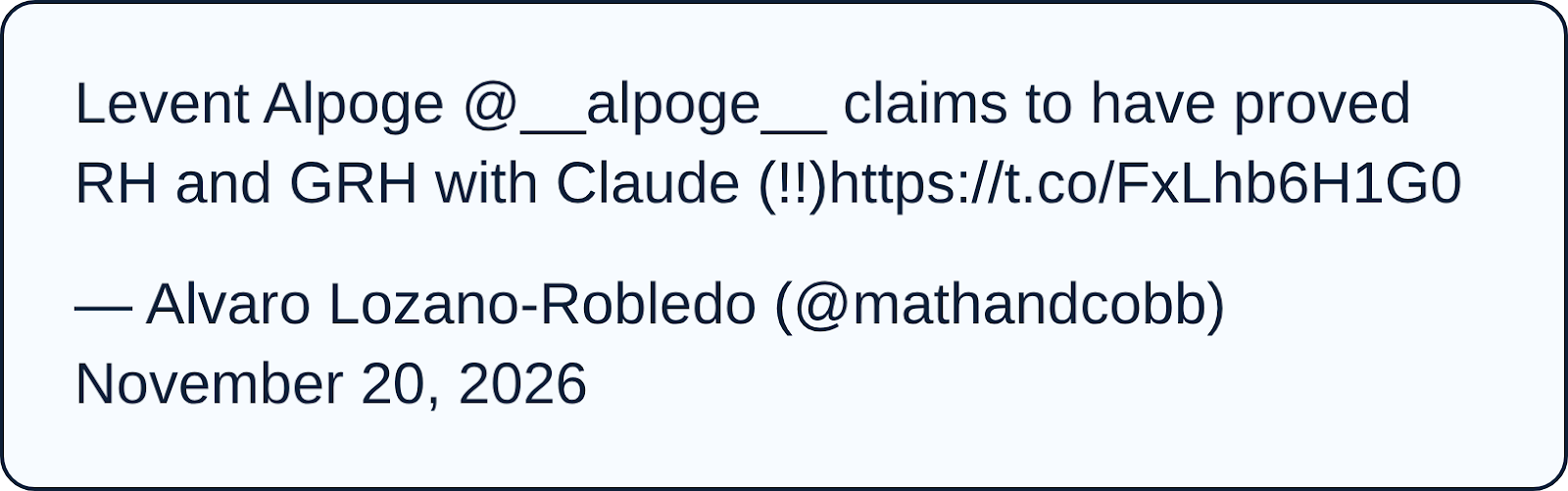
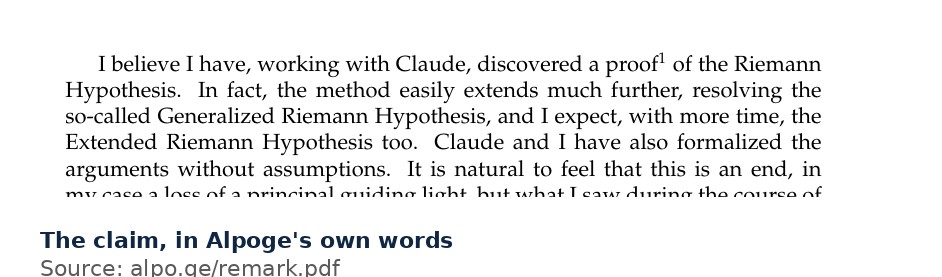
“I believe I have, working with Claude, discovered a proof of the Riemann Hypothesis,” Alpoge wrote in the note. He said the method extends to the Generalized Riemann Hypothesis and may reach the Extended Riemann Hypothesis with more time.
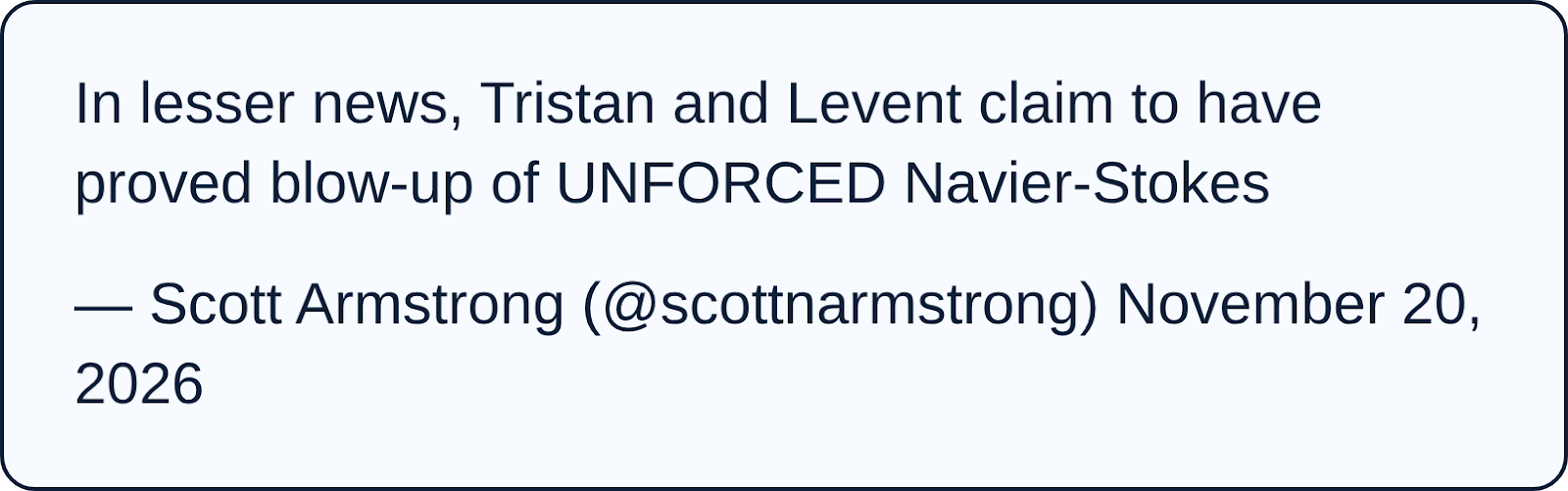
“In lesser news, Tristan and Levent claim to have proved blow-up of UNFORCED Navier-Stokes,” Scott Armstrong, a mathematician at New York University and Sorbonne, wrote on X. His post drew about 33,000 views within hours.
What Alpoge has claimed, and what he has not
The Riemann hypothesis claim rests on a narrow question: whether every nontrivial zero of the zeta function sits on one vertical line. The question is narrow in form but vast in consequence. It reaches across number theory because the zeta function encodes how prime numbers are distributed, and thousands of results assume the hypothesis is true.
Alpoge is a mathematician at Anthropic, a Princeton PhD supervised by Manjul Bhargava, a former Harvard junior fellow and a Morgan Prize winner. In the note, he describes a route inspired by Stepanov’s proof of the Riemann hypothesis over function fields. He says Claude suggested the decisive step: a long chain of theta lifts, with the chain length set at roughly the square root of the size of the primes involved.
The note is unusually candid. It says no readable paper exists, that the informal draft runs past 250,000 pages and that Alpoge had not mastered every part of the argument before the announcement. That honesty matters because the proof is not yet open to normal academic scrutiny.
Scientific American reported the Riemann hypothesis claim on Friday. Its report stayed cautious, noting that Lean can contain errors and that experts must check whether the theorem was coded correctly. Being thanked in the note does not mean a named mathematician has checked the proof.
The Navier-Stokes paper goes further than September’s claim
The Navier-Stokes claim has more material for researchers to inspect. A 79-page paper by Alpoge and Buckmaster says they construct smooth initial data for the three-dimensional Navier-Stokes equations without force, and that the resulting solutions blow up in finite time. If correct, the result would disprove statements A and B of the Clay problem and prove statements C and D.
This is not the September claim from OpenAI. That result used a smooth external force and did not settle the unforced problem at the centre of the Millennium Prize.
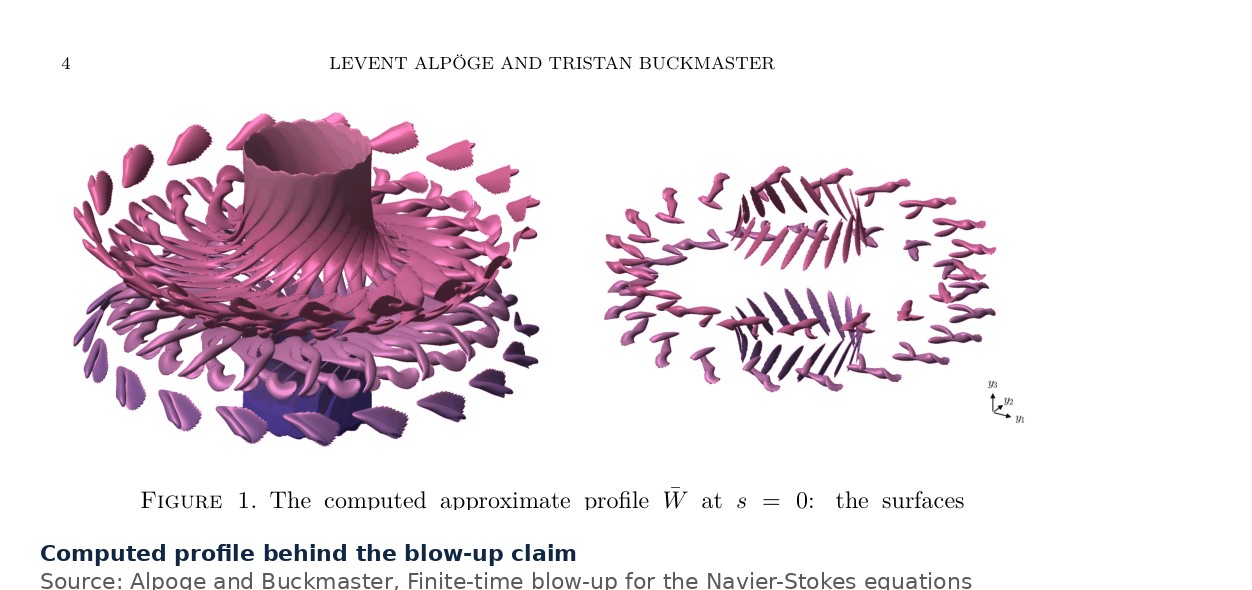
The new paper still leaves a gap. It depends on a numerical certificate that is not in the repository. The paper gives a hash and says the certificate will be released soon. The repository also says the rigorous interval computation that verifies the certificate is not part of the Lean formalisation. The posted Lean package was patched on 20 November and was not rebuilt after the patch.
Buckmaster said the team rushed the write-up. “After last time, we couldn’t risk waiting, so the Navier-Stokes write-up is unpolished and heavily LLM-assisted,” he wrote on Mastodon in a post quoted by Armstrong. “Fortunately, once the numerical profile is in hand, the proof follows a well-trodden computer-assisted path.”
Readers can see what is present and what is missing. That transparency does not prove the result. It does show how the work was released.

Lean can check a proof, but it cannot explain it
Lean is a proof assistant. It checks each logical step against a fixed set of rules. A proof that compiles with standard axioms is strong evidence that the formal statement follows.
A clean compile does not prove that the formal statement matches the informal claim. It also does not guarantee that a human can understand why the result is true. That gap now sits at the centre of the AI maths debate.
In October, a MathOverflow question asked how Anthropic’s earlier Lean-verified zeta-zero result could contain false statements in its human-readable version. The answers described a common failure: a model can formalise a headline theorem and prove that form while the natural-language proof contains steps that do not survive close reading.
A group of 25 Fields medallists made a wider version of the same point in September. In a declaration titled “A Severe Misalignment of AI in Mathematics“, they wrote that rushed announcements leave no time for proper write-ups, isolation of new ideas and citation of earlier work. They argued that solving problems is a proxy for the real goal, which is understanding.
Manjul Bhargava, one of the signatories, is named in Alpoge’s Riemann note. Peter Sarnak and Maksym Radziwiłł are named too. None of that is endorsement.
AI labs are treating famous problems as demonstration stages
The Navier-Stokes claim sits inside a contest between Anthropic and OpenAI. Alpoge and Buckmaster were at the centre of the Navier-Stokes priority dispute in September, after OpenAI announced a forced blow-up result that followed work they had discussed publicly.
Now the same names are back with an unforced claim. Alpoge, working with Claude, has also put forward a Riemann proof. One mathematician and his collaborators have produced three high-profile results in a year in which AI labs have begun treating famous problems as demonstration stages.
That does not make the claims false. It does mean the incentives are loud. Announcements arrive before papers, before clean builds and before the community has time to absorb the ideas.
What researchers need to check next
The first test for the Riemann hypothesis claim is mechanical. Outside researchers need to download the Riemann archive, build it from scratch and confirm that the final theorem states the Riemann hypothesis or GRH. They also need to check that the formalisation uses only standard axioms.
The Navier-Stokes claim has a similar gate. The certificate must be released. The interval computation must be reproduced. The patched Lean package must be rebuilt. Other mathematicians then need to decide whether the formal theorem matches Fefferman’s statement of the Clay problem.
Clay’s rules are slower than the announcement cycle. A solution must be published in a qualifying outlet, wait two years and gain general acceptance before a prize can be awarded. A personal note, a GitHub repository and a formal proof do not shorten that path.
The honest story here is not that mathematics has been solved. It is that AI-assisted mathematics now produces proofs, code and understanding at different speeds. Researchers now have to catch up with all three.
Last updated: November 20, 2026