

African startups raised more than $1 billion in the first half of the year, with 146 deals recorded, according to data tracked by Condia.
Much of the funding went to fintech startups, reflecting the sector’s continued prominence in Africa’s startup ecosystem. More than 200 investors participated in deals across the continent, highlighting the breadth of investor interest despite a funding environment that remains challenging for many startups.
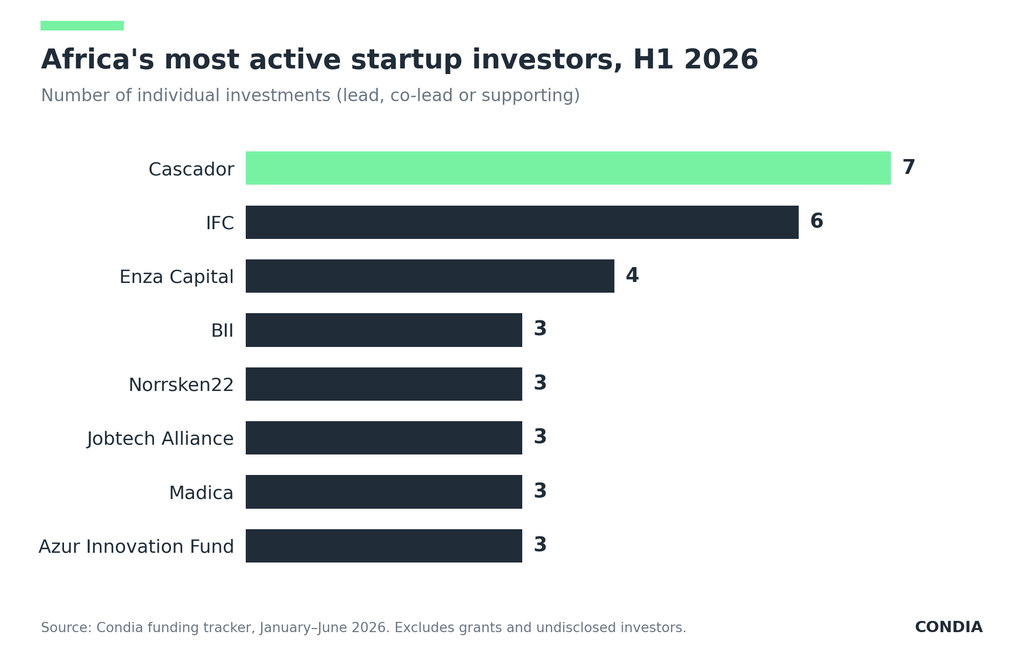
Condia also tracked the most active investors during the first six months of the year, providing a closer look at the investors backing African startups and the sectors attracting the most capital. Nigeria-focused accelerator Cascador emerged as the most active investor on the continent during the period.
Three things stand out from this list. First, DFIs (IFC, BII, and Proparco outside the top eight) are doing the heavy lifting in capital-intensive sectors like clean energy, electric mobility, and healthcare infrastructure.
Second, Enza Capital, Azur Innovation Fund, and Attijariwafa Ventures are converging on Morocco and Egypt specifically, targeting proptech, retail tech, and urban mobility. Third, catalytic and accelerator-style capital (Cascador, Madica, and Jobtech Alliance) is outpacing traditional lead-VC activity by deal count, even though it rarely produces the largest checks.
The data offers a snapshot of where capital is flowing across Africa’s startup ecosystem and which investors are playing the most active role in supporting the continent’s startups.
1. Cascador
Cascador is a not-for-profit entrepreneurial organisation that invests in growth-stage businesses. While not a traditional tech investor, it has deployed capital into tech startups, including Sycamore, Utiva, and Fez Delivery.
The Lagos-based accelerator awarded roughly $5.6m in catalytic funding and $20,000 in prizes to seven Nigerian startups at its 2026 Pitch Day, with the largest award going to Agriarche, an agricultural technology company. The other beneficiaries, including Koolboks, Powerstove, and Stears, span clean energy, agriculture, and financial data.
Read: Amanda Etuk of Cascador bets on Nigeria’s economy
2. International Finance Corporation (IFC)
The World Bank Group’s private-sector lending arm plays two roles in the African tech ecosystem. It serves as a direct equity and debt investor and a limited partner that funds other venture firms.
In the first six months of 2026, it led or co-led investments in Yakeey, Breadfast, MNT-Halan, Biovac, Gozem, and Arc Ride. The IFC’s $15 million Series A into Yakeey in January 2026 marked the institution’s first-ever venture capital equity investment in Morocco. Its investment footprint is now visible across Egypt, Morocco, Kenya, and South Africa.
3. Enza Capital
The Nairobi-based firm led investments into Yakeey and Tuteria and co-led investments into Orcafraud and AethexAI, spreading its bets across South Africa, Nigeria, and Morocco.
The firm has backed five Egyptian companies to date and just completed its first Moroccan investment. As Africa-focused investors turn their gaze beyond the continent’s Big Four markets, North Africa has emerged as a worthwhile destination, and Enza Capital has described North Africa as a market that looks modern on paper but sits on entrenched, opaque legacy systems underneath. Enza’s typical cheque size ranges from $250k to $5m, backed by a growth-capital vehicle that can write up to $20m for follow-on rounds.
4. British International Investment (BII)
The UK’s development finance institution led three deals in this period. Its investments into Starsight, Dodai, and Lovegrass show an interest in the clean-energy and electric-mobility sectors that has proven attractive to other DFIs.
Read:10 African VC firms you should know in 2026
5. Norrsken22
Norrsken22 is one of the largest funds focused on investing in Africa, with its latest fundraising of $205 million. Its investments have largely been concentrated in Kenya, Nigeria, and South Africa, with investments in Raenest, Stitch, and Nala. Norrsken22’s focus is on the fintech and AI sectors this H1, with bets on Lua, Shiprazor, and Orcafraud.
6. Jobtech Alliance
Jobtech Alliance works with founders, funders, and policymakers across Africa to improve the jobtech sector. It has backed 51 companies, including Tanda, Scalein, Aktivate, Orda, and InfiBranches.
The five-year-old accelerator Jobtech Alliance backed Bumpa, Flowcart, and Twiva in H1 2026. That’s three bets on e-commerce and retail-enablement platforms. In 2024, it was the first external investor in Selar, the e-commerce platform.
7. Madica
Madica is an early-stage investor targeting pre-seed companies in Africa. Backed by Flourish Ventures and launched in 2022, it typically invests up to $200k in selected startups. It is also sector agnostic, and its three deals in the first half of the year — Hakimu, Biovana, and Kilimo Fresh — went to agriculture and health ventures across East and West Africa.
8. Azur Innovation Fund
Morocco’s Azur Innovation Fund closes out the list with three deals, Enakl, Z Systems, and Weego, all around urban mobility. Alongside Enza Capital and Attijariwafa Ventures, Azur is part of a small cohort of regional VCs concentrating almost exclusively on Morocco and Egypt, a pattern distinct from the fintech-heavy focus further south and west.
Methodology: Data was sourced from the Condia funding tracker for January–June 2026. It excludes grants and undisclosed investor names. Investors are ranked by total number of individual investments—whether as lead, co-lead, or supporting investor.
Last updated: October 3, 2026