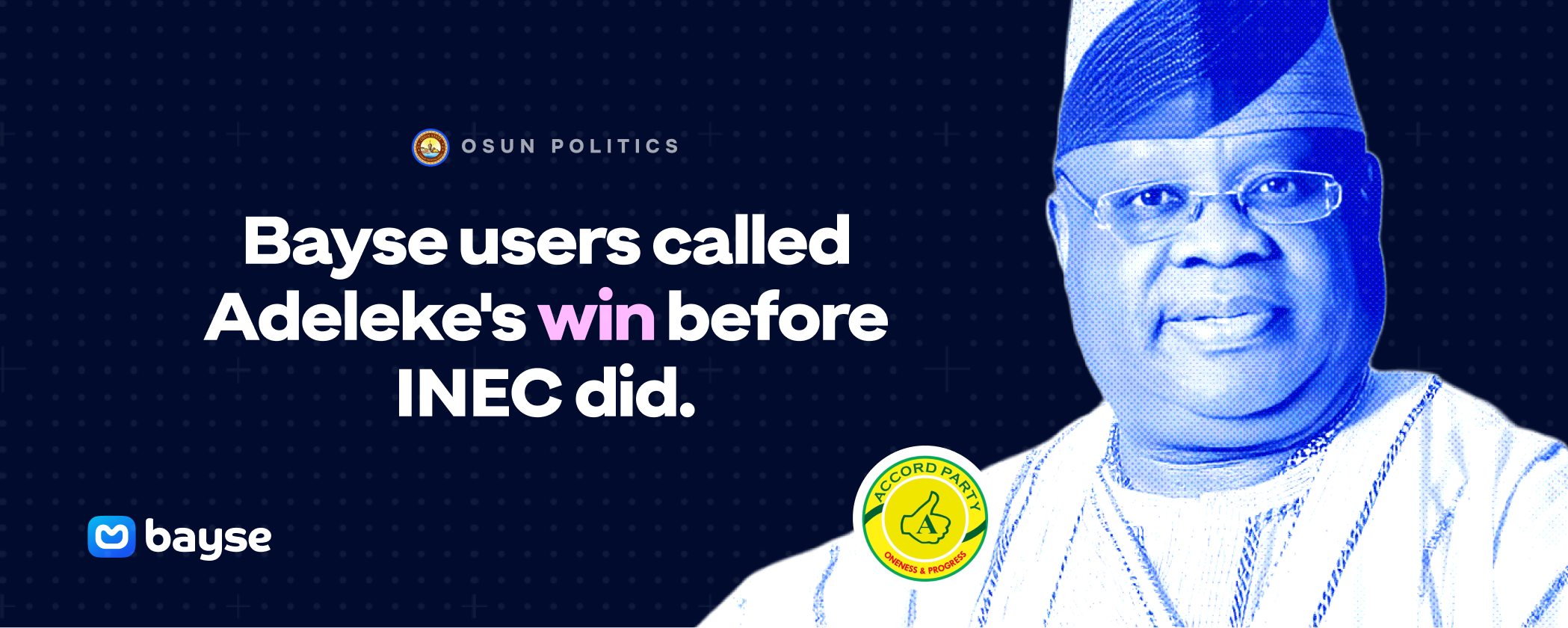
On August 16, 2026, Nigeria’s Independent National Electoral Commission (INEC) declared Ademola Adeleke of the Accord Party the winner of the Osun State Governorship Election.
For most of the country, this came after weeks of a tightening race. In the final stretch of campaigning, the opposition APC ramped up activity, and commentary across social and traditional media increasingly framed the contest as too close to call.
But on Bayse Markets, Africa’s largest prediction market platform, that framing never held up.
The market saw it coming
In the weeks leading up to the election, Adeleke’s odds of winning on Bayse averaged around 69%, climbing as high as 88% by election day itself.
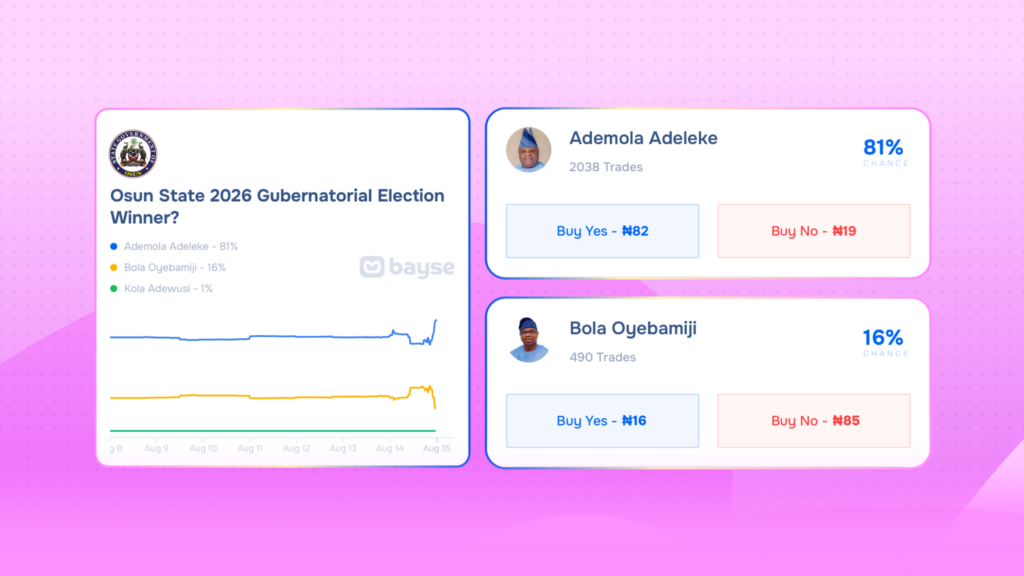
That is not the shape of a toss-up race. It’s the shape of a frontrunner pulling steadily away from the field while everyone else scrambled to catch up.
You May Also Like: Send App by Flutterwave Named Headline Sponsor of EbonyLife Place London Launch as Flutterwave Becomes Exclusive Payments Partner
The gap between public conversation and market pricing is the interesting part. X threads and news coverage suggested uncertainty. The market, priced in real time by people trading with real money on the outcome, told a different and ultimately more accurate story.
How a prediction market actually works
The mechanics are simple. Traders take positions on the outcome of a future event, in this case, who would win the Osun governorship race. If you believe a candidate will win, you take that side of the market. As more people trade on an outcome, the price shifts to reflect where sentiment is actually landing.
Because participants have skin in the game, they’re incentivised to trade on genuine conviction rather than noise. Aggregated across thousands of trades, the result is a real-time forecast, one that tends to reflect the actual state of a race more accurately than punditry or social sentiment alone.
A first for Nigerian politics
This is the first time Nigerians have engaged with, and profited from, a political prediction market at scale. Adeleke’s win on Bayse proves what these markets are built to do: surface where an outcome is genuinely headed before it’s officially confirmed. Prediction markets like Bayse have become tools for predicting what will happen in the future, and we might as well embrace them.
It also won’t be the last test. Markets are already live for the Oyo, Lagos, and Ogun governorship races, alongside the 2027 Presidential Election. As Nigeria heads into a dense cycle of consequential elections, these markets offer something distinct from polls or punditry: a live, financially backed signal of what’s likely to happen next.
Bayse Markets is positioning itself as that signal, and Osun is the first big receipt.
Last updated: August 20, 2026