




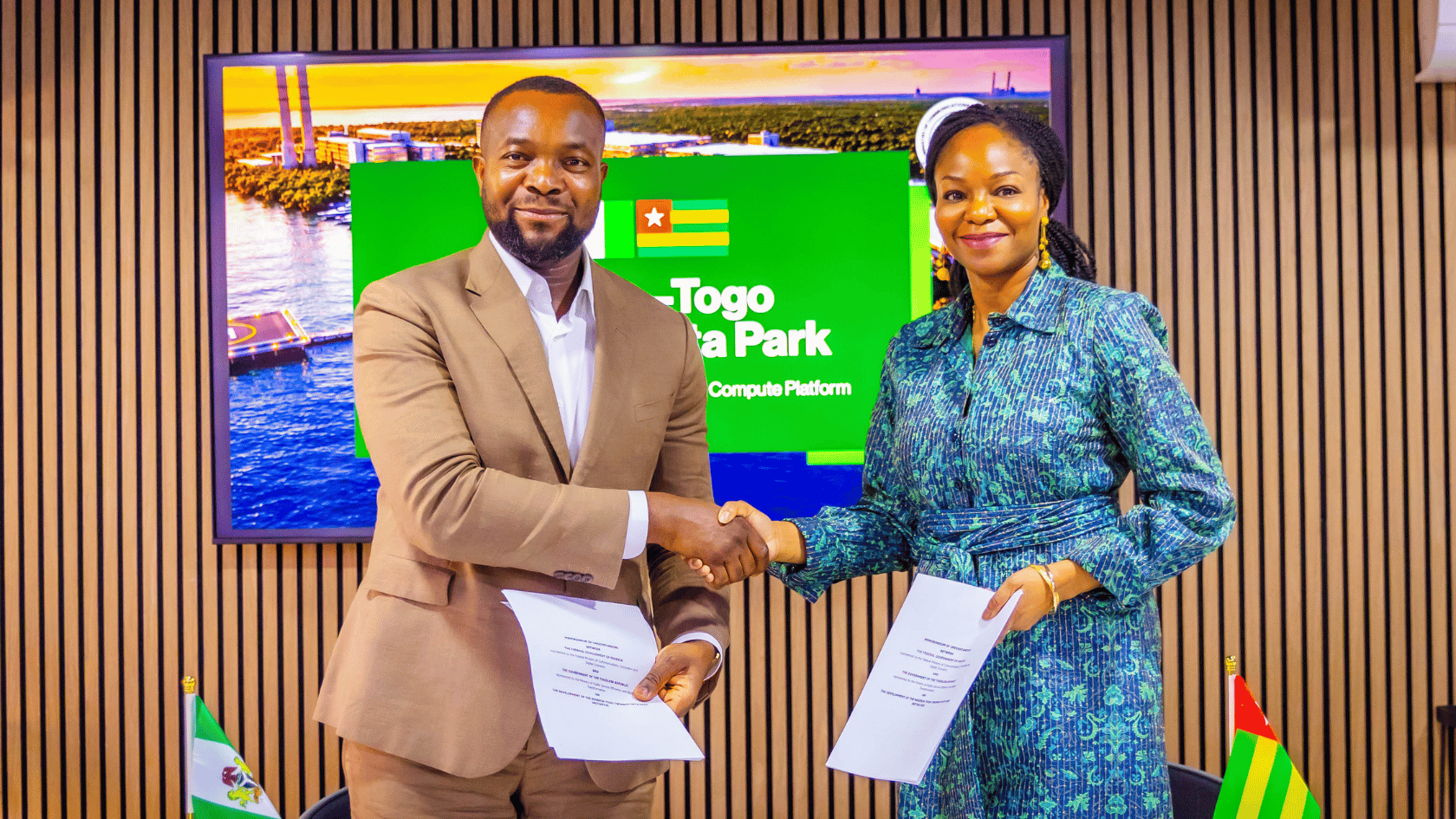
Nigeria and Togo have signed a Memorandum of Understanding to advance two proposed twinned data parks for West Africa. Advisers estimate the first phase could cost between $30 million and $50 million but are still working on a final figure.
Dr. ‘Bosun Tijani, Nigeria’s Minister of Communications, Innovation and Digital Economy, and Cina Lawson, Togo’s Minister of Digital Economy and Transformation, signed the MoU on Thursday, November 26.
The signing followed a site visit and a working session with the World Bank team. The parks remain a project under development, and technical, commercial and financing decisions still need further assessment.
Tijani said the plan is for both parks to become active at about the same time, so Nigeria will not start alone. On timing, he said the hope is to see some elements in place by Q2 2027, but highlighted that raising the funds for the project is not fully in the government’s control.
The proposed model would place both parks under one company owned by both governments and private investors.
“Government won’t be funding this fully,” Tijani said. “Government will back it with appropriate laws.” He pointed to the LNG model, where government holds between 25 and 49% and private investors hold the rest.
In other words, a proposed special purpose vehicle (SPV) is intended to bring together investment from both governments and private-sector participants.
Tijani also made clear what the project is not. “We’re not building data centres; we’re building parks so that data centre operators can come,” he said.
Why Egbin
The proposed Nigerian site is a plot next to Egbin Power Station in Ikorodu, which Tijani called the largest privately owned power plant in Sub-Saharan Africa. The site remains a candidate, subject to feasibility assessment.
Tijani gave four reasons for considering it. The plant offers power. The site sits by the water, which data centres need for cooling. It can connect to fibre and possibly a subsea cable. It also offers security, which he said matters because data infrastructure has become a target in conflicts.

Read also: Africa can’t afford to be left behind in AI, says Nigeria’s Bosun Tijani
Lawson said Togo’s candidate site has similar features. She said a new Togolese law lets the proposed company buy electricity from anywhere, including Nigeria. She also said the partnership helps Togo, because “small countries are less attractive when it comes to data centres” and larger operators have shown more interest in bigger markets.
The ministers also described a plan called a data embassy. Under it, a country that builds a data centre on the park would treat that space like its own territory, much as an embassy works under international law.
Tijani said this should help countries feel safe storing critical data in Nigeria. Both ministers want ECOWAS to back the rule.
“It shows that Africa is changing,” Lawson said of the partnership, which she described as the first digital project the two countries will do together. “This project is open to all of West Africa,” she added.
What it could mean for users
Tijani said data stored closer to users means better service.
Many apps today call data centres outside the region, and that adds delay. “Latency will be reduced, which means your services will be faster,” he said. Lawson said the project also aims to draw both French speaking and English speaking countries.
Last updated: November 27, 2026
People in this article