


After the first six months of 2026, widespread media headlines reported that Nigerians had spent ₦6.98 trillion on mobile internet data. Celebrated by uncritical commentators as proof of a thriving digital economy, this headline figure is, in reality, an illusion.
The ₦7 trillion figure is the product of a flawed calculation that multiplies raw network volume (8.52 million terabytes) against an assumed flat retail price of ₦800 per gigabyte.
To understand why the headline narrative breaks down, one must look at the actual revenues collected by mobile operators versus theoretical projections:
| Metric Category | Estimated / Audited Figure | Status & Real-World Basis |
| MTN Nigeria Data Revenue | ~₦1.70 Trillion | Verified Cash: Audited H1 financial filings reported to the Nigerian Exchange (NGX). |
| Airtel Nigeria Data Revenue | ~₦691 Billion | Audited Estimate: Extrapolated from Nigeria market segment financial postings. |
| Globacom & 9mobile Revenue | ~₦400B – ₦550 Billion | Market Estimate: Unaudited hazard estimate based on active subscriber market share. |
| Total Industry Cash Collected | ~₦2.80T – ₦3.20 Trillion | Realistic Revenue Range: Total audited cash earned across MNOs, fixed ISPs, and Starlink. |
| NCC Physical Traffic Baseline | 8.52 Million Terabytes | Verified Traffic: Official NCC volume metrics recorded across national networks. |
| Blended Market Model | ₦3.67 Trillion | Adjusted Valuation: Traffic calculated at a realistic blended benchmark (~₦431/GB). |
| The “₦7 Trillion” Headline | ₦6.98 Trillion | Flawed Projection: Flawed multiplication of total volume against flat ₦800/GB retail prices. |
In reality, while actual industry earnings sit between ₦2.8 trillion and ₦3.2 trillion, calculating exact national out-of-pocket spending requires acknowledging key market variables that the ₦7 trillion projection completely ignores.
Crucially, it is impossible to know precise consumer adoption splits for discounted off-peak night plans (often priced at ₦150-₦250/GB), bulk monthly subscriptions, or daily micro-promotions. These high-volume, lower-cost bundles significantly drive down the effective average price per gigabyte across the market. When evaluating traffic at a realistic blended rate of ₦431/GB, total market value drops closer to ₦3.67 trillion, aligning far more accurately with actual operator cash flow.
Even as an unverified projection, the ₦6.98 trillion headline figure eclipses the entire annual Internally Generated Revenue (IGR) of all 36 Nigerian states and the FCT combined, which stood at ₦5.15 trillion for the full year 2025. The fact that media outlets could credibly float a ₦7 trillion narrative underscores how central mobile connectivity has become compared to local tax collection.
The illusion of expansion
A rigorous examination by Condia of ground-level telecom engineering, audited operator financials, and enterprise balance sheets exposes the verifiable (still in trillions) figure for what it truly is: an inefficiency tax wrung out of citizens, not a badge of digital health.
The figure is artificially inflated by high data tariffs, the financial drain of continuous network retries, and a crumbling, off-grid physical infrastructure that forces consumers and businesses to pay significantly more money for increasingly unstable service.
The public narrative surrounding the data surge relies on the assumption that higher spending reflects a widening digital footprint. However, regulatory data says, far from expanding inclusion, market dynamics show a shrinking consumer base paying higher unit costs.
Recent Nigerian Communications Commission (NCC) metrics highlight that over one million active internet subscriptions dropped off the grid entirely in 2026.
Macroeconomic headwinds – driven by persistent inflation and a devalued naira – have turned digital access from a basic public utility into an elite privilege. With the cost of an entry-level smartphone climbing toward ₦220,000, millions of low-income Nigerians are priced out of device upgrades or line renewals entirely.
Consequently, total market revenue is not surging simply because a wave of new participants are joining the digital train.
Instead, an economically squeezed user base is being forced to spend more of its declining disposable income on data bundles simply to preserve basic daily survival, including executing transfers, maintaining remote jobs, and conducting basic commerce.
The telcos operate on a fractured backbone
To understand why data delivery is so expensive, one must inspect the physical environment through which bytes travel. Mobile network operators (MNOs) in Nigeria operate on a deeply fractured physical backbone.
According to official NCC disclosures, operators recorded an astonishing 155,397 fibre-optic cable cuts during April and May 2026 alone, an average of about 2,500 physically severed lines every day due to uncoordinated road construction, community friction, and outright vandalism.
155,397 fibre cuts recorded (April–May 2026)
[~2,500 fibre cuts per day across Nigeria]
→ Primary cause: Uncoordinated road works
→ Secondary cause: Vandalism & theft
→ Tertiary cause: Community / RoW conflicts
The operational expenditure (OPEX) footprint required to manage this level of physical disruption is immense. Telcos spent an estimated ₦27 billion to ₦35 billion annually patching severed lines.
Beyond fibre cuts lies the power trap. Over 75% of the country’s 50,000+ base transceiver stations (BTS) run entirely off-grid on diesel generators. When diesel prices trend upward, the baseline cost of maintaining uptime climbs symmetrically.
Abdulbaseet Olayinka Amoo, a telecom site acquisition specialist, emphasises the extraordinary capital requirements behind keeping rural and semi-urban sites functional:
“To build a single tower, fully equipped, costs between ₦40 and ₦50 million. Where fibre and microwave links aren’t feasible, and a satellite dish is the only option, that adds another ₦3 to ₦5 million on top.
“Site identification, community engagement, documentation and permitting alone can run up to ₦10 million or more depending on location… Put it together, and a single rural site can cost close to ₦100 million before it carries a single byte of traffic.”
Amoo notes that these capital outlays are routinely compounded by community-level operational friction:
“I once worked on an acquisition in Benue State where the company had to build and reconstruct a small bridge before we could even move equipment to the site… I was once called to negotiate a site in Kogi where the community stopped a diesel delivery over a promise made at acquisition that was never kept, and the tower went dark for days over it. So no, what a subscriber pays for data isn’t sitting on top as pure margin. A real share of it goes into standing the site up, then keeping it standing.”
The anatomy of “ghost” data depletion
For the average subscriber, the primary frustration centres on rapid data exhaustion. Consumers frequently report that data plan disappear faster than their usage habits justify. The root cause lies in the mechanics of packet transmission over unstable infrastructure.
When a network experiences structural instability, such as the 577 major network blackouts documented across various clusters in Q1 2026, data packets fail mid-transmission.
When a mobile payment on a banking or fintech platform freezes, or a web portal stalls mid-load, the user initiates a manual retry. This forced retry forces the device to re-transmit data packets from scratch, consuming additional bandwidth simply to complete a single transaction.
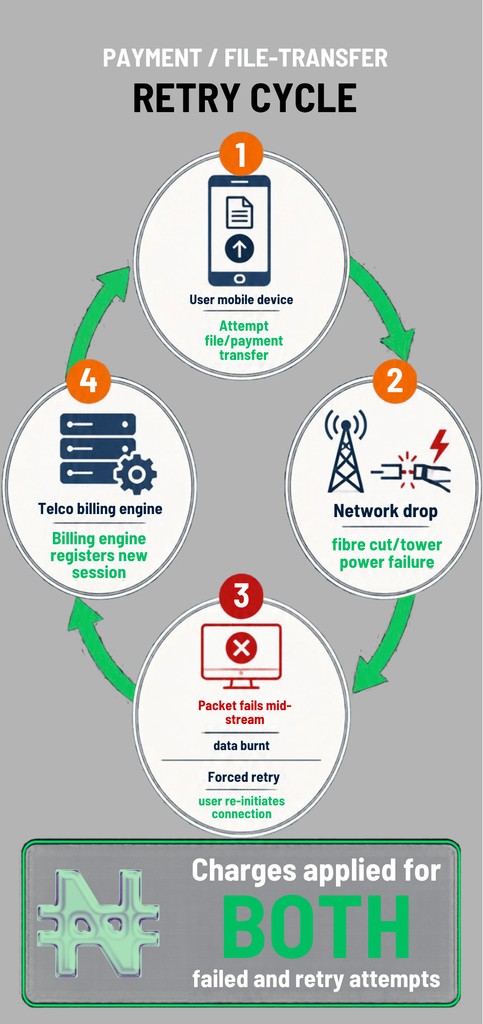
While independent NCC billing audits confirm that MNO billing engine hardware operates accurately, these metres record every byte sent across the airwaves, including lost or corrupted data packets generated during network drops.
Therefore, subscribers are technically billed accurately by the metre, but they are also paying for data consumed while devices attempt to re-establish dropped sessions.
Olalekan Ifatimehin, a telecom infrastructure expert, clarifies the technical distinction between billing systems and network performance:
“A failed transmission can trigger packet retransmission or an application retry, which consumes network resources again. However, that does not automatically mean the customer is billed twice. Network retransmission and customer charging are separate processes. The key issue is that poor network quality can create inefficiency and additional traffic.”
Ifatimehin emphasises that technical accuracy in metering does not equate to value delivered to the consumer:
“Accurate billing does not necessarily mean good service. A subscriber can be correctly billed while experiencing congestion, poor coverage, transmission problems or outages. The important thing is that the customer should not continually bear the consequence of service failure.”
Speaking further, Ifatimehin notes that focusing purely on headline spending metrics obscures the operational inefficiencies embedded within network delivery:
“I would not say a specific percentage of the spendings would disappear. Data spending is influenced by consumption, tariffs, inflation, exchange rates and digital adoption. However, better electricity and fibre protection would reduce diesel, restoration, maintenance and downtime costs. The real question is how much of the cost of delivering each gigabyte is being consumed by avoidable infrastructure inefficiencies.”
The middle-mile bottleneck and the business toll
A significant structural mismatch in Nigeria’s broadband ecosystem exists between coastal capacity and inland distribution. High-capacity subsea cables landing along the Lagos coastline offer abundant international bandwidth, yet transporting that capacity to regional markets inland remains expensive.
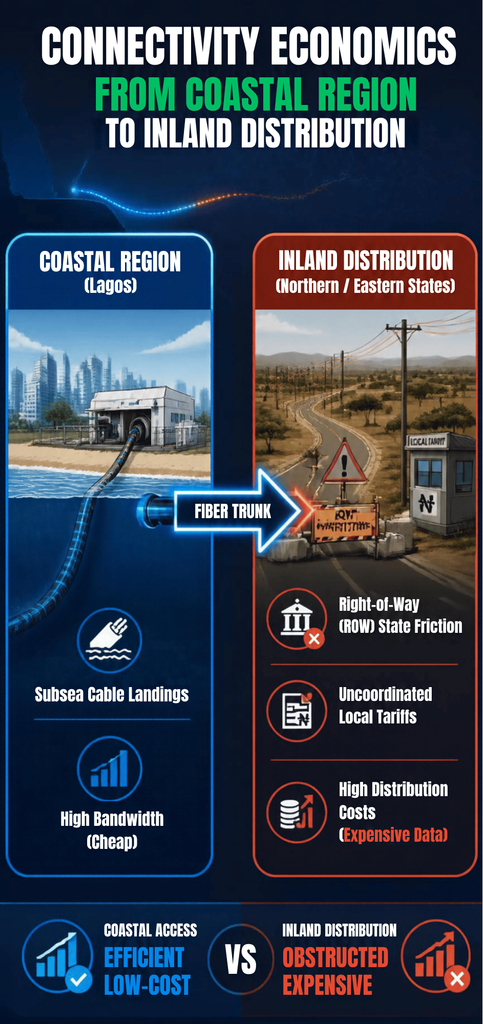
Amoo points directly to the state-level right-of-way (RoW) regulatory friction as the primary driver of this disparity:
“The cables landing in Lagos carry more capacity than the country is using. The cost climbs the moment that bandwidth has to move inland, because getting fibre from the coast to a town in the North means trenching and negotiating right-of-way across every state and local government the route crosses, each charging its own rate.
“Nigeria’s states agreed on a uniform ₦145 per linear metre back in 2013, but most states never adopted it, some still charge into the thousands per metre, and that cost gets built into what an operator has to recover from subscribers.”
The broader economic consequences of this infrastructure bottleneck are absorbed directly by commercial enterprises.
Emmanuel Ajopo, an entrepreneur and business consultant, explains how unstable connectivity acts as an unrecorded operating tax across corporate portfolios:
“Connectivity has actually become a recurring operating expense across all my business portfolios, particularly because so much of our communication, customer follow-up, and the coordination of business developments happens virtually… Connectivity interruptions create a lot of hidden productive costs. The cost may not be literal; it could just be the trust or the discomfort that an investor feels because of dropped calls.”
Ajopo details a recent high-stakes incident where poor network stability disrupted critical corporate capital acquisition:
“Just a few weeks back, I was in a meeting with a potential investor, and the network kept going off. I was having to connect and reconnect… I had to switch networks from my primary line to MTN and eventually had to ask a friend using Airtel to turn on a hotspot so I could stay in the pitch. That was a major blow for us. Lean startups run on tight margins, and any small delay or transaction failure from network retries directly inflates operational costs.”
Policy failures and the de-bloated narrative
The official response to systemic quality-of-service failures has begun to reflect the depth of the issue. The NCC’s implementation of the Consumer Compensation Framework, which mandates that operators credit subscribers for prolonged outages, functions as a formal regulatory acknowledgement that physical infrastructure is failing to meet basic service thresholds.
However, broader state policy continues to treat the telecoms sector as an extractive source of tax revenue rather than an essential public utility.
Multi-layer taxation across federal, state, and local government tiers combined with uncoordinated right-of-way pricing drains capital that operators could otherwise direct toward network expansion and energy transition.
Amoo outlines the core policy shift required to address inland distribution costs:
“If we want to fix this, we need to be more serious. We must enforce that one national right-of-way rate and build shared, open-access backhaul routes inland so operators aren’t each digging and paying for a private trench down the same road.”
Ajopo echoes the need to shift public debate away from top-line expenditure metrics toward real economic productivity:
“The conversation shouldn’t just stop at how much Nigeria actually spends on data, but focus on how much productive economic activity our network connectivity expenditure enables us to attain.
If we are spending more simply to maintain basic access to an essential service, we must look beyond data consumption and ask whether the underlying infrastructure is actually enabling productivity, commerce, and innovation at the level it should.”
Ultimately, Nigeria’s multi-trillion naira mobile data market represents an economic tax paid by consumers and businesses navigating fragile physical networks, high energy overheads, and regulatory fragmentation.
Until the federal and state governments treat telecom fibre networks as critical national infrastructure, harmonise right-of-way policies, and stabilise the macro environment, the nominal cost of connectivity will remain artificially high.
Headline statistics may continue to report record consumption totals, but without structural reform, those trillions will reflect capital consumed by systemic friction rather than value generated for Nigeria’s digital economy.
Last updated: September 29, 2026