

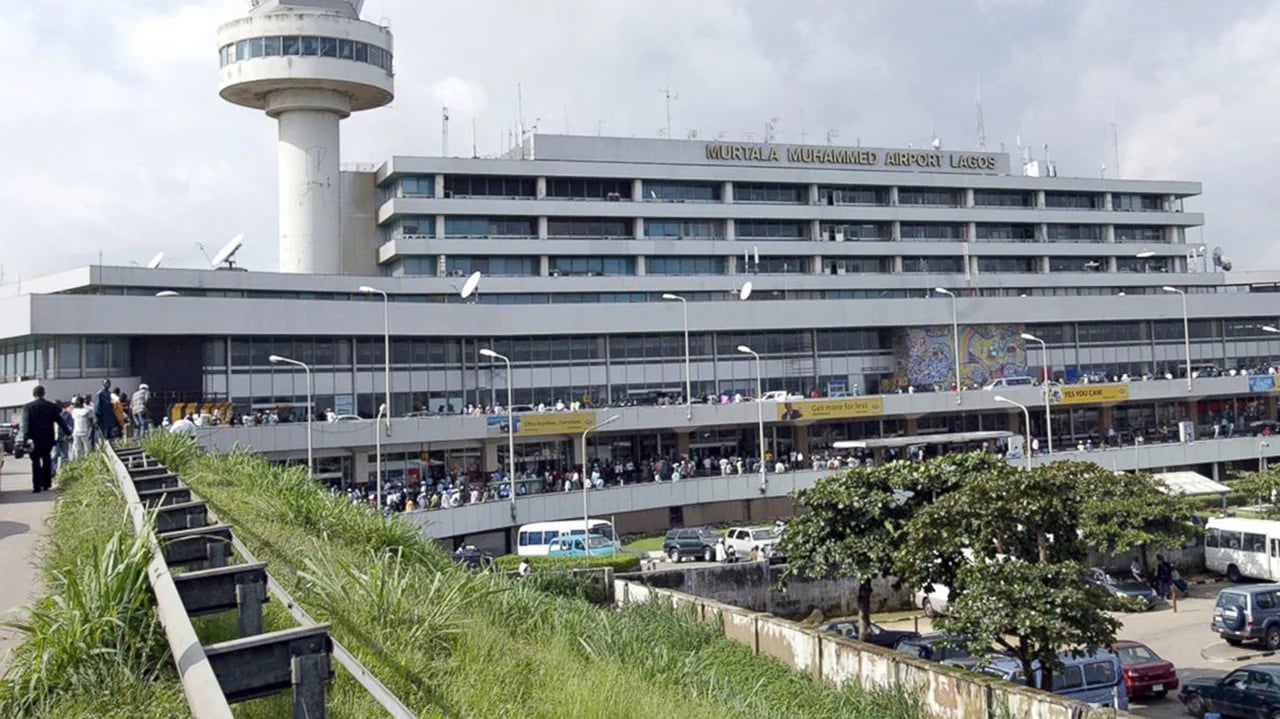
At the arrivals terminal of Murtala Muhammed International Airport in Lagos, travellers dragging luggage are increasingly walking past the airport taxis parked directly outside the terminal and heading instead toward bus stops on the airport’s outer perimetre. They are choosing a longer, less comfortable walk over a ride they say they cannot afford, and their choice reflects a pricing gap created by a federal directive that most passengers never see.
“I’m seeing a lot of people walking out now,” said a ride-hailing driver who used to serve the Lagos airport hubs and who spoke on condition of anonymity because he was not authorised to discuss FAAN policy. “At the local terminals, people are walking out to the bus stop to pick a ride there and be going to their homes. They would rather take public transport than order inside the airport at ridiculously high amounts.”
An internal Federal Airports Authority of Nigeria (FAAN) directive, corporate registry filings, and interviews show how the agency has used its regulatory authority over airport concessions to shape who can operate at Nigeria’s busiest airports and at what price.

FAAN did not respond to written questions sent on the record for this story. When contacted by phone, an official at the agency declined to answer questions about the current status of concession negotiations with ride-hailing platforms and asked that further questions be submitted in person at FAAN’s office rather than by phone or email.
Meanwhile, the policy rests on an internal memo addressed to the managing director of Bolt App Support Nig. Ltd. The memo states that pending finalisation and execution of a concession agreement, Bolt is directed to cease all commercial operations at FAAN-managed airports across the country with immediate effect.
The directive, dated July 27, 2026, does not describe itself as a ban. Instead, it withholds execution of the concession agreements — a commercial licence issued to businesses seeking to operate on airport property — that ride-hailing companies need to legally operate on federal airport property.
The memo was addressed to the app companies rather than driver associations, a distinction the driver said matters.
“They directed the memo to the app companies, not to the driver associations,” the driver said. “They are telling the app companies to put a geofencing barrier around the airport so the driver cannot pick anybody up.”
Once a ride-hailing app deploys that geofencing, the platform stops offering pickups to passengers standing in the arrival zone, even though drivers using the same apps are still permitted to drop off departing passengers, since FAAN cannot block public access roads used for departures.
The app behind the rides
FAAN’s airport transit app, the mandatory booking and dispatch platform that airport taxi operators are required to use once a driver’s vehicle is registered onto the approved system, has changed hands since it first launched. But there’s still a lot of confusion between the app that appears in some listings and the one FAAN actually uses.
According to app stores reviewed for this story, the original FAANTaxi app was built by Zacrac Integrated Ltd. Company records list Adewale Zacheus Adeyemo, who goes by Wale Adeyemo and has described himself publicly as the company’s chief executive and co-founder, along with Abigael Titilade Aina, as directors and shareholders of the firm. CAC records show two related entities under the same group, Zacrac Learning Limited and Zacrac Farms Limited. The Zacrac-built FAANTaxi app struggled with technical problems, particularly on Android devices, where passengers reported being unable to complete bookings, and it remains listed today on Apple’s App Store even though it is no longer FAAN’s active platform.
FAAN has since moved its official transit activity to a different application altogether, one published under a different developer account and built by a different technology partner. The current platform, listed on Google Play and also on Apple’s App Store as FAAN ACHRAMS Passenger, is published by AB Uobis Limited.
The underlying technology, however, belongs to a separate company. ACHRAMS Nigeria Limited’s own terms of service state that the platform is designed, built, and powered by Excelian Technologies, which the terms describe as the developer of record for the app’s software and infrastructure. Publicly available company information lists Abubakar H. Umar as Excelian’s founder, president and group chief executive, Abubakar M. Shehu as director and principal partner, Ifeanyi Mbah as chief technology officer, and Murtala Jinjiri as chief operations officer.
The result is a system with three names attached to two functions. Passengers searching app stores for an official FAAN taxi service can still find the older Zacrac-built FAANTaxi app sitting alongside the newer AB Uobis-published FAAN ACHRAMS Passenger app, with no indication in either listing that only one of them connects to FAAN’s active dispatch and payment system.
AB Uobis appears as the registered publisher and commercial operator, while Excelian Technologies, according to its own platform’s terms of service, built and maintains the software underneath it, with FAAN itself operating the payment gateway that both companies’ terms describe as the mechanism through which driver commissions are collected.
Unlike commission structures on standard ride-hailing apps, where the platform itself takes a cut of each fare, the ACHRAMS system routes driver commissions and platform fees through a FAAN-operated payment gateway, according to the platform’s own terms of service. Those terms also state that during the current pilot phase, passengers pay drivers directly in cash rather than through the app, meaning the fare itself changes hands outside any centrally recorded system.
A more expensive alternative
The gap between what standard ride-hailing apps charge and what FAAN-approved platforms charge is where the policy’s effects reach passengers most directly. The driver who spoke to this reporter shared that fares on FAAN-approved airport taxi platforms run far higher than equivalent trips on standard ride-hailing apps.
He alleged that a trip from the airport to Lekki Phase 1, which he said typically costs between ₦10,000 and ₦12,000 on standard apps, is priced at between ₦50,000 and ₦70,000 on the official airport platform.
That figure, the driver continued, reflects the app’s quoted fare and does not account for the extra cash some drivers on standard apps request directly from airport passengers.
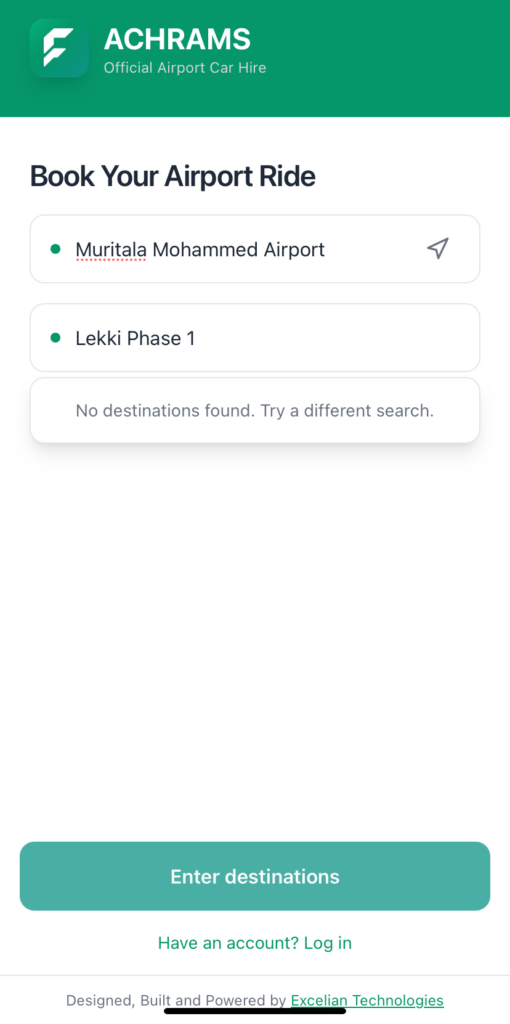
Attempts to use the app by this reporter kept displaying a ‘No destinations found’ message.
The driver further alleged that FAAN’s vehicle requirements for airport taxi operators, which initially called for cars from 2020 or newer, have functioned less as a safety or quality standard and more as a barrier that benefits well-positioned insiders. He alleged that FAAN staff themselves supply some of the newer vehicles used on the approved platform.
“The claim is that the cars are new and should be the ones patronised,” he said. “But because there is no patronage on their end, they decided to bring this ban. Meanwhile, it is the staff of FAAN that have those cars. It is them that are bringing the cars onto the platform because they can afford it.”
FAAN was asked about the vehicle mandate and about potential conflicts of interest in vehicle onboarding as part of the written questions sent for this story and had not responded to those questions by the time of publication.
According to the driver, officials within FAAN justify the pricing gap by reasoning that a traveller who can afford an international flight can afford a costly taxi fare. He disputed that logic directly.
“You don’t know who the passenger is,” he said. “Do you know if the trip was office funded? Do you know if it was sponsored by a philanthropist who just wanted the person to travel? You arrive at the airport, you want a ride that is affordable for your budget, and then you are told you must pay an outrageous amount just because you stepped off a plane.”
For passengers unwilling to pay the premium fare, the remaining option is to walk past the terminal and out to the perimeter road, where standard ride-hailing apps still work.
Responding to the backlash, FAAN announced on August 27 that it has resolved its dispute with Bolt and cleared the platform to resume operations at its airports immediately.
In a statement signed by Henry Agbebire, the agency’s Director of Public Affairs and Consumer Protection, FAAN apologised to passengers for the disruption and said the original restrictions were driven by safety, security and accountability concerns rather than commercial interest.
The agency also pushed back directly on the framing of ACHRAMS as a monopoly, stating that the platform is a queue management system for airport car hire ranks rather than an e-hailing competitor to Uber and Bolt, and that it does not seek to displace competition.
On pricing, FAAN said the fares that drew public criticism were not newly created by ACHRAMS or by the agency, and that airport taxi rates existed independently of the app, though it acknowledged that the platform made those rates more visible to passengers used to lower e-hailing prices.
FAAN said discussions with other e-hailing operators remain ongoing and that it expects resolution in the coming days, which suggests Uber’s status was still unresolved as of the statement.
Read also: Bolt data shows rising airport trips despite growing insecurity
Last updated: August 27, 2026