



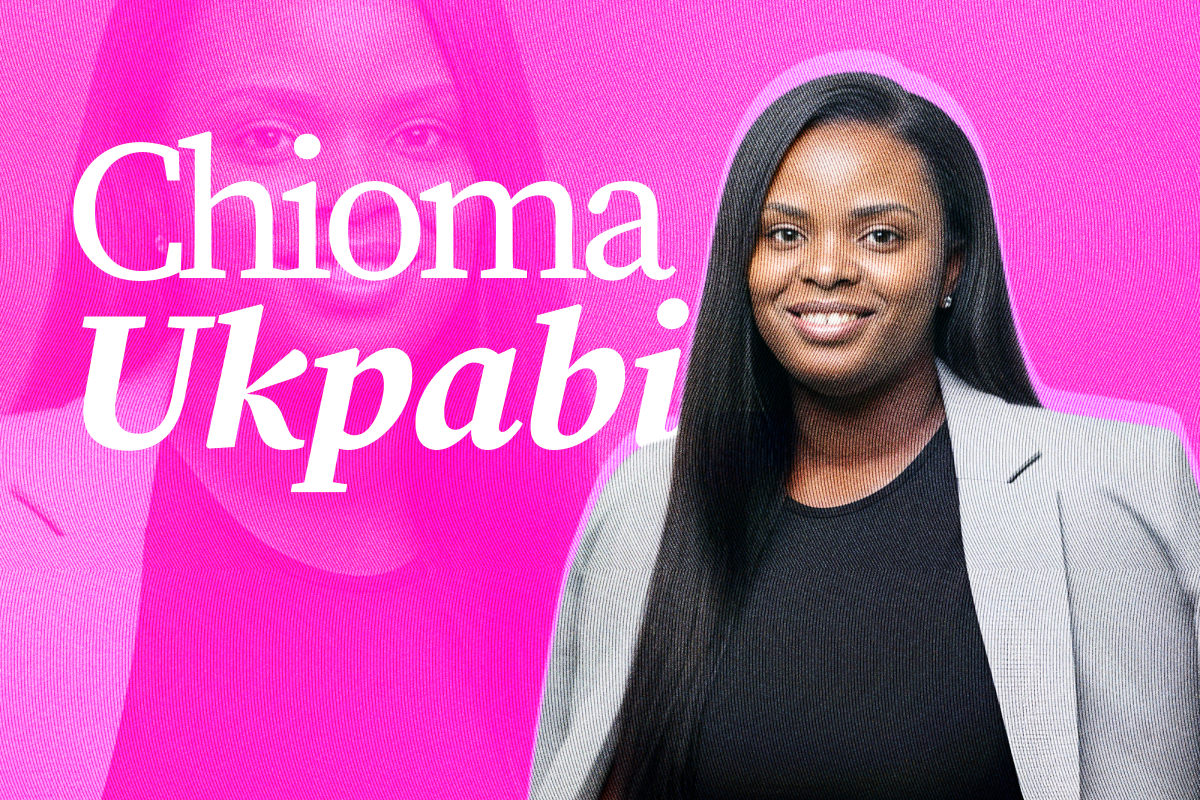
As part of this year’s International Women’s Day celebration, Condia spotlights Chioma Ukpabi, the CEO of the edtech company Suwk Technologies and chief marketing officer at OpTracka.
She arrived early, in her own car. She had been asked to speak and receive an award. She was, by any measure, a guest of honour. And yet when she walked into the conference hall, one of the sub-organisers looked straight through her, shoved her off with a wave of the hand, and moved on. Chioma Ukpabi stepped aside. She found a corner, sat down, and watched.
She wanted to see if it was personal, but it wasn’t. The same woman did it again to the next female panellist and the one after that. Then the only male speaker, a Nigerian celebrity, arrived, and the sub-organiser suddenly became warm and full of deference.
The female speakers didn’t let it go. They waited for the main organiser, reported what happened, and insisted on an apology.
“I have been treated like that a couple of times,” Ukpabi told Condia. “I think it’s a thing most women face.”
The accidental tech woman
Ukpabi will tell you plainly that she did not see herself as a tech person. She studied communications. When she landed her industrial training (IT) placement at Megamound, a partial tech but real estate giant, as a student.
The experience continued when she later returned to the company for her NYSC placement after graduating. She made one thing clear from the start: no core tech departments. They placed her as an administrative assistant, and she spent that time learning how to track and organise files, something that turned out to matter. Her team still acknowledges it today.
She got that first placement through her mother.
After completing her service year, she chose to move on and explore building something of her own. What followed were several entrepreneurial experiments, including launching a shoe brand and other ventures, which led to a career in tech; experiences she says helped shape the business instincts she carries into her work today.
The moment that changed her direction was almost accidental. She discovered she could build a website on Canva. That was it. No coding bootcamp, no formal training. She simply realised that most people didn’t know what she now knew, and she started charging ₦50,000 for a website. Then ₦250,000. “You don’t need to code,” she said. “Just think.”
Her first seven-figure payment came from a founder she met at a startup event. They exchanged contacts, stayed in touch, and later he reached out for help with a specific problem in his business.
“What he needed help with was slightly different from what I had previously delivered for clients,” she explained. “But it was still within the scope of the kind of work I understood.”
Rather than turn the opportunity down, she leaned into it. She studied the problem, structured a solution, and executed the project.
“I went back, did the research, figured out how to approach it properly, and delivered,” she said.
That consulting engagement, valued at about ₦1.5 million, became the first time someone paid her a seven-figure fee for her work in tech.
She told this story to make a specific point about women and risk. In her observation, women take extraordinary personal risks—packing their bags, travelling across states, trusting strangers in ways that have real stakes and then become conservative when money enters the picture.
“I want them to stand on business,” she said. “Take calculated risks when it comes to money, the way you take risks in other parts of your life.”
To illustrate the pattern, she recalled two vendors she once approached. The male vendor quoted ₦1,000 and held firm. The female vendor was unsure of her price and sold for ₦800, a ₦200 loss she didn’t need to take.
“She wasn’t sure of the price,” Ukpabi said. “The loss was not forced on her. She gave it away.”
What has actually moved and what hasn’t
Ukpabi was precise about funding for women. Funding is coming to women, she acknowledged. But she has watched what happens in the selection room. “80% percent of the time, these women are not really prepared,” she said.
She included her former self in this. “Luckily for me, I had a male co-founder whose logical thinking helped,” she said.
But she does not think that luck should be the variable. She thinks women need to close the preparation gap and stop expecting their gender to carry them past the parts that require work.
On accelerators and incubators, she offers a more critical perspective on certain programme models. While acknowledging the value many initiatives bring, she questions formats that bring together very large numbers of participants for long training cycles, only for a very small number to eventually receive funding or tangible support. According to her, this structure can sometimes create unnecessary competition among participants and may not always translate into meaningful outcomes for most founders involved. She encourages programme designers to rethink empowerment models so that they deliver clearer value to participants and make better use of entrepreneurs’ time.
Her advice is that if you are seeking funding, only apply to programs where every participant is guaranteed a specific amount.
She also believes mentorship needs to be more intentionally structured and valued. In her view, women should be encouraged to invest in mentorship where possible, as it often creates commitment and access to more meaningful guidance. From her experience, purely free mentorship can sometimes come with limitations in the level of engagement and support available.
“My secret is that I use a stage growth ladder,” she explained, a mental framework where she identifies women ahead of her at each level, deliberately targets what they know, and then moves up the ladder as she grows.
The woman she studies, the stories she keeps
The woman Ukpabi looked up to died during her early years at the university. She has written about it and said it many times, and she said it again to Condia: Late Dora Akunyili, a director general (DG) of the National Agency for Food and Drug Administration and Control (NAFDAC). “She was kind, had a high moral standard, and had integrity. I really wish she had stayed longer,” said Ukpabi.
For sustenance, she has been watching The Mentalist, a TV crime drama series where the main character uses mental skills to solve crimes. to sharpen her ability to read the gap between what people say and what they actually mean. In business, she said, that gap is everything. The show she returns to most for inspiration is Two Broke Girls—two women who lost everything, started over, and went back to school. “It inspired me to want to go back to school,” she said.
She is also firm that women must stop waiting to be ready. “If Chef Dammy hadn’t started, Lemfi would never have reached out to her,” she said. “Women need to start breaking out of that jinx that ‘there is someone better than me.’”
What does she want to be known for beyond the title, the tools, and the company?
She quoted her Instagram post, something she had already written a day before. “Truth or dare. But I’m only interested in socially impactful dares. Shall we?”
Get passive updates on African tech & startups
View and choose the stories to interact with on our WhatsApp Channel
ExploreLast updated: March 10, 2026


