


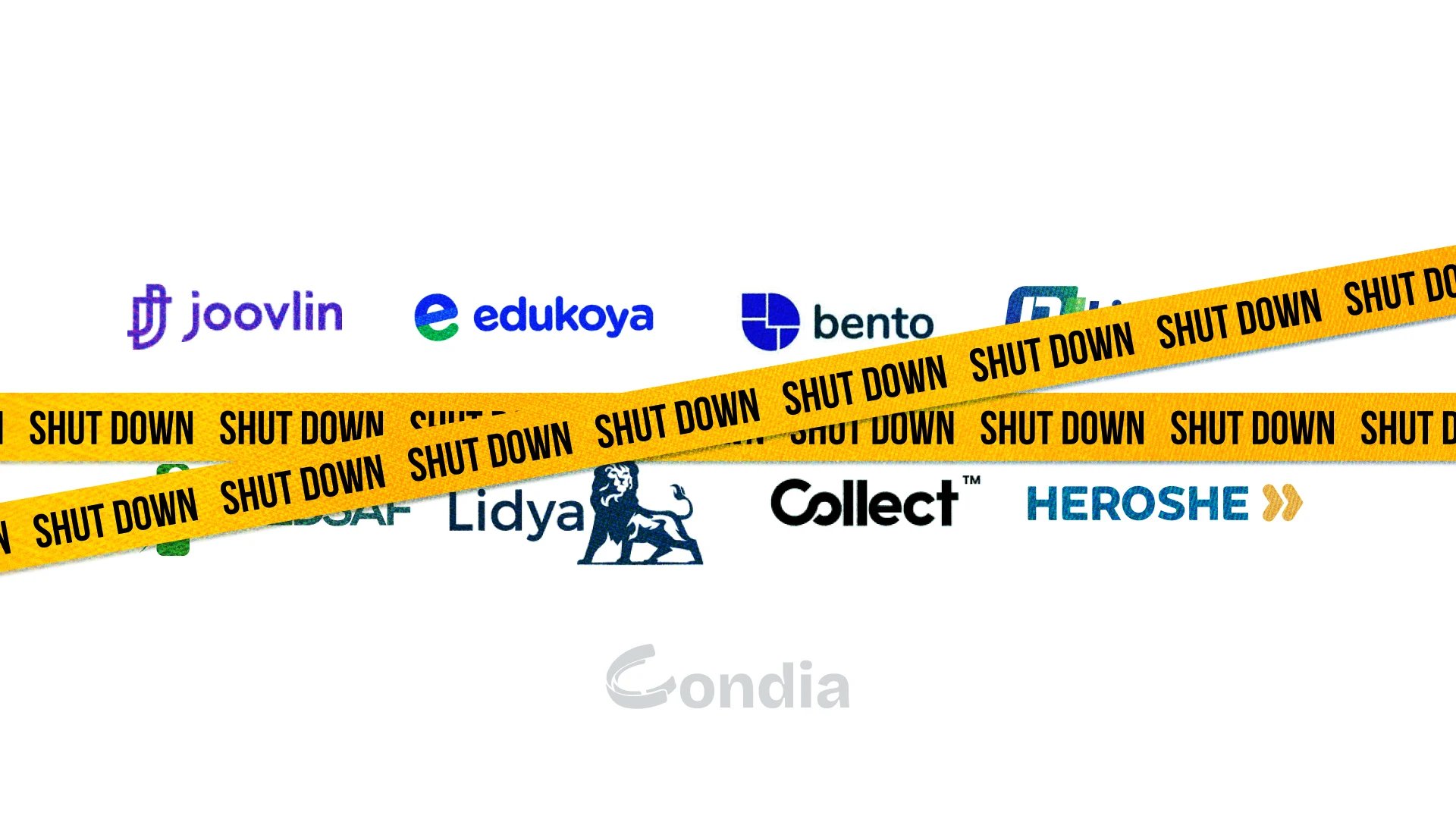
The African tech ecosystem grew in 2025. More startups launched, and venture investments increased compared to 2024.
However, it also faced painful corrections. The time to raise funds elongated, and several startups shut down. The shutdowns were agnostic to sector, funding level, founder experience or age of the company.
By our count, fintech saw the most shutdowns in 2025. This aligns with broader ecosystem dynamics where fintechs are the prominent and receive the most funding.
Likewise, Nigeria had the most startups that shut down, indicating activity and volatility in the country.
Nigeria’s Okra is also not on this shutdown list because it’s undergoing restructuring. Lipa Later, which entered administration in March 2025, was eventually rescued for $24.5 million in a leveraged buy-out (LBO) transaction. So, that has been removed from the list.
Otherwise, find below the list of African startups that shut down in 2025.
1. Joovlin (Nigeria)
Founded: 2019
Sector: Fintech
Total disclosed funding: $100,000
Founders: Kingsley Nwoos, Yusuf Olalere, Lucky Mark
Joovlin built tools to help small suppliers and retailers digitise operations through a single app that enabled inventory management, order tracking, and social-commerce integration. By 2022, it hosted more than 2,000 active vendors and over 6,000 products.
Despite early traction and a $100,000 seed round from MEST Africa, Joovlin struggled to scale its user base or generate consistent revenue. With no further funding and mounting financial pressure, the company’s CEO announced its shutdown in January 2025.
2. Edukoya (Nigeria)
Founded: 2021
Sector: Edtech
Total disclosed funding: $3.5 million
Founder: Honey Ogundeyi
Edukoya aimed to transform K–12 learning through live tutoring and curated academic content. Its $3.5 million pre-seed round became one of the continent’s largest edtech raises. At its peak, the platform supported over 80,000 students, delivered thousands of daily classes, and logged more than 15 million solved questions.
But scaling proved difficult. Limited internet access, device constraints, and low household purchasing power weakened the business model. After several pivots and unsuccessful partnerships, Edukoya closed in February 2025, returning the remaining capital to investors.
3. Bento (Nigeria)
Founded: 2019
Sector: HRtech
Total disclosed funding: $3.1 million
Founders: Ebun Okubanjo, Chidozie Okonkwo
Bento Africa was a pioneer in the payroll and HRtech space in Africa. At the peak of their powers, they had over 1,000 businesses, including Moniepoint, Paystack, and Bamboo, using them.
In March 2022, they faced public backlash over “Tyranny in the workplace“. At the time, the board temporarily suspended CEO Okubanjo, the protagonist.
Towards the end of January 2025, the company started facing allegations of unpaid pensions, tax irregularities, and unresolved salary disputes. A few days later, the CEO Ebun Okubanjo resigned, and the board opted for a temporary shutdown to manage outstanding obligations.
No timeline has been announced for a potential return.
4. Medsaf (Nigeria)
Founded: 2016
Sector: Healthtech
Total disclosed funding: $7 million
Founder: Vivian Nwakah
Medsaf connected hospitals and pharmacies to safe, quality-assured medications through a digital marketplace, aiming to combat fake drugs in Nigeria’s supply chain.
The startup won the Bill & Melinda Gates Foundation prize for the Malaria challenge in 2019. It worked with over 1,000 hospitals and raised more than $7 million from investors.
However, FX shocks, investor pullouts, a failed acquisition attempt, and outstanding debts ultimately forced Medsaf to shut down. While it ceased operations in March 2024, its eventual shutdown became public this year.
5. FanBants (Nigeria)
Founded: 2021
Sector: FanTech / Fantasy Sports
Total disclosed funding: $20,000
Founder: Fola Folowosele
FanBants created fantasy leagues for AFCON, the NPFL, global tournaments, and even reality TV shows through its “Gist Markets” feature. The platform recorded over 50,000 Android downloads and joined the Techstars Minnesota Twins Accelerator in 2022.
Super Eagles player and professional footballer, Wilfred Ndidi, was an investor and a partner in FanBants, likewise, Ozoemena “Ozo” Chukwu, a former Big Brother Naija housemate and SuperSport football show host.
The startup announced its shutdown in 2025 without providing a specific reason.
6. Afristay (South Africa)
Founded: 2006, as Accommodation Direct
Sector: Travel
Total disclosed funding: $2.2 million
Founders: Oliver Bryant, Ric Meulemans
Afristay, an accommodation marketplace which raised money in 2017 to rival Airbnb, halted operations in early 2025.
Director Rupert Bryant reported that by the end of 2023, the business had sharply declined, reaching only about 30 monthly bookings and operating with two part-time staff before deciding to close.
7. Lidya (Nigeria)
Founded: 2016
Sector: Fintech
Total disclosed funding: $16.45 million
Founders: Tunde Kehinde, Ercin Eksin
Lidya was once a flagship African digital lender, offering fast, collateral-free loans to SMEs. The company claimed to have reviewed over $50 billion in credit applications and disbursed $150 million to 32,000 businesses.
But efforts to expand into Poland and the Czech Republic in 2020 stretched resources. Operational costs surged, and profitability lagged. By 2023, the company exited its European markets. Combined with a harsh funding environment and internal difficulties, the Lidya shut down in 2025.
8. Heroshe (Nigeria)
Founded: 2019
Sector: E-commerce/Logistics
Total disclosed funding: $275,000
Founders: Osinachi Ukomadu, Chichi Ukomadu, Joseph Cobhams
Heroshe built a logistics platform to help Nigerians shop from the US, UK, and China. It served individuals and businesses for several years but began deteriorating in 2024 due to financial constraints.
Customers reported missing packages, communication failures, and unexpected charges. After eight months of turbulence, Heroshe shut down, making it one of the Nigerian startups that ceased operations in the first half of 2025.
9. Collect Africa (Nigeria)
Founded: 2021
Sector: Fintech
Total Disclosed Funding: $135,000
Founders: Abraham Ojes, Wale Martins
Collect Africa enabled SMEs to manage payments via transfers, POS, QR codes, links, and direct debits through a unified dashboard. The platform processed more than $4 million in payments for 5,000 businesses.
Collect Africa shut down operations by August 31, 2025, as the team shifted focus to a new stablecoin venture, Autospend. The founders say the pivot reflects a larger global opportunity rather than distress within Collect Africa.
In conclusion, the closure of well-known players like Lidya and Medsaf, all led by experienced founders, shows a maturing ecosystem where even strong pedigrees cannot shield companies from market realities.
Despite the closures, the wider market showed early signs of stabilisation. African tech shutdowns dropped to six in the first half of 2025, down from nine in the same period in 2024. Layoffs also declined sharply—765 in H1 2025 compared to 1,730 in H1 2024, a 56% drop—suggesting that the period of major market correction may be easing.
At the same time, mergers and acquisitions rose as startups sought consolidation for survival, though many of these deals were driven by necessity rather than high-return exits.
Still, the year’s closures reveal that startups with strong paths to profitability are attracting investment, while early-stage companies or those with heavy operational models struggled to stay afloat.
Editor’s note, Dec. 6, 2025, 1:08 PM (WAT): We’ve made several finetunings to this article. Including:
- Updated Bento’s fundraised to $3.1 million based on data from Pitchbook
- Removed Y Combinator and Techstars mention from Medsaf
Get passive updates on African tech & startups
View and choose the stories to interact with on our WhatsApp Channel
Explore


