




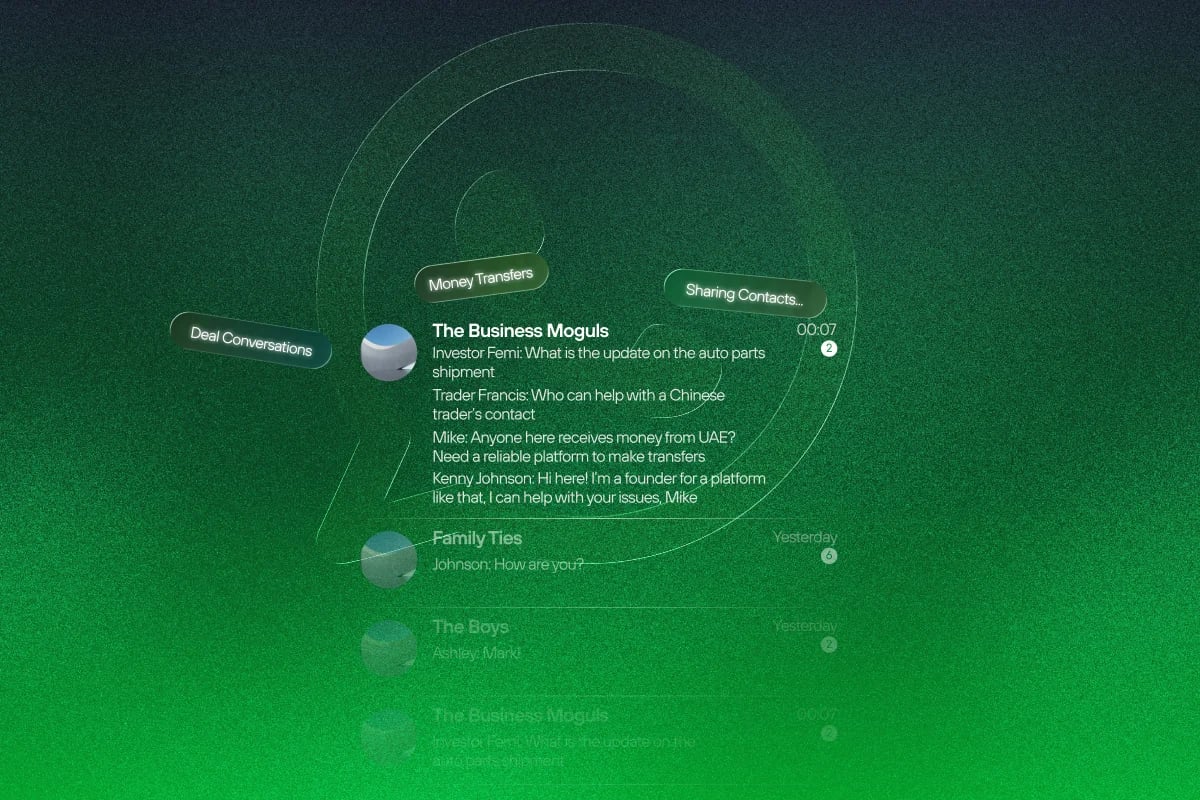
Before Verto had a platform, Ola Oyetayo had a group chat. In the company’s early days, he and his co-founder added their first customers to a WhatsApp group, coordinated FX rates inside the thread, resolved payment bottlenecks in real time, and ran what was effectively a currency exchange through a messaging app before any formal product existed. The platform came later; what Verto eventually built into a cross-border payments infrastructure processing over $25 billion annually, serving businesses from Lagos to Unilever and Maersk across 49 currencies, began as a chat where trust moved faster than any system could.
That sequence is not unique to Verto, and it is not really a WhatsApp story. The infrastructure is wider than one app. Telegram handles volume, particularly in P2P crypto and foreign exchange groups where hundreds of participants need to coordinate at speed. X Spaces functions more like a live deal room, where founders pitch in real time, and connections form in public. Discord holds tighter, more specialised communities.
People move between these channels depending on what they need, and the need is almost always the same: to find someone they can trust quickly enough for something actually to happen. WhatsApp, available to two billion people globally, sits at the centre of that spread. That is where the close-range, high-stakes conversations live, the ones where having someone’s number in your contacts already signals access, history, and the unspoken promise of a warm introduction, a lead buyer, a co-founder, a regulatory contact at nine in the evening, or a deal that never gets announced anywhere.
The only functioning architecture
This reliance on the informal grew from a convenient habit into a structural necessity between 2023 and 2026. The shift was driven by three colliding forces that forced the underground network into the light.
Three factors collided between 2023 and 2026 to make what was always true suddenly visible at scale. First, the naira lost more than 70% of its value against the dollar following the 2023 FX reforms. This compression did not slow financial activity; it simply pushed it further into the threads. P2P crypto groups and FX coordination chats expanded rapidly as reputation-driven alternatives to a banking system that could not supply dollars at functional rates. For many, the group chat effectively became the FX desk.
At the same time, Nigeria’s startup ecosystem went through its own correction. As funding tightened and the era of growth-at-any-cost wound down, founders operated with more discipline and discretion. Unscripted introductions and back-channel hiring became more valuable because formal channels like investor decks and LinkedIn outreach carried too much public scrutiny. The network moved into private chats not to hide, but because that was where the real work happened.
This shift was reinforced by a generational tilt.
The cohort that entered professional life after 2009 did not simply learn to use these tools for work; they built their professional identities inside them. Jobs, reputations, and early client relationships all formed in DMs. By 2025, cheap data and broad mobile penetration had matured that behaviour into default infrastructure. It was no longer a workaround. It was the first thing anyone reached for.
Trust travels with the person, not WhatsApp
This generational shift explains why these groups run on a form of collateral. For a freelance event coordinator like Anuoluwapo Niyi, sourcing a vendor through a chat is not a shortcut but a transfer of risk. Every referral in a WhatsApp group carries the weight of the person who shared it. The decision to hire someone is also a decision to trust the reputation behind their introduction.
You see the rules more clearly when the system fails. When Niyi hired a mascot vendor through a formal Instagram outreach, the vendor disappeared and refused to admit fault. There was no cost to that silence.
In a referral network, the person who made the recommendation shares the damage if things go wrong. Accountability doesn’t sit in a contract. It sits at risk of being cut off from the network.
Amanda Etuk, Program Director at Cascador, sees this same logic operating at a higher altitude. She watched a founder drop a regulatory question into an alumni group at 9:00 PM and get a warm introduction to the exact contact he needed by 9:15 PM. That kind of turnaround compresses what would normally take weeks of cold outreach. It works because the group already carries shared trust.
Etuk views the alternative as a form of corporate performance. This is the posture platforms like LinkedIn require, where everything is public-facing, and everyone is presenting a version of themselves rather than asking for what they need. WhatsApp removes that layer. Having someone’s number implies proximity. It suggests a relationship exists, even if it has not been tested.
The outcomes of this proximity are not anecdotal. Within the Cascador alumni group, an opportunity from the NSIA NPI 3.0 program was shared. GeroCare applied, got selected, and secured $50,000 in cash and equity, along with a placement at Draper University. In the Accelerate Africa alumni group, the Zecathon opportunity surfaced and Messenger received a ₦2.5 million grant. These deals started in a chat thread, not a formal pipeline.
Verto’s trajectory is the clearest illustration of what this foundation can become. The company started with a WhatsApp group serving customers who needed help moving money across borders. It now processes payments in nearly 50 currencies across more than 190 countries. The WhatsApp group was not a workaround. It was the first version of the product. It was where Oyetayo learned the actual shape of the problem, where regulatory friction lived, and where the pace of customer response made or broke trust. Doing things that aren’t fancy in the early days teaches the basics.
The reason these groups work at small scale and degrade as they grow is not particular to Nigeria. Research suggests people maintain roughly 150 stable relationships, with a much smaller inner circle of about 15 where genuine reciprocity exists. Beyond that, the mechanisms that sustain trust begin to weaken. WhatsApp does not remove that limit. It works within it. The most reliable groups are usually built on shared history, an accelerator, a school, a previous job. The accountability is already there before the first message is sent.
How groups lose their value, and why some don’t
The evolution of these spaces follows a predictable arc: as a group scales, its utility often inversely declines. Etuk is direct about this dilution. In the early days of the ecosystem, private groups were a reliable source of high-quality opportunities. But as many of those communities began to monetise or expand too quickly, the signal-to-noise ratio shifted. More gatekeeping and more “fluff” meant fewer genuinely valuable opportunities surfaced organically.
The groups that still function at a high level are almost always alumni networks. These are communities anchored by a shared prior experience, a gruelling accelerator program or a university degree, that creates a layer of accountability without requiring explicit rules.
The unspoken logic of these groups follows a clear principle: you have to earn the right to ask for things. Founders who appear only when they need a favour, without prior participation, are rarely met with enthusiasm. In a network where reputation is the primary currency, there is no free lunch. This isn’t a new social dynamic; it is the same one that has governed informal trade networks and market associations in Africa for generations. WhatsApp simply made the ledger faster and more legible.
This is also why group quality degrades when the barrier to entry falls. A closed network maintains its signal because membership is earned, and the stakes of being kicked out are high. A public or loosely curated group eventually becomes noise because the social collateral that makes it useful has been spread too thin. The platform is not the variable here. The network architecture is.
The economist Hernando de Soto argued for decades that informal markets are not primitive versions of formal economies but sophisticated systems with their own rules of contract and enforcement, running parallel to institutions that failed to serve them. In Nigeria, a screenshot of a WhatsApp agreement or a voice note confirming a rate is not an approximation of a formal contract. It is the contract, and in overlapping networks where everyone eventually knows everyone, social collateral is often more enforceable than paper. WhatsApp acknowledged the scaling problem in its own way when it launched Communities in late 2022, nesting up to 50 subgroups under one umbrella so professional networks could segment by function without fragmenting. It is a technical answer to what was already a social fact: trust does not scale linearly, and any infrastructure built on it has to account for that.
When trust meets compliance
While the hallway conversation works for scrappy founders, operators like Benita Riagbayire, who has worked in marketing operations for international teams, see a different side. At institutional scale, a deal that exists only in a chat thread creates gaps in visibility, governance, and accountability that compound quietly until they become impossible to ignore.
The issue is not the platform itself but what it bypasses. Conversations that stay inside WhatsApp leave no audit trail for investors, regulators, or internal teams, and when personal accounts carry business activity, customer data becomes fragmented across devices no one centrally controls. The assumption of privacy that makes WhatsApp feel safe for sensitive conversations also has a ceiling most operators never check: businesses that scale through third-party service providers for automation and customer support hand those providers access to message content. For African SMEs especially, the encryption holds only until the business hands the keys to a vendor, and that distinction matters enormously for anyone building toward institutional investment or cross-border compliance.
Riagbayire’s principle is simple enough to sound obvious and difficult enough to actually enforce: never let a deal exist without a corresponding CRM record. Not because WhatsApp is unreliable, but because a conversation is not documentation, and the channel where things begin cannot also be where they end.
This is the wall every business built inside these networks eventually hits. The same informality that made the group fast and trusted becomes the thing that limits how far it can go. Verto crossed that threshold by turning what began as a chat into a platform with records, workflows, and infrastructure that now moves over $25 billion a year. Most businesses reach the same point, not when they decide to formalise, but when the volume makes staying informal impossible.
Get passive updates on African tech & startups
View and choose the stories to interact with on our WhatsApp Channel
ExploreLast updated: April 10, 2026


