



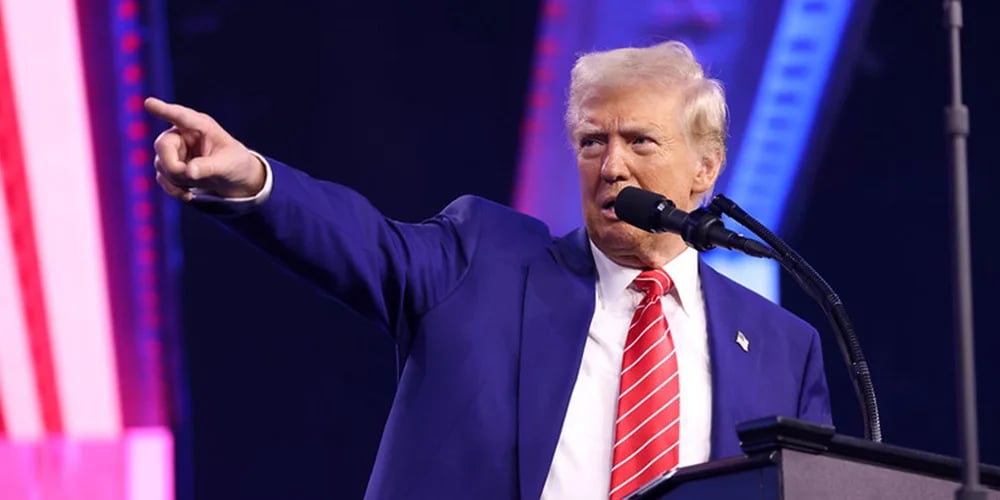
At Davos this week, U.S. President Donald Trump told a room of global leaders and bankers that the United States has “secured its place as the crypto capital of the world.” The claim came with a familiar Trump mix of bravado and strategy: the announcement of a “landmark GENIUS Act,” new legislation to formalise stablecoins, and a promise that broader digital-asset laws are “very close.”
The GENIUS Act, signed late last year, creates the first federal footing for stablecoin issuers by requiring 100% reserve backing and Treasury-supervised attestations. It effectively pulls digital-dollar issuance into the banking system, while two Senate committees now work on the larger question of market structure and token classification. “I thought it was politically good, and it was,” Trump said. “I got tremendous political support.”
That support has been well-funded. Crypto PACs poured more than $200 million into the 2024 election cycle, making digital assets one of Washington’s most aggressively lobbied industries. With midterms ahead, the incentives for both parties to appear crypto-friendly have only grown.
Markets noticed. Bitcoin jumped briefly above $90,000 after Trump’s comments, a reflexive rally that shows how sensitive traders remain to any hint of U.S. regulatory clarity. Analysts said the bump reflected optimism that the White House and Congress might finally align on digital-asset rules after years of mixed messages from the SEC and CFTC. “Investors are desperate for clarity,” said Galaxy Digital’s Laura Chin. “Even imperfect rules beat uncertainty.”
Trump’s Davos message wasn’t only domestic. It positioned crypto squarely in the same geopolitical frame as artificial intelligence and semiconductors—another domain where the U.S. must outpace China. “China wanted that market too,” he said. “We have to make it so that China doesn’t get hold of it.”
That framing may prove consequential. Beijing’s digital yuan already operates in cross-border pilots across Asia, while Washington still leans on privately issued stablecoins like USDC and PayPal USD for dollar reach. By tying crypto policy to national competition, Trump effectively turned a fragmented tech debate into an extension of economic statecraft—a move some analysts say was inevitable once CBDCs entered global finance.
The GENIUS Act itself reads more technocratic than Trump’s delivery. It sets reserve and redemption rules, defines who can issue U.S.-denominated stablecoins, and invites regulated banks into the process, an attempt to keep digital-dollar liquidity under U.S. jurisdiction. In practice, it mirrors what Singapore, the EU, and the U.K. have already implemented. If passed quickly, it could make the U.S. competitive again after years of regulatory drift.
That race is far from won. Switzerland’s Crypto Valley still leads in institutional custody. The EU’s MiCA framework went live this year with clear licensing standards. Singapore continues to court exchanges with predictable tax rules. For Washington to claim leadership, the rest of Trump’s promised framework—covering market structure, DeFi, and consumer protection—would need to materialise within the next 12 months.
Still, the political calculus is clear. Trump’s remarks landed well with an industry eager for legitimacy and capital markets looking for predictability. The immediate beneficiaries would be U.S. banks and stablecoin issuers, finally allowed to scale without regulatory limbo. Critics, meanwhile, warn that the same clarity could entrench incumbents and crowd out smaller innovators unable to meet new reserve or audit thresholds.
In that tension lies the broader story. Crypto has always oscillated between rebellion and regulation; Trump’s Davos declaration formalises its migration to the latter. What began as an experiment in decentralised finance is now a tool of national strategy. Whether that makes the U.S. the crypto capital of the world, or just the safest jurisdiction to issue a digital dollar, will depend less on presidential speeches and more on what Congress delivers before the next election.
Get passive updates on African tech & startups
View and choose the stories to interact with on our WhatsApp Channel
ExploreLast updated: January 23, 2026


