




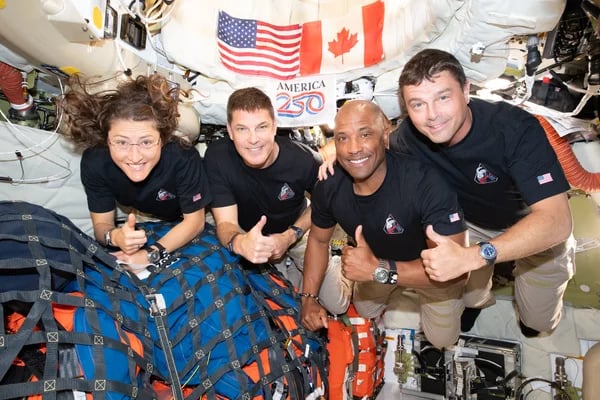
The United States and Canada are back to pushing the limits of science after taking a 50-year break in exploring the moon. 10 days ago, three American astronauts and a Canadian astronaut left the Earth to lead mankind’s latest exploit of the Milky Way.
Aboard the spacecraft were Commander Reid Wiseman, pilot Victor Glover, and mission specialists Christina Koch and Jeremy Hansen. The team of four was tasked to execute the space mission code-named ARTEMIS II, funded by the United States’ National Aeronautics and Space Administration (NASA).
The ten-day mission was successful, and the team of four touched down on Earth, landing in the Pacific Ocean off the coast of San Diego, California, at 5:07 p.m. Pacific Time, according to NASA. Artemis II represents a new milestone for science. Here are five standout facts to know and remember about this latest science exploration.
First Moon Landing Mission since Apollo 1972
The Artemis II Lunar Flyby mission in 2026 is the first mission beyond low Earth orbit since Apollo in 1972. The new Artemis project, therefore, happened 54 years after the last major moon landing mission. The significance of the time gap lies in the improvements in space science since Apollo 1972 and the need for fresh information from the Milky Way.
Farthest Travel from Earth by Humans Ever
The Artemis II crew travelled farther from Earth than any Human ever. The crew travelled an estimated 252,760 miles, the farthest from Earth in recorded history. The crew orbited the moon, taking the latest photos of it, and even witnessed a total solar eclipse.
Artemis II was not a Moon Landing Mission
The Artemis II space mission was not a moon-landing mission like Apollo in 1972. None of the crew members nor the spacecraft used for the mission landed on the moon. It was more of a Lunar Flyby mission, where the crew flew past the moon and took photos of it. During the flyby, the crew studied the solar corona as the Sun disappeared behind the Moon, and watched for meteoroid flashes on the lunar surface.
Artemis III is Planned to be a Full Moon Landing Mission
NASA is planning another space mission next year, code-named Artemis III. Artemis III will be a full-moon landing mission with boots on the moon. This will be a direct replica of the Apollo 1972 mission, with better technology and more data expected to be extracted on the moon. The mission is fully funded by NASA and presents itself as America’s latest show of soft power.
First Woman and First Non-American onboard
The Artemis II space mission featured many firsts in space history. Mission Specialist Christina Koch became the first woman to travel to the moon, while Canadian Jeremy Hansen became the first non-American to reach the moon. The two crew members were mission specialists, complementing the technical astronauts driving the space mission.
Space and Science enthusiasts celebrated the mission’s success by taking to X to share their delight. Isaacman, a commercial astronaut, reacted on X, framing the mission as another success for America.
“America is back in the business of sending astronauts to the Moon and bringing them home safely,” He stated
“This was a test mission, the first crewed flight of SLS and Orion, pushing farther into the unforgiving environment of space than ever before, and it carried real risk. They accepted that risk for all we stood to learn and for the exciting missions that follow, as we return to the lunar surface, build a Moon base, and prepare for what comes next.” He added, giving credit to NASA.
Reeling from an embarrassing outing in the Middle East, the United States of America will salvage the success of Artemis II as damage control for its battered image.
Get passive updates on African tech & startups
View and choose the stories to interact with on our WhatsApp Channel
ExploreLast updated: April 11, 2026


