



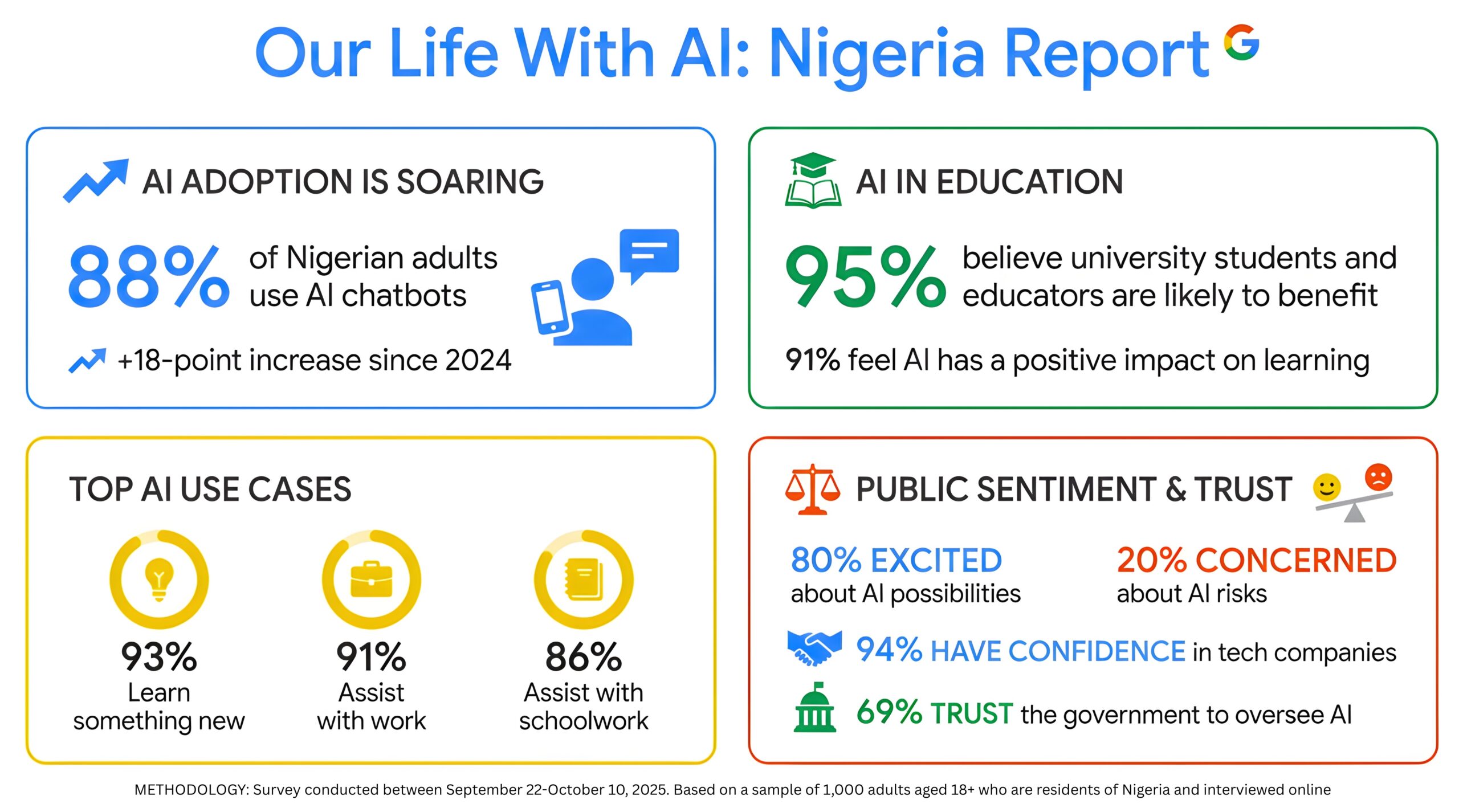
88% of Nigerian adults used an AI chatbot in 2025. That’s an 18-point jump from the year before, according to new data from Google and Ipsos. The global average sits at 62%. What started as curiosity has become routine. Students are using ChatGPT to work through physics problems. Entrepreneurs are drafting business plans on Gemini. People are using AI for career planning, learning new skills, starting businesses. The question isn’t whether Nigerians are adopting AI—clearly they are, faster than most places—but what that adoption is actually building toward.
The numbers look like validation: Nigerians are early adopters, enthusiastic experimenters, exactly the kind of users AI companies claim they’re building for.
How Nigerians are using AI
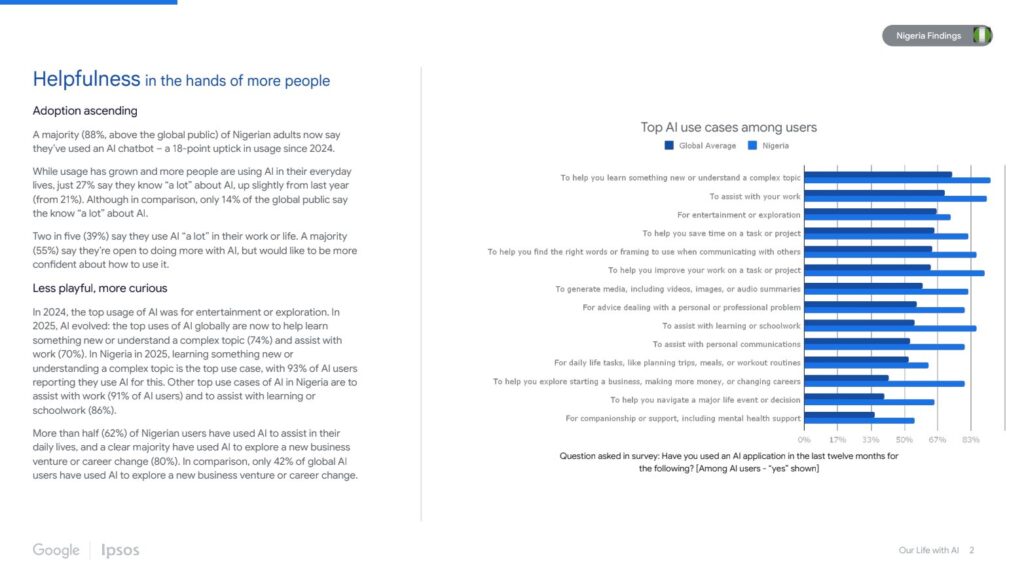
The 2026 report, Our Life with AI: Helpfulness in the Hands of More People, shows the shift clearly. 93% of Nigerians use AI to learn or understand complex topics, up from 81% in 2024 and well above the global 74%. At work, 91% rely on AI tools for tasks. 80% are using AI to explore new business ideas or career changes—nearly double the global figure of 42%.
“It’s inspiring to see how Nigerians are creatively and purposefully using AI to unlock new opportunities for learning, growth, and economic empowerment,” said Taiwo Kola-Ogunlade, Google’s West Africa communications manager. “This report doesn’t just show high adoption rates; it tells the story of a nation actively shaping its future with technology.”
The technology has moved from novelty to infrastructure faster in Nigeria than in most other markets. In places like the U.S. and Europe, educators and policymakers are still debating whether AI belongs in classrooms at all, weighing its learning benefits against privacy risks and over-reliance concerns, according to a January 2026 Axios report.
Education is leading AI Adoption in Nigeria
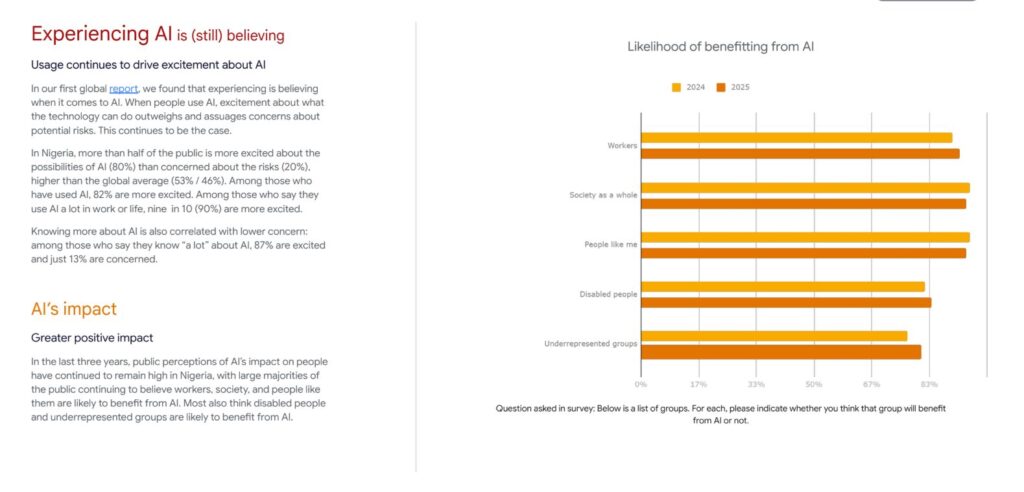
9 in 10 Nigerians say AI improves how people learn and access information, and 95% believe students and teachers benefit directly. From simplifying coursework to exam prep, AI has become a default study tool—a shift that has happened more completely in Nigeria than in markets still debating whether AI belongs in classrooms.
This adoption matters because it isn’t just about convenience or entertainment. Nigerians are using AI to understand complex topics, acquire skills, and prepare for work or entrepreneurial opportunities. The intent is clear, even if broader economic outcomes are still uncertain.
A case of unusual optimism
80% of Nigerians say they’re more excited than concerned about AI’s potential. Globally, opinion is split nearly evenly: 53% excited, 46% worried. Among frequent Nigerian users, optimism rises to 90%.
That confidence extends to institutions. 94% trust tech companies to manage AI responsibly, significantly higher than global averages where tech company trust is generally declining. 69% trust government regulation of AI.
The trust levels are striking because they’re so different from patterns in markets where AI is being developed. In London, or Beijing, people who work closely with AI tend to be more cautious about its risks and limitations. In Nigeria, familiarity seems to breed confidence rather than concern. Whether that optimism is warranted depends partly on how quickly the ecosystem can build local capacity—not just consumption of AI tools, but development of them.
In Nigeria, familiarity appears to breed confidence rather than concern. This optimism is justified depending on how quickly local capacity is built, both by using AI tools and developing them.
What the numbers don’t show
High adoption creates both opportunity and risk. Developers and entrepreneurs can build services on top of these platforms or create alternatives tailored to local needs. At the same time, dependency on foreign-built tools could limit value capture.
The fintech parallel is instructive. Early mobile money adoption in Nigeria eventually produced a thriving local fintech ecosystem, supported by responsive regulation and homegrown innovation. Whether AI follows a similar path remains to be seen.
For now, Nigeria is leading the world in AI adoption. How that momentum translates into local innovation, economic impact, or sustainable advantage is still unfolding.
Get passive updates on African tech & startups
View and choose the stories to interact with on our WhatsApp Channel
ExploreLast updated: January 22, 2026


