



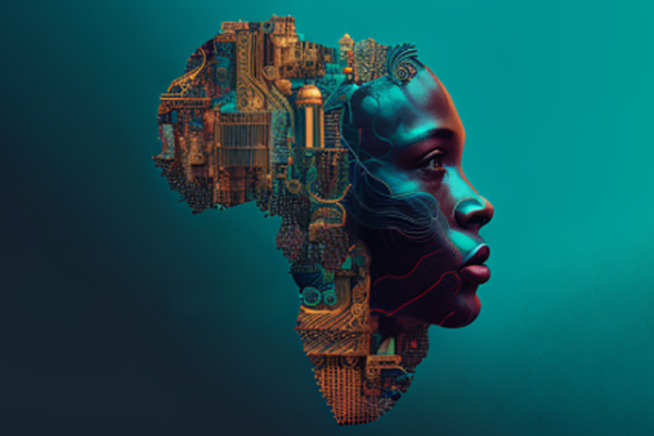
Efe Ebieroma is an Artificial Intelligence Engineer based in the United Kingdom. Efe Ebieroma is an ex-Piggyvest and Fincra employee who currently chairs AI Nexus, an AI-focused Society empowering students and young professionals. In this interview with Condia, Efe dives into the unique leverage Africans have in the Global AI Market and how it can be wielded for maximum Output.
Efe also touches on the necessary infrastructure and educational capacity for Africans to make headway in the global AI race.
Condia: The AI industry is new in Africa. Africa is home to 1.4 billion people. Are there signs that Africa will be a viable market for this industry?
Efe: Yes, there are strong signs that Africa will become a viable market for AI. Our continent has over 1.4 billion people and one of the youngest populations in the world, which means a growing digital workforce and user base for AI-powered products. Also, we have unique sets of problems and datasets, and data is the lifeblood of AI.
We are already seeing strong growth in areas like fintech, mobile services, and digital platforms, which shows that Africans adopt technology quickly when it solves real problems. An example of this is the telecommunication industry in Nigeria; Nigeria’s internet penetration grew from 0.06% in 2000 to 55.4% in 2021.
However, for Africa to fully benefit from the AI economy, there must be continued investment in infrastructure, digital education, and research. If these areas are strengthened, Africa will not only become a large consumer of AI technologies but also a builder of AI solutions for the entire world. and the government has a major part to play in it.
Condia: AI technology requires infrastructure to function optimally. Microsoft invested $1 billion in a data centre in Kenya. Can Africa, through global partnerships and local innovation, provide the needed infrastructure for AI to thrive?
Efe: Yes, global partnerships combined with local innovation will be critical to building Africa’s AI infrastructure.
When major technology companies invest in data centres and cloud infrastructure, it helps provide the computational resources needed to train and deploy AI systems.
However, infrastructure is not just about data centres. AI depends heavily on data, energy, and connectivity. As I said earlier, data is the lifeblood of AI, so African countries must also think carefully about data governance, privacy, and, especially, sovereignty. It is very important that Africans should own their own data, even if it is funded from external sources.
The best path forward would be a balance: global partnerships that bring investment and expertise, alongside a strong local framework and policies and innovation ecosystems that ensure Africa maintains control over its data and technological future.
Thanks to Microsoft once again for investing in Kenya.
Condia: Does Africa have the leverage to get ahead of other markets in the AI race?
Efe: Yes, we have a leverage with our young population, and historically we have been behind in many technological revolutions, but AI presents a new opportunity for us because the field is still evolving and no one has figured it out completely yet, not even China or America.
Our continent also has a large young population, rapidly growing developer communities, and many real-world problems that AI can help solve, such as agricultural productivity, financial inclusion, healthcare access and climate management
However, for us to truly compete globally, governments and institutions must invest more in AI research, universities, and innovation ecosystems. Countries like the United States and China lead in AI largely because they are heavily funding research and development.
I believe this time would be different, though. I am very optimistic because we now have access to information faster than ever
Condia: What are some African AI projects that are worth following this year, and why do they stand out?
Efe: An example is Data Science Nigeria, whose mission is to raise 1 million AI talent and build AI solutions that improve the quality of life and well-being for 2 billion people in emerging markets.
AfDB and UNDP recently launched a $10bn AI initiative to support startups and institutions in the AI industry
You also have institutions like the Masakhane Research Foundation developing natural language processing tools for African languages. Imagine a customer support agent trained in Isoko (my native language), Yoruba, or Hausa interacting with native speakers. African projects are interesting because they cater to our unique datasets.
If there is anyone who would build solutions to African problems, it has to be us, because we have context. So yes, our projects stand out because they are solving our problems
The Deep Learning Indaba society is another example, helping to grow a strong AI research community across our continent
Condia: In your experience, what are some of the important things an AI builder in Africa should be on the lookout for?
Efe: Infrastructure . Very important. We need to build our own infrastructure and own it.
As an AI builder, I believe you are building to solve African problems.
I understand, though, that deploying AI systems requires reliable cloud computing, internet connectivity, and data infrastructure, etc., but we can own one or all of the rails in this sector, and it doesn’t have to be all of them, and we also have African companies that have built some infrastructure that can be leveraged.
It’s also about self-belief. I currently live in the Western world, and they don’t have two heads, but they are very optimistic and determined people.
The second one is energy and computing resources. Training and running AI models require significant computational power, which depends on stable energy systems. We need to make provisions for energy generation, and that is why AI builders should be very outspoken with their governments about the need for stable electricity and funding to acquire computing resources or build them.
The government has a huge part to play here, and all AI builders should be major stakeholders in their countries and should hold politicians accountable, also because there is a limit to what individuals can achieve on their own, but with support, everything becomes easy.
The most important of them all is data and real world aplications of problems. We need to build unique datasets in health, agriculture, etc.
Our problems are different from those of the First World nations. We need AI builders that can leverage our own unique datasets and contexts to solve our own problems.
Condia: Any closing remarks?
Efe: My conclusion is that Africans should believe in themselves.
Also, African students need to dream beyond Africa. When they acquire knowledge, they need to learn to dream. They need to accept being global citizens. The world is global now, irrespective of what you read in the news.
They need to have absolute confidence that they can go toe-to-toe with their counterparts anywhere in the world. They should learn Physics, Mathematics, Biology, Chemistry, Accounting, history and think beyond hypes.
These fields are what make up AI. Every single one is important. They should see that AI is the part by which they can become the giants that they truly are.
Get passive updates on African tech & startups
View and choose the stories to interact with on our WhatsApp Channel
ExploreLast updated: March 7, 2026


