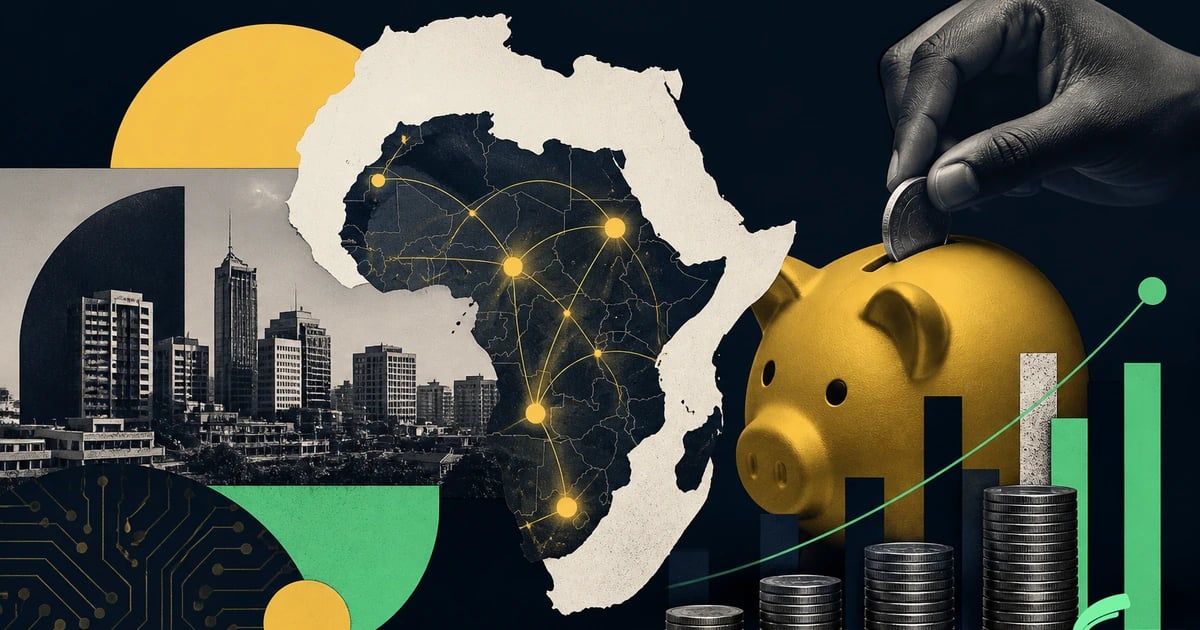

African tech startups raised about $2.45 billion in disclosed funding between January and September 2026, across 230 announced deals, according to Condia’s funding tracker. That figure, with the leading countries, sectors and rounds, is the clearest measure of how much capital moved.
This report looks beneath the headline: who the capital went to, on what terms, and how the way deals are announced shapes the figures.
Across nine charts, it finds a market shaped by a small number of very large rounds, a growing role for debt and development finance, and wide gaps between deal activity and capital across markets and founding teams.
A year decided by a few cheques
Capital in 2026 has been highly concentrated. The 32 rounds above $20M took 77% of disclosed capital, while being only 18% of disclosed deals. The 108 rounds of $5M or less, which make up most of the activity, took ~7%. The ten largest rounds alone account for almost half the money.
One company shows this most clearly. Spiro, the electric motorcycle and battery-swap company, raised $345m across five rounds in nine months. That is 14% of all disclosed capital, and more than every pe-seed and seed round combined ($177m across 84 deals).
The pattern repeats at the seed stage. Terra Industries announced three seed rounds totalling $51.75M, 36% of all seed capital. Each of those rounds was at or above the median Series A value.

This concentration means totals can move sharply on a few transactions. Spiro and Moove alone account for $595M, nearly a quarter of disclosed capital, so period-on-period comparisons are best read alongside deal counts and median round sizes.
Equity, debt and development finance
Funding totals combine equity, debt and blended finance. Separating them shows how differently companies are financing their growth.
In the first quarter, debt outran equity. Much of this was lending capital: 47% of Q1 debt went to fintech lenders such as ValU, MNT-Halan, Mylo and Lula, raising money to lend on. One solar project loan made up much of the rest. From Q2, equity took over again.
Whether a company raises debt depends heavily on what it owns. 89% of CleanTech capital and 83% of AgriTech capital was debt or blended finance. AI, deeptech and e-commerce raised no debt at all. Companies with solar kits, cold rooms, vehicles and loan books borrow against them while software companies sell equity.
The largest rounds are often both at once: rounds that combine equity and a debt facility have a median of $27.85M, roughly 12 times the median equity round.
This is also where the most important investors sit. Development finance institutions and banks were involved in 26% of disclosed deals, but 51% of the capital, two-thirds of it as debt or blended finance.
Who gets the large cheques
Deal activity and capital are distributed differently across markets and founding teams.
Nigeria had the most deals of any market, 26% of them, but only 7% of the capital. Its median disclosed round was $1.5M, against $6.6M in Kenya. Nigeria is where the most startups get funded; Kenya and South Africa are where the large cheques land. What gets funded differs sharply by market. In Kenya, 73% of disclosed capital went to mobility, mostly Spiro’s battery-swap network, and a further 17% to CleanTech; in Egypt, 71% went to Fintech. Nigeria had the most CleanTech deals of any market (9), but they raised $27M in total, against $96M across three CleanTech deals in Kenya and $123M across four in South Africa.
The gender data shows a gap that widens with stage. At Series A, female co-founded teams raised a median round of $11.25M, against $11.5M for male-only teams: effectively the same. At the growth stage, the medians are $1.8M and $18M, ten times apart. The female co-founded sample at growth is small, with only seven deals, so this is a signal rather than a verdict. But only two of the 32 rounds above $20 million had a female co-founder.
Looking ahead
The first nine months show a market that is active and increasingly varied in how it is financed. Four measures will be worth tracking into the fourth quarter and 2027:
- The share of capital in rounds above $20M.
- The split between equity, debt and blended finance.
- Who raises at Series A and beyond, by market and founding team.
Together with headline totals, these give a richer view of the ecosystem’s depth and direction.
Methodology/Source
The data comes from Condia’s funding tracker of 230 publicly announced African tech funding deals from January to September 2026. Amounts are disclosed for 174 of them; every share of capital uses those 174. “DFI or bank” means a development finance institution or a bank named anywhere in the round.
Last updated: October 23, 2026