



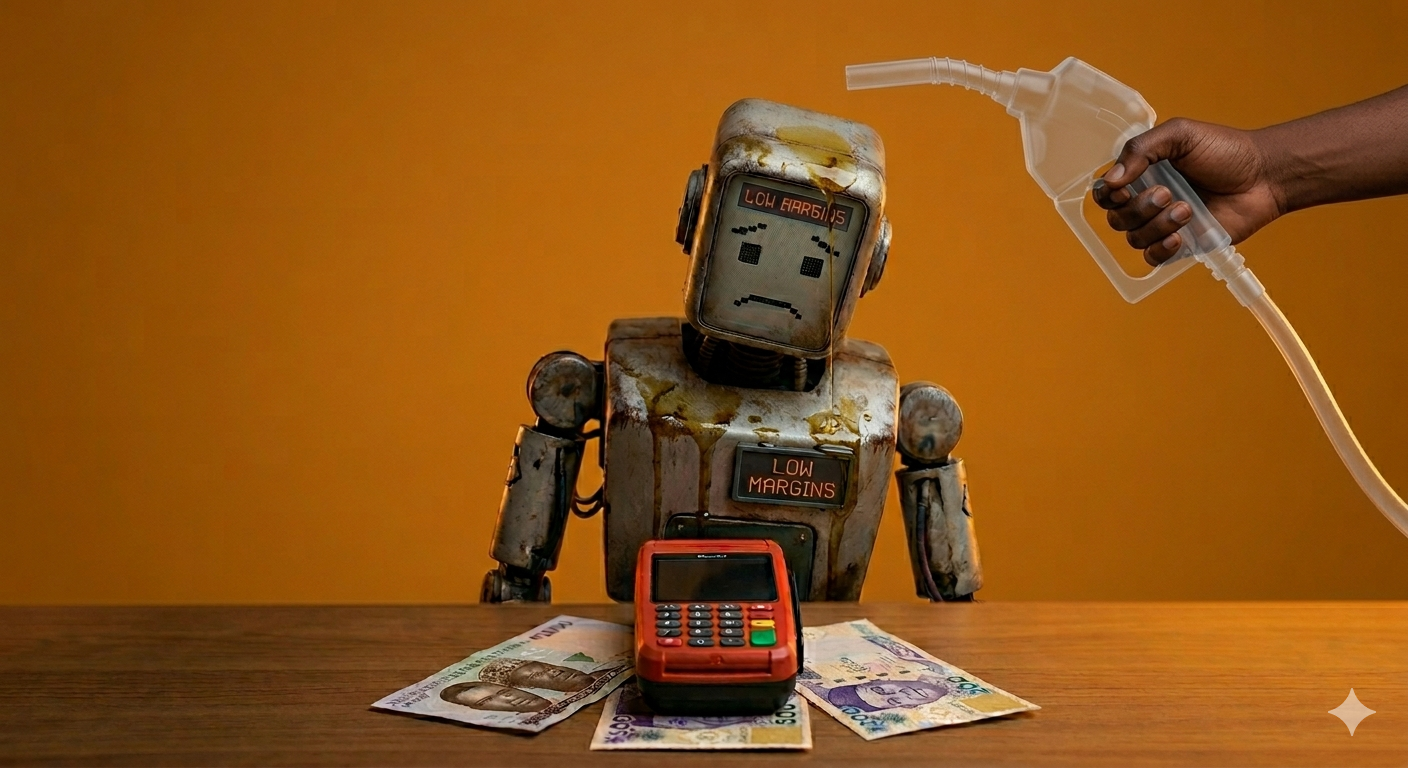
For many PoS agents, the day begins with a trip to the bank to source cash. In places like Ekiti State, Nigeria, where most banks sit in the state capital, that journey can cost up to ₦4,000. But a PoS agent earns only ₦20 on every ₦1,000 withdrawn. Dispense ₦100,000 in a day, and you make roughly ₦2,000. Transport alone wipes that out.
A system built on fixed rules would not survive that kind of math. It would raise prices sharply, cut service, or shut down entirely. At best, it would wait for fuel prices to stabilize, for margins to improve, or for some external intervention. But that is not what happened.
Across neighborhoods, small-scale PoS agents source cash from the shops around them. Retailers who handle large volumes of cash daily hand that cash to nearby agents. The agents use it to serve customers and transfer the equivalent amount digitally into the retailer’s account. Zero transport costs.
It is a small trick, but it reveals something fundamental about how the system works. Because if PoS agents were robots designed to follow a fixed workflow of “withdraw cash from bank and dispense to customer”, this adaptation would not exist.
The idea of replacing human work with automated systems often rests on a simple assumption that work itself is structured, repeatable, and predictable. If a process can be mapped clearly enough, it can be automated. If a role involves repetition, it can be optimized. But in practice, the work of a PoS agent is not a fixed sequence of steps. It is a series of decisions made in response to changing conditions: where to source cash, how much to hold, who to rely on, when to adjust pricing, how to manage shortages, how to keep customers coming back.
When fuel prices rise, the workflow changes. When cash is scarce, relationships become more important. When a bank is too far or too slow, alternatives emerge. None of this is pre-programmed.
The retailer who hands over cash is not part of a formal supply chain. The agent who accepts it is not following a standardized protocol.
This is what makes the PoS network resilient. It is not efficient in the way formal systems aim to be. It does not minimize variation or eliminate redundancy. Instead, it absorbs variation and uses redundancy as a buffer.
Now, imagine the system without its human layer. A fully automated version of the PoS workflow would require clearly defined inputs and outputs. Cash would be sourced from designated points. Transactions would follow fixed rules. Exceptions would be minimized or handled within predefined limits. Under stable conditions, that system might perform well. But under stress, it would struggle. It would not adjust its sourcing strategy based on transport costs. It would not build informal relationships that allow it to operate without direct access to a bank.
Humans do the opposite. They stabilize the system themselves. And this is not unique to PoS. Across many everyday systems in Nigeria and in much of Africa, what appears informal is often a form of organization built for environments where conditions are uncertain and infrastructure is uneven.
Markets adjust prices throughout the day. Transport networks shift routes in response to demand and regulation. Small businesses extend credit based on familiarity rather than formal scoring. These systems are not optimized for predictability. They are optimized for survival. And survival requires the ability to change.
This is where the conversation around automation and efficiency becomes more complicated. Technologies designed to replace human labor often assume that the value of that labor lies in execution, but in many of these systems, the value lies in the ability to see a constraint and reroute around it.
When fuel prices rise, a human agent does not simply follow a failing process. That kind of adjustment is difficult to encode because it depends on context that is constantly shifting.
None of this means automation has no place.
Digital payments, for instance, have expanded rapidly in Nigeria precisely because they fit into existing systems. The most successful technologies tend to work with the grain of existing behavior, and not against it. The challenge arises when the goal is replacement. Because what is being replaced is often not just a set of tasks, but a system of adaptation.
In Ekiti, the rising cost of fuel did not shut down small PoS businesses. It forced them to find another way to operate. The solution emerged from the interaction of people responding to the same constraint. And the result is a system that continues to function.
If Nigeria’s PoS agents were robots, the system would likely be cleaner, more structured, and easier to model. It would also be far more fragile. Because the strength of the system is not in how efficiently it follows a plan. It is in how quickly it can abandon one.
Get passive updates on African tech & startups
View and choose the stories to interact with on our WhatsApp Channel
ExploreLast updated: March 26, 2026


