




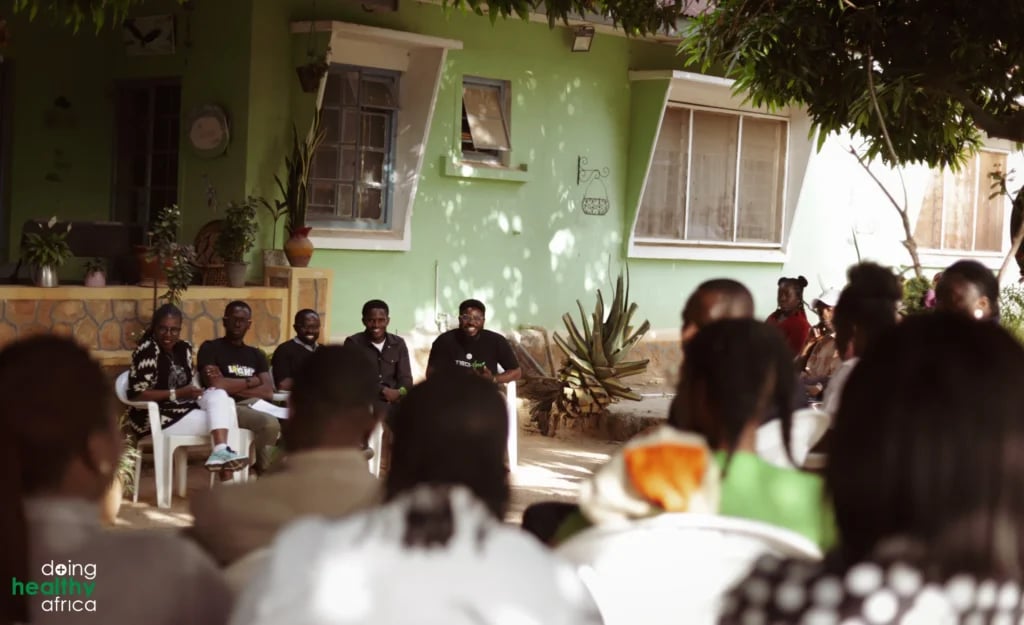
In 2023, Oluwatosin Olabode was running a workshop on sleep and smartphone use in Bauchi, a city in northeastern Nigeria. Among the people in the room that day was Hauwa*, a young woman who, as Olabode recounts it, had built her income entirely around her phone. Across Nigeria, several young people have turned mobile connectivity into a livelihood: freelance work, content, small commerce, where the phone is not a distraction from the job but the job itself.
What had brought the woman’s attention to her phone use was her sleep, or the absence of it. She was always on her device, and the line between working hours and rest had dissolved so completely that her body had stopped knowing when it was supposed to shut down.
Olabode, a biochemistry graduate turned digital wellness educator and founder of Doing Healthy Africa, and his team assessed her situation. Instead of asking her to use her phone less as her income depended on it, Olabode said they set up the screen time feature that already exists natively on her device, a tool designed precisely for this.
They configured it together, set the limits and showed her how it worked.
For the first few nights, she followed it. Then one evening she opened her settings and turned the restrictions off. “It goes beyond having discipline,” Olabode says. “You have to have the identity that aligns with where you want to be, and then build the structure from that perspective.”
In Lagos, southwestern Nigeria, Halima Nuradeen, a counselling psychologist, has been watching the same pattern from a different angle. Clients come to her reporting anxiety, poor sleep, a restlessness they cannot locate. They are not always sure why they cannot focus, and when she begins to explore what is underneath the presenting complaint, the same architecture keeps appearing: the late-night scrolling, the notifications that have colonised every hour, the sense of being permanently on call for an attention economy that never closes.
“Sometimes clients reach for their phones in the middle of a session without even realising it,” Nuradeen says. “It’s almost automatic.” She has started asking clients, depending on the sensitivity of the session, to silence their devices and put them out of reach before they begin. The smartphone has become a variable she has to manage in a room designed for the most focused kind of human conversation possible.
That gap — between knowing what the problem is, having access to the solution, and still being unable to close it – is the territory that Doing Healthy Africa has been working in since 2021, and in a country that arrived at one of the world’s most intense mobile environments faster than any institution was prepared to absorb.
When access outpaces understanding
What makes that gap harder to dismiss as personal failure is the environment it sits inside.
By 2025, Nigeria had approximately 150 million active mobile connections, and within a decade of mobile broadband taking hold, the country moved from low connectivity to ranking fifth globally for daily social media use, averaging over three hours a day, not counting time spent elsewhere online. Among undergraduates in Lagos, more than half report spending upwards of six hours daily on their phones.
The behavioural infrastructure that usually absorbs a shift of that scale, clinical awareness, school-based education, workplace norms, regulation, largely did not arrive at the same speed.
Nigeria’s federal government only began consultations on age-based social media restrictions in early 2026. The National Information Technology Development Agency (NITDA) and the Nigerian Communications Commission (NCC) spent the intervening years focused on digital economy growth and cybersecurity, not on what sustained, high-intensity phone use does to attention, sleep, or mental health.
Into that gap, with little institutional precedent on the continent, walked Oluwatosin Olabode, who had started this work not in digital wellness but in suicide prevention.
In 2018, he founded Strengthening Society Today Foundation with a focus on youth mental health, specifically suicide prevention. The reasoning was blunt: if the goal was to help young people, they needed to be alive to receive the help. Within a year, he kept running into the same variable. Technology, particularly social media, was not in obvious or easily named ways, but persistently working against everything the foundation was trying to build. Not dramatically, not in ways that were easy to name, but persistently. The fear of missing out was real. The social comparison was grinding. The sleep was gone. Attention itself was fragmenting.
“We began to realise the role that technology was playing in overall well-being,” he says. That realisation led him into digital wellness, a field focused not on reducing technology use entirely, but on building a more deliberate balance between online and offline life.
By 2021, he had shut down the foundation and started Doing Healthy Africa, focusing more directly on how technology was shaping behaviour.
Following the smartphone problem to its source
Doing Healthy Africa operates across three areas: corporate wellness programmes, a course called Digital Auditing, and its most visible offering, the No Gadget Hangout. While the Hangout acts as the proof of concept, its success proves more telling than its simple premise suggests.
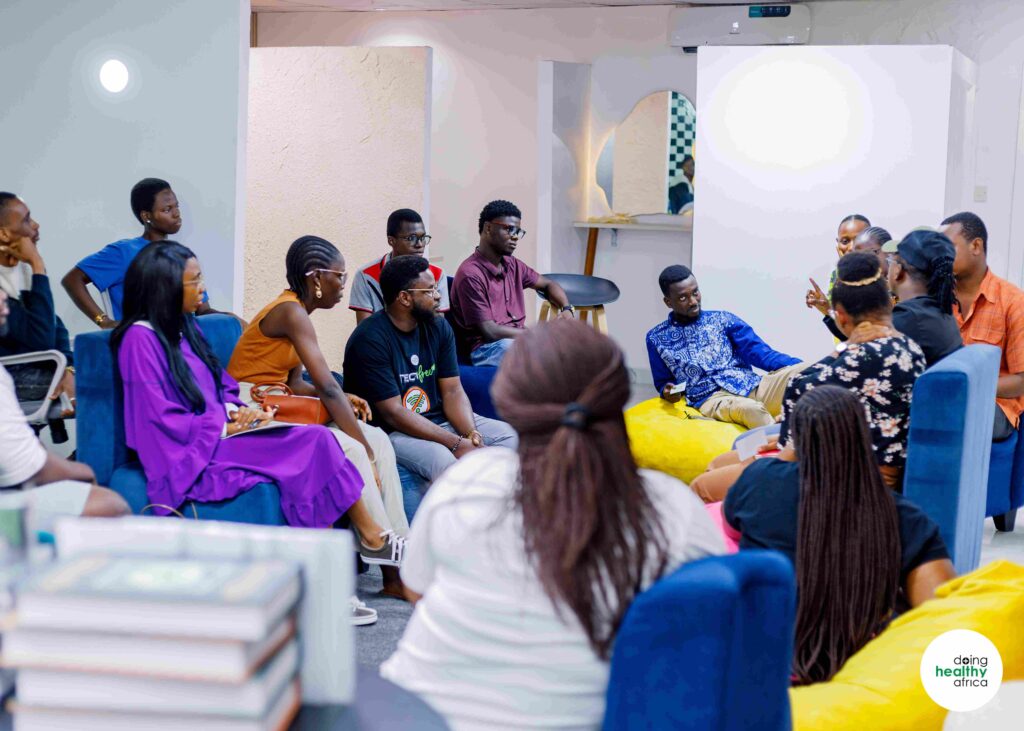
The process begins at the door, where attendees surrender their phones to be tagged and slotted securely for three hours of structured, screen-free conversation. What started as a hesitant one-hour trial in Jos expanded quickly by popular demand. By the time the programme reached Lagos, even a user averaging thirteen hours of daily screen time went the full duration without noticing the clock. “Subtly, subconsciously, people are looking for a way out,” Olabode says. “They just don’t know that templates exist to create that system.”
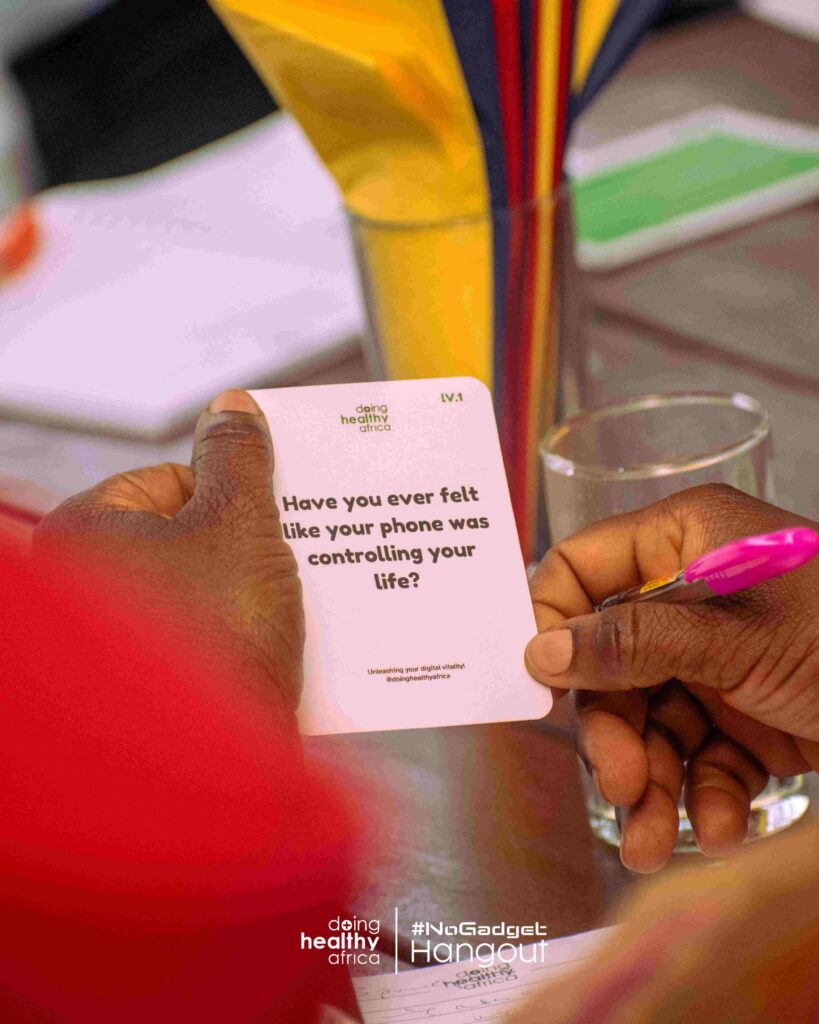
To make this system accessible, Olabode is moving toward a sponsored model to remove cost barriers, similar to a recent edition funded by the Swedish Embassy. The Hangouts also run on Vivify, a conversation card game he developed, drawn from the word vitality, to structure the discussions inside each session and give participants something to take back into their own spaces. These sessions are built on the laws of intention, scheduling, and traction. This framework suggests that the enemy is not the technology itself, but rather the lack of a plan for its use. Drawing from the work of Nir Eyal, a globally recognised authority on behaviour change and human potential. Olabode notes that you cannot call something a distraction if you do not know what it is distracting you from.
This logic scales directly into the Digital Auditing course, which applies the same rigour to professional, personal, and social life. The objective is not to achieve a perfect fifty-fifty balance, which Olabode dismisses as a recipe for burnout, but to reclaim intentionality. If work demands 90% of a day, that is acceptable as long as it was a conscious choice. In this view, the crisis is not the lopsided proportion of our time, but the accident of how we lose it.
Where the wellness framing runs out of road
What gives Olabode’s framework weight beyond a typical productivity course is how closely it aligns with independent clinical evidence. Narudeen notes that the “nameless exhaustion” walking into her practice almost always begins with the collapse of sleep. Because sleep is foundational, its disruption by late-night phone use triggers a domino effect where emotional regulation weakens and attention fails. In a high-stress environment like Lagos, this is not just a wellness inconvenience; it is a force multiplier for every other economic and personal pressure a person carries.
The data suggests this is no longer a niche issue. Halima’s clients now span ages 16 to 40, ranging from professionals to couples, all navigating a shift where stress has moved from being purely relational to being increasingly cognitive and digital. This is where the argument for simple discipline falls apart. When phone use becomes an automatic habit loop driven by the brain’s reward system, it serves as a subconscious coping mechanism for stress. At this level, the brain’s capacity to override the behaviour weakens, creating a pattern that mirrors addiction even without a formal diagnostic label.
The struggle of Olabode’s client in Bauchi highlights a gap that no amount of software has been able to bridge. In 2018, Google integrated an entire suite of “Digital Wellbeing” tools into Android, from grayscale modes to strict app timers. On paper, it was the perfect structural solution for two billion people. In practice, users immediately began finding workarounds, disabling trackers, and snoozing limits to keep scrolling.
The technology worked exactly as designed, yet it failed to change behaviour. This confirms Olabode’s point that the crisis is a fundamental tension between the tool and the person holding it. A dashboard can provide the “how”, but it cannot provide the “why” or the internal character required to actually stay the course.
What it looks like on ground
Since the first No Gadget Hangout in Jos in 2019, Doing Healthy Africa has scaled its impact across Kaduna, Lagos, and Abuja, reaching over 200 participants through nine focused editions. These rooms stay small by design. Past the 25-person mark, Olabode notes, the environment shifts from genuine depth to social performance.
The audience has also matured alongside the format. What began as a local experiment has expanded through a partnership with the Swedish Embassy and targeted sessions at the Abuja Boardgames Convention. While corporate interest is developing, the most tangible metric of success remains the Living Digitally Well Tribe—a WhatsApp community of 113 alumni. With nearly 60% of the group active in weekly check-ins, members report real-world adjustments: tech-free zones and restructured morning routines that suggest a permanent shift in behaviour rather than a temporary pause.
The organisation funds its operations through corporate engagements, ticket sales, and partnerships in cash or in kind. This model supported the Living Digitally Well Africa Summit in May 2026, which brought together 19 speakers from eight African countries. The summit’s central premise was that digital wellness in Africa cannot be imported. While Kashifu Abdullahi, NITDA’s Director General, was represented at the opening, the path forward remains largely unmapped.
That arc, from a hesitant one-hour session in Jos to a continental summit, has been built without the institutional infrastructure Nigeria still lacks. There is still no school curriculum, no clinical referral pathway, and no workplace policy that treats digital exhaustion as a serious public concern. As the federal government begins its early consultations on social media, the gap Olabode identified in 2019 remains. He no longer needs to convince people that the problem exists. He only needs to provide the structure for those who already know, like the woman in Bauchi, that the current arrangement is not working.
*Hauwa is a pseudonym. Her name has been changed to protect her identity.
Get passive updates on African tech & startups
View and choose the stories to interact with on our WhatsApp Channel
Explore


