





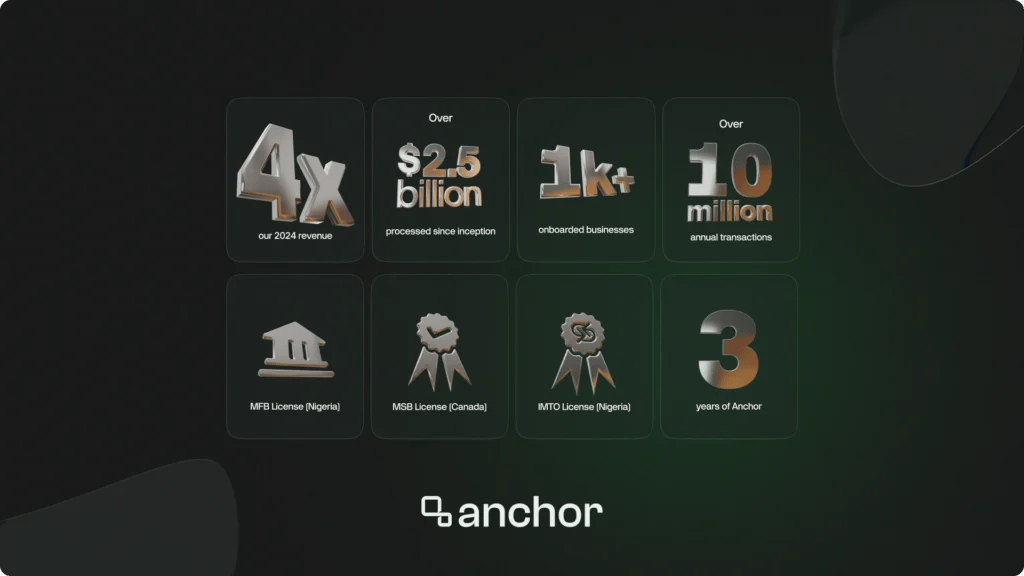
When Anchor turned three last year in August, it said it had now processed a total of $2.5 billion (₦3.5 trillion).
Given how competitive and crowded the local payments space is in Nigeria, that’s quite impressive. For context, 17-year-old fintech Paga said it processed ₦17 trillion in 2025, with most of its growth coming in the last four years. Infrastructure-native startups like Anchor are on track to surpass that performance, latching onto the increased digitalisation and fintech adoption in the country versus when pioneers like Paga started.
In its recently released year in review, Anchor said it quadrupled its 2025 revenue over the previous year, secured three key regulatory licences, launched a multicurrency card infrastructure and has onboarded 1,000 businesses from 18 countries in Africa, North & South America, and Europe.
Anchor is positioning for the future of fintech in emerging markets
A review of Anchor’s roster of licences gives a sense of the future of fintech in Nigeria and other emerging markets. Anchor secured a local banking licence and an international money transfer licence from the Central Bank of Nigeria. It is registered as a Money Service Business in Canada and is soon to be a Payment Service Provider there.
The future of emerging market fintechs, which often start in payments, is to become a bank and then facilitate money in/out of their domestic market. Becoming a bank allows fintechs to earn overnight interest on float in their custody, thereby supplementing their fee income. It also allows fintechs to keep more of what they earn by reducing the number of parties they have to share with. “Becoming a bank means that we own more of our stack as a business and can improve our unit economics while offering advanced and more diversified financial products. For instance, things like seamless refunds on dynamic virtual accounts used for online checkouts could be fixed if the core banking application were designed to natively support dynamic NUBANs.”
On the other hand, facilitating cross-border payments encourages natural geographic expansion and improves take rate.
Anchor CEO, Segun Adeyemi, told Condia that, “The demand for financial products today has become global first.” Indeed, and as Condia predicted in January 2025, fintechs in the remittance and cross-border payments space grew the fastest (30%) when compared to other sub-sectors, according to the Nigerian Fintech Map, which is incidentally curated by Segun Adeyemi and others. The Nigeria Fintech Map is a seven-year-old directory that tracks the growth of fintechs in the country. Last year, there were over 505 companies and 12 sub-sectors, including digital banks, BaaS, and FX/Cross-border payments.
This demand for cross-border financial products from fintechs has guided Anchor’s product roadmap. “The demand for multi-currency rails has become table stakes for us, 90% of the new and innovative products that we power today have some form of cross-border elements in them. Instead of customers using Anchor to power just the Naira and domestic currency side and using companies like Bridge for the global rails, we want to provide the bridge that connects the domestic and international rails in one single API and a single contract,” Adeyemi said.
Thus, “in 2026, we will be doubling down on our Global Services product rollout, which is multi-currency account and card issuing and cross-border payments. Stablecoins will be a key infrastructure to power all this.”
Stablecoins as key infrastructure for Anchor’s next phase
Anchor’s place in the market is interesting. While it’s an infrastructure provider that processed over 20 million local and international payments, it is also a company, like those it serves.
Innovations like stablecoins have benefits for both Anchor—the B2B2X platform, and Anchor—the company.
“Stablecoins are a key infrastructure already enabling our customers in other markets. It also makes it possible for us to have customers in multiple markets, where we are not yet present. For instance, our USD cards are being funded by the issuers, which are our customers, in USDT/USDC,” Adeyemi said. “As we expand more on our cross-border capabilities, we are looking to leverage stablecoins in a way that enables us to offer a deep liquidity pool, the best possible FX rates, and become the go-to platform for companies that need to handle multicurrency conversions across markets.”
As a company, Anchor uses stablecoins for treasury management across multiple currencies. Stablecoins enable just-in-time funding because of their instant settlement. Thereby, freeing up working capital that would otherwise have been tied up as part of pre-funding payout companies like Anchor.
Nigeria is just a launchpad, says CEO Adeyemi
Launching in a large market like Nigeria is often enough for startups to prove their model and scale it. Hence, many startups operating in Nigeria do not think about expansion immediately. For instance, it took Paystack three years to expand into its first market, and it only did so after raising a Series A round.
However, others, such as Flutterwave, sought expansion within their first two years. There is no right or wrong answer to startup growth. Anchor has chosen a combination of deep and wide.
This year, the startup intends to launch in three markets, which comes after three years of proving the model in Nigeria. By contrast, Paystack took 6 years before getting to its third market, Kenya (2022).
“The demand from existing customers who now trust and rely on our infrastructure is too high to ignore. They want us to unlock additional markets for them,” Adeyemi said. “We have identified strategic partnership opportunities that will help us hit the ground running strongly from Day 1.”
Beyond the current market demand, it has always been Anchor’s plan to play globally. “Our ambitions have always been to create a platform that truly connects African and global banking rails. On the Africa side, Nigeria alone is not sufficient; it is just a starting point for us to validate our model and set up our compliance and technology infrastructure for growth and scale”
Anchor is part of a crop of startups that emerged post-ZIRP era, where profitable growth has been prioritised over growth-at-all costs. The pathway it takes to market dominance bears watching, as it epitomises how others like it scale. A few things are clear: fintechs that will win in this era will become banks, facilitate cross-border money movement and leverage emerging technologies like stablecoins.
Get passive updates on African tech & startups
View and choose the stories to interact with on our WhatsApp Channel
ExploreLast updated: April 13, 2026


