




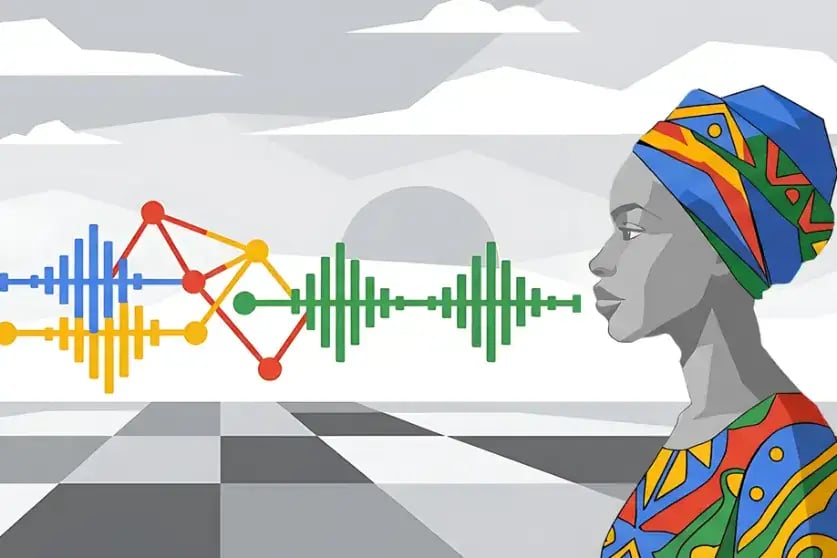
On February 2, 2026, Google Research Africa released WAXAL, an open-source dataset covering 21 Sub-Saharan African languages.
Expected to bridge the digital divide through integration into African speech technology, WAXAL includes over 11,000 hours of speech data collected from nearly two million recordings.
For decades, if you didn’t speak English, French, Portuguese, or any other other colonial language, you might find it difficult to navigate the digital age.
Now that the vernacular barrier is falling, here is what Africa stands to gain:
1. Death of the English Tax
For millions of Africans, interacting with digital tools requires basic knowledge of a second language.
Depending on how it is deployed in products, WAXAL may help remove this cognitive tax.
When a mother can describe her child’s symptoms in Luganda to a triage bot, or a trader can check commodity prices in Hausa, the speed of information and the accuracy of the outcome skyrockets.
2. Financial Inclusion
Financial inclusion has long been hindered by complex USSD menus and text-heavy apps. Vernacular voice-AI turns a smartphone into a personal banker that speaks the language of an uneducated African.
A massive segment of the unbanked population may, in no distant time, navigate fintech ecosystems using their voice.
3. Digital Sovereignty
Historically, when big tech wanted African data, they took it. WAXAL represents a new, ethical model. Developed in partnership with Uganda’s Makerere University and the University of Ghana, the institutions that collected the data actually retain ownership of it.
This prevents data colonialism and ensures that the value created from African voices stays in African hands, empowering local universities to become hubs of AI research rather than just data suppliers for Silicon Valley.
4. Preventing Linguistic Extinction
In a digital-first world, if a language isn’t machine-readable, it risks becoming a relic.
By bringing languages like Acholi, Kikuyu, and Shona into the AI training loop, WAXAL may help Africans perform digital preservation.
5. The Leapfrog Effect
Africans are empowered to skip text-first AI for voice-first AI.
While the rest of the world is obsessed with typing prompts into chatbots, Africa’s AI revolution may come through voice.
6. Closing the Security Blind Spot
Currently, social media platforms struggle to moderate content in many lesser-known languages, creating a dangerous blind spot where terrorist recruitment, ethnic incitement, and misinformation can flourish.
Because automated filters lack the linguistic depth to catch nuances or slang in these languages, bad actors may hide in plain sight.
By providing 1,250 hours of transcribed natural speech, the kind used in everyday conversation rather than formal scripts, WAXAL gives safety researchers the raw material to build more vigilant AI.
What is WAXAL?
The story of WAXAL (Wolof for ‘speak’) is a three-year journey of digital reclamation that culminated in its official release on February 2, 2026.
Announced by Google Research Africa in partnership with a consortium of leading African institutions, including the Digital Umuganda in Rwanda, the project was born from a desire to end the data desert that has long sidelined African languages in the AI race.
WAXAL was built on a model of data sovereignty: the African institutions that coordinated the thousands of volunteers (over 7,000 in Ghana alone) retain ownership of the data they collected.
The dataset is now openly accessible on Hugging Face for use in African speech technology.
Get passive updates on African tech & startups
View and choose the stories to interact with on our WhatsApp Channel
ExploreLast updated: February 9, 2026


