



In a tech landscape dominated by cloud-heavy AI, a Nigerian-led startup is quietly building a counter-narrative.
Talksign, founded by UK-based Nigerian Edidiong Ekong and Bangladesh AI engineer Kazi Rahman, has just launched Talksign-1, an artificial intelligence model that translates sign language in real time.
What sets Talksign-1 apart is its speed. But more critically, it is designed to work offline, a foundational decision that could redefine accessibility for millions of deaf people across Africa, where internet access remains unreliable or unaffordable.
A serial entrepreneur who has contributed to products at Fireflies.ai and Boomplay, Ekong’s relationship with sign language began in childhood.
“I was a native [signer] at 9 years old,” he told Condia.
Growing up with three deaf friends in Nigeria gave him an understanding of communication barriers in a resource-constrained environment and fueled an innovation that Google’s SignGemma, for all its power, has yet to fully address.
The approach that changed everything
Most video-based AI systems rely on a cloud-first architecture: raw footage is streamed to remote servers, where powerful GPUs process and interpret the data. But in markets like Nigeria, and much of the Global South, this model quickly breaks down as high data costs, unstable connections, and latency make continuous video streaming impractical.
Instead of sending video to the cloud, Talksign-1 processes key motion data directly on the user’s device, using a technique known as ‘landmark extraction’ in the browser.
Rather than transmitting full video frames, the system identifies and tracks critical points and converts them into lightweight data that can be interpreted locally. The result is faster performance, lower data usage, and, crucially, offline capability.
“The solution would be hard to adopt in Africa without the offline move because of low connectivity and data issues,” Ediong explained. “So for us, it’s a big part of our strategy.”
Imagine your hand signing a word. Instead of uploading a heavy video file, Talksign-1’s on-device processing extracts just the 3D coordinates of your hand and body joints, a tiny stream of data. This skeleton data is then used for translation, consuming significantly less data than traditional cloud-AI models.
Since the heavy lifting happens on your device, the system remains responsive even with intermittent internet, aiming for sub-100ms latency. Raw video never leaves the user’s device, an important consideration for privacy-conscious users globally.
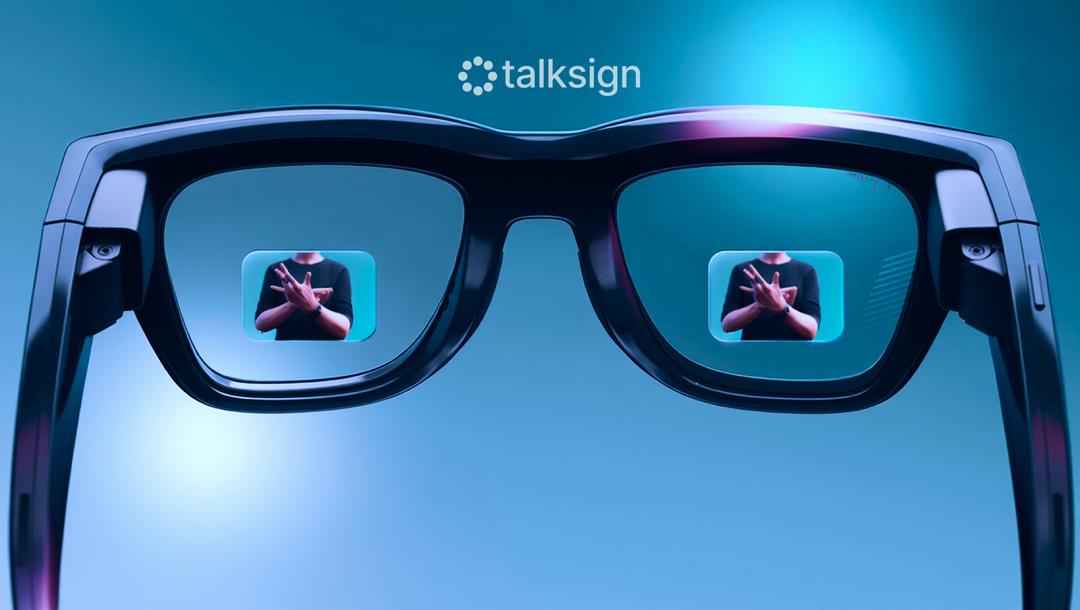
While the current version of Talksign-1 supports both online and offline modes, Ekong hints that a fully local, server-independent experience is imminent, spearheaded by a forthcoming smart glasses.

Beating giants: Why a startup can out-innovate Google
When asked about competing with behemoths like Google and its sign-language model, SignGemma, Ekong’s answer was pragmatic, yet confident: “We have the largest sign datasets across sign languages, plus our cross-platform integrations.”
Not only is the team working to expand vocabulary and continuous signing, but also where Google prioritizes the American Sign Language (ASL), Talksign is developing support for other sign languages.
The team is also building for the specific constraints and opportunities of emerging markets. While SignGemma is a powerful foundation model, Talksign-1 is a highly optimized tool designed for immediate, practical use cases.
Many existing tools prioritize sign-to-text or sign-to-speech, but Talksign-1 is built to be bidirectional. It converts ASL into audible speech through a webcam and also converts spoken or typed words back into sign language video sequences, allowing the hearing individual to sign back via the AI.
Bridging communication in the informal economy
For an artisan in a busy market, Talksign’s bidirectionality is the difference between a one-sided broadcast and a genuine negotiation.
Its imminent offline capability and rapid translation could be transformative for Africa’s vast informal sector. For instance, the deaf shoemakers in Nigeria’s bustling markets could finally get digital assistance when negotiating with hearing customers.
My own shoemaker is deaf, and I see firsthand how challenging it is to negotiate technical details like sole types or delivery dates. Talksign-1 feels like it could be the engine for that.
“We are looking at all sectors,” Ekong told me.
Meanwhile, Talksign is transparent about the model’s current Alpha stage. Talksign-1 currently recognizes a vocabulary of 250 ASL signs with a reported 84.7% accuracy.
The model is currently limited to isolated signs, meaning it doesn’t yet handle the complex fingerspelling or the fluid, continuous sentences of native signers.
The ‘why not?’ of a confident builder
Talksign is currently self-funded, a rare feat for a startup with such ambitious technical goals. When asked if he’s comfortable spending his savings on the project, Ekong’s response is imbued with profound conviction: “Why not? For a good cause. I care about the problem, everyone working with us cares. That’s the biggest difference. We are not doing it because we want to look cool, but because this will change the future of accessible communication across sectors.”
Beyond commerce, his vision extends to fundamental human rights.
“This means better education, better healthcare access, better legal access for 430 million-plus people who have been limited due to barriers,” he told Condia.
Ekong is building a future where communication is no longer a privilege. With Talksign-1 and its groundbreaking offline strategy, he’s showing global giants how to build for the real world.
Get passive updates on African tech & startups
View and choose the stories to interact with on our WhatsApp Channel
ExploreLast updated: February 19, 2026


