




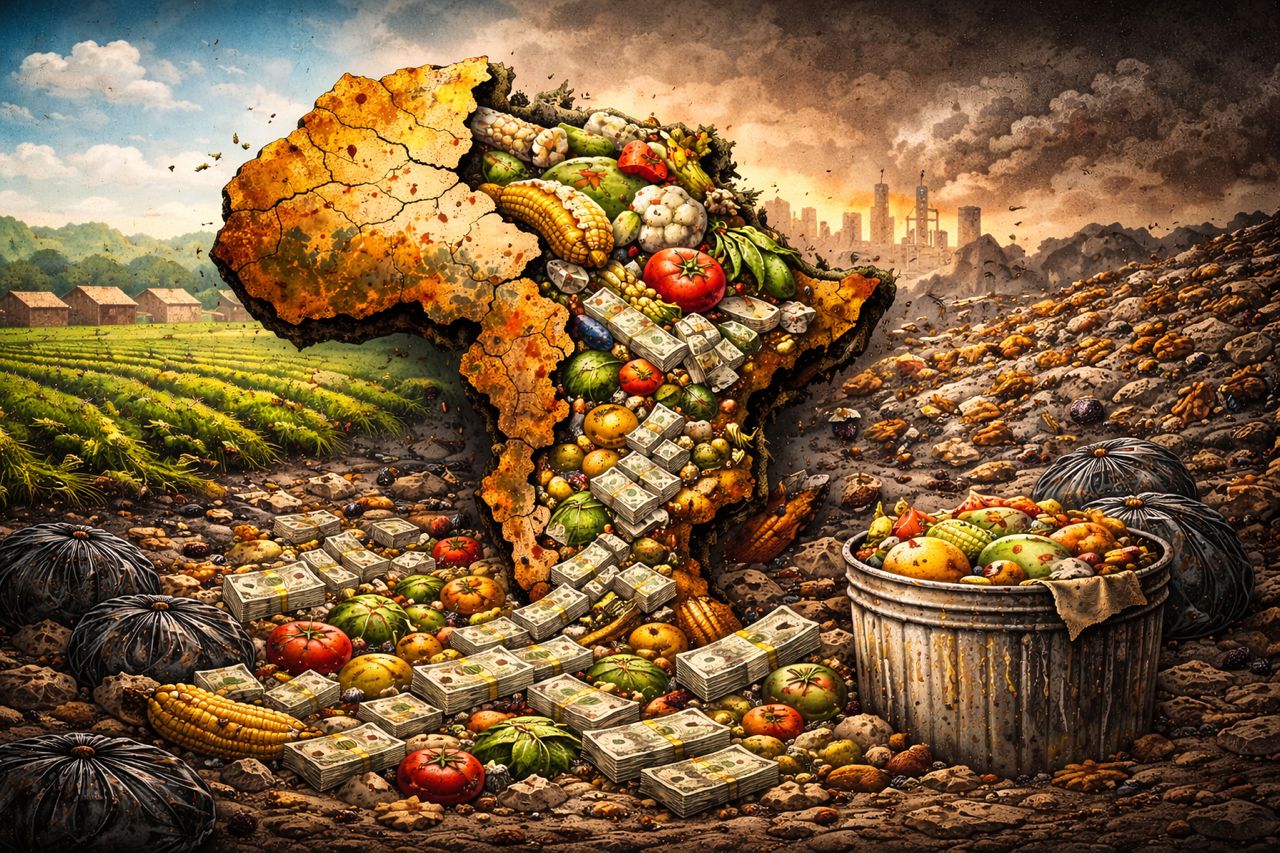
Africa loses up to 60% of its harvested crops before they ever reach a market. Not to drought or pests but to rot, spoilage, and poor road networks between farm to table. If you do the maths on Africa’s $400 billion agricultural output, we’re talking about $200 billion worth of food disappearing every year.
We have venture capitalists throwing millions at apps. Development banks financing “digital inclusion” programmes. Governments subsidising fertiliser. But this one crisis destroys half of what farmers actually grow.
Africa imported nearly $100 billion worth of food in 2023, with projections showing this could hit $110 billion by 2025. Nigeria alone imported $5.6 billion in food between 2021-2023. We’re buying tomato paste from China, rice from Thailand, and frozen chicken from Brazil while our own farmers watch their harvests rot in the field. We’re losing $200 billion worth of locally grown food, then spending another $100 billion importing food we could have produced ourselves.
Nigeria loses 45% of its tomato harvest annually to post-harvest waste. A farmer who harvests 10 tonnes will watch nearly half spoil before reaching a buyer. Hermetic storage bags, zero-energy cool chambers, and solar-powered cold rooms have been proven to reduce losses by 30–70%. But uptake remains under 20% across most of Sub-Saharan Africa.
The Processing Gap
Most African smallholders have no access to processing infrastructure within reach of their farms. A tomato farmer in Kaduna can harvest 8 tonnes, but if the nearest processing facility is 200 kilometres away with terrible roads, those tomatoes will spoil before they arrive. A processing hub within 20 kilometres could turn those tomatoes into paste or dried products within hours, eliminating 70-80% of potential loss.
Processing near the farm doesn’t just reduce loss. It multiplies farmer income by 2-4x through value addition. Cassava becomes garri or flour. Maize becomes cornmeal. Palm nuts become oil.
Companies like Releaf understand this. Their “Kraken” machines process palm nuts with 95% efficiency right at the farm gate. They raised $4.2 million because the model works: less transport, less spoilage, more income.
Building decentralised processing hubs is capital-intensive. A small-scale palm oil mill in Nigeria costs ₦3-7.5 million, while cassava processing plants can require ₦30-40 million, depending on capacity. Returns come over 3-5 years through service fees and product offtake.
The Double Standard
Lagos has cold storage facilities concentrated near ports for food imports, and according to industry experts, “the only produce that benefits from some cold storage is imported fish”. Meanwhile, research shows cold chain operations are “conspicuously absent” in tomato-producing regions like Kano and Kaduna, where organisations like HortiNigeria had to deploy emergency Zero Energy Cool Chambers because no cold storage existed.
We built cold chains for foreign products but not for our own farmers’ harvests. Africa’s cold chain infrastructure lags due to insufficient investment and unreliable power. This is a priorities problem.
The Funding Mismatch
Between 2020 and 2024, African agritech startups raised over $1 billion. The vast majority went to digital platforms: marketplaces, SMS advisory, and farmer profiling apps. Active usage sits between 25–40%, and almost none have reduced post-harvest loss at scale.
Meanwhile, companies building physical storage, processing hubs, and aggregation infrastructure struggle to raise funds because founders are unable to prove scale as a result of the challenges within this space. Yet when digital aggregation is paired with physical logistics (warehouses, trucks, and processing centres), post-harvest losses drop from 50% to 15%, and logistics costs fall by 40%. AgroMall in Nigeria proved this. But that model needs upfront capital and long payback periods, so it gets passed over.
Here’s the real problem: farmers already knew about better practices. A study in Uganda found 93% knew about improved seed varieties. Only two-thirds adopted them because of cost, credit access, and lack of storage. We spent a decade solving a knowledge problem that didn’t exist. The barriers were always physical and financial.
Who Profits From the Broken System
Middlemen thrive on this chaos. When farmers are desperate to sell before crops spoil, they accept 40-60% below market prices. Middlemen margins can reach 28-38%, and when prices rise by 1%, farmers receive less than 0.5% of that increase.
The loss becomes the middleman’s margin. A trader with storage has pricing power over a farmer whose tomatoes spoil in three days. If we solved post-harvest loss through accessible storage and processing, farmers would have negotiating power.That’s why the system stays broken. It’s not in everyone’s interest to fix it.
What Actually Needs to Happen
Post-harvest losses are solvable, but only with a better understanding of what the problem demands: high-risk, capital-intensive infrastructure, operational expertise, and patient capital. Building the infrastructure required to curb these losses calls for development banks to deploy blended finance vehicles aligned with 5–7-year infrastructure timelines. Addressing post-harvest losses is materially harder than launching the next application marketplace, and founders operating in this space require a different level of support. We need accelerator programmes to drive the training of the new generation of agri-infrastructure entrepreneurs who value warehouses, cold rooms, and processing hubs as much as apps.
Subsidy frameworks also need to be restructured and redirected. African governments spend hundreds of millions of dollars annually on fertiliser subsidies, yet nearly half of harvested produce is lost. Redirecting even 20% of these subsidy budgets toward cold storage and processing infrastructure in farming districts would preserve value already being generated in the field, rather than continually subsidising production that never reaches the market.
Cooperative-led infrastructure should be scaled deliberately. Ethiopia’s Cooperative Storage Project has equipped 40 cooperatives with warehouses, enabling aggregation and stronger price negotiation, while Rwanda is expanding storage through farmer cooperatives with plans to reach 200,000 tonnes capacity by 2029. Evidence shows that cooperative membership increases technology adoption by 10% and raises farm income by 40%, making this a proven and scalable model.
Finally, post-harvest loss reduction must become a political priority. Nigeria loses an estimated 45% of its tomato harvest each year while simultaneously importing tomato paste. This level of inefficiency should trigger emergency infrastructure deployment. What is missing is political leadership willing to be held accountable for the estimated $200 billion in food lost annually across the continent and the $100 billion spent on food imports that domestic systems should be able to supply.
Editor’s Note:
Written by Ndubisi (Endy) Ugonabo.
Get passive updates on African tech & startups
View and choose the stories to interact with on our WhatsApp Channel
ExploreLast updated: January 9, 2026


